


Start Your Project Today
Tell us about your project — we’ll get back within 24 hours

Founder
WordPress website development cost in India ranges from Rs 25,000 ($300) for a basic template-based site to Rs 10 lakh ($12,000) or more for a fully custom enterprise platform in 2026. For most small and mid-size businesses, a professionally built business website with custom design, mobile responsiveness, and basic SEO setup falls between Rs 60,000 and Rs 2 lakh ($720 to $2,400).
WordPress remains the practical choice for most businesses because it covers roughly 43% of all websites globally and offers the lowest total cost of ownership for a CMS-backed site that needs room to grow.
This pattern holds across the broader website development costspectrum regardless of platform.
This article breaks down WordPress website development costs in India by scope, platform extension (WooCommerce), ongoing costs, and the decision points that actually move the price up or down.
WordPress website development cost depends primarily on design depth, the number of pages, and how much custom functionality the site needs beyond a theme and standard plugins.
| Scope | Build Cost (Rs) | Build Cost ($) | Timeline | What It Includes |
|---|---|---|---|---|
| Basic (template-based, 5–10 pages) | Rs 25,000 to Rs 60,000 | $300 to $720 | 1 to 2 weeks | Paid theme, content placement, basic SEO, mobile responsive |
| Mid-range (custom design, 10–20 pages) | Rs 60,000 to Rs 2,00,000 | $720 to $2,400 | 3 to 6 weeks | Custom design, on-page SEO, contact forms, analytics setup |
| Larger (custom theme, integrations, multilingual) | Rs 2,00,000 to Rs 5,00,000 | $2,400 to $6,000 | 6 to 12 weeks | Custom post types, API integrations, CRM connections, multilingual setup |
| Enterprise (large-scale, multisite, high traffic) | Rs 5,00,000 to Rs 10,00,000+ | $6,000 to $12,000+ | 12 to 24 weeks | Multisite architecture, deep caching, custom dashboards, dedicated infrastructure |
Most small and mid-size businesses in India fall into the basic or mid-range tier. The larger and enterprise tiers apply when the website needs to function as a business system, not just a presence: think multilingual content, deep CRM integration, or traffic volumes that strain standard hosting.
WooCommerce powers an estimated 20–39% of the global e-commerce market, depending on the measurement methodology, making it the most widely used e-commerce platform by store count. For many Indian businesses, it is the preferred way to add online selling capabilities to an existing WordPress website.
Because WooCommerce is built as a plugin on top of WordPress, its development cost is added to the cost of the underlying website rather than replacing it. This is one of the implementation paths covered in the broader ecommerce website development cost in India guide, alongside Shopify and fully custom e-commerce platforms.
At this scale, the overall ecommerce development service strategy—including platform selection, performance architecture, and integration planning—often has a greater impact on long-term success than the initial WooCommerce development cost.
WooCommerce stores also incur higher hosting costs than standard WordPress websites because product catalogues, customer accounts, and order history place significantly greater demand on the database and server infrastructure. This is a common expense that businesses underestimate when planning a WordPress e-commerce project.
Once a store grows beyond approximately 100 products or begins receiving consistent daily traffic, managed WordPress hosting is generally a better choice than shared hosting for maintaining performance, reliability, and scalability.
The build cost is one payment. The ongoing costs continue every year, and most businesses underestimate them when comparing initial quotes.
A WordPress site without consistent maintenance accumulates security gaps, compatibility issues, and slower load times over time.
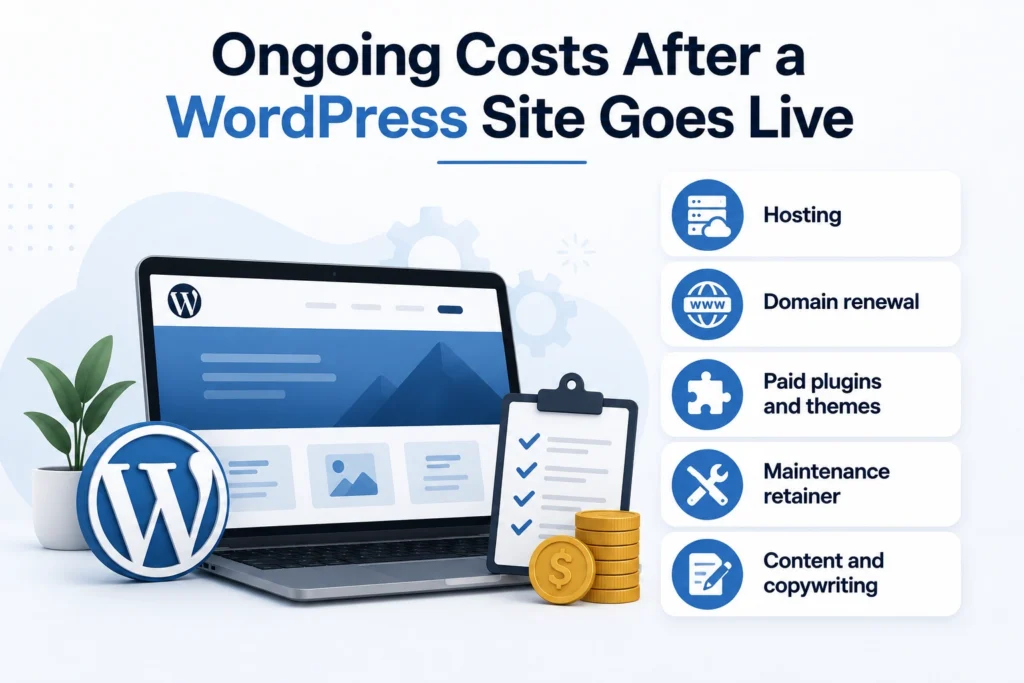
Annual ongoing costs to budget for:
Security monitoring matters here. WordPress sites face roughly 90,000 attacks per minute, and 97% of vulnerabilities originate in plugins and themes rather than core software.
A well-built Rs 80,000 WordPress site that is properly maintained consistently outperforms a Rs 3,00,000 site that is neglected after launch. The total cost of ownership over three years, not the launch price alone, is what determines whether a WordPress investment delivers value.
Two sites built on the same platform can cost very differently. The gap usually traces back to a handful of factors that shape WordPress website development cost in India more than the platform choice itself.
A WhatsApp or website chatbot is one of the more common additions. AI chatbot development cost is typically scoped as a separate line item rather than bundled into the base WordPress build.
Freelancer quotes for WordPress development in India typically run Rs 15,000 to Rs 70,000 ($180 to $840), well below agency pricing for what looks like the same scope on paper. The gap usually comes from what is excluded, not from a different level of skill.
Most freelancer quotes do not include original design work (a paid theme is installed and lightly customised instead), professional copywriting, on-page SEO beyond basic plugin installation, or post-launch support beyond a short warranty period. When any of these become necessary after launch, they become separate costs negotiated after the fact rather than scoped upfront.
Agencies charge more because the quote typically includes design, development, QA, a structured process, and a defined maintenance path. Choosing the right software development company for a WordPress project is as much about evaluating process and accountability as it is about comparing line-item pricing.
For a one-time landing page with no ongoing needs, a freelancer can be the right call. For a business website meant to generate leads, rank in search, and scale over several years, the agency cost difference is usually smaller than the cost of rebuilding a site that was scoped too thin the first time.
WordPress handles the large majority of business website requirements effectively. Custom development (React, Node, Laravel) becomes the better choice in three specific situations:
For businesses outgrowing WordPress entirely and considering a native mobile experience alongside or instead of the website, mobile app development cost follows a different cost structure entirely from CMS-based website work and should be scoped as its own project.
For everything else, including most ecommerce stores via WooCommerce, WordPress remains the more cost-effective and practical choice. Custom development costs significantly more and takes longer, and that investment should be reserved for cases where WordPress genuinely cannot do the job.
WordPress website development cost in India is not a single number. The businesses that plan well are the ones that budget for the full picture: build cost, hosting, maintenance, content, and the iteration that happens after launch.
A site scoped accurately from the start avoids the most expensive pattern in WordPress projects, which is paying for a cheap build twice once gaps surface after launch.
Zethic builds WordPress and WooCommerce websites for businesses across India and globally. Design, development, SEO setup, and ongoing maintenance are scoped as part of a single, structured process. If you are comparing quotes or planning a WordPress project, Zethic is a good place to start.
Let Zethic help you build smarter Not just faster
A small store with up to 50 products costs Rs 1,00,000 to Rs 2,00,000 ($1,200 to $2,400). A mid-scale store with 50 to 500 products runs Rs 2,00,000 to Rs 5,00,000 ($2,400 to $6,000). Large catalogues or B2B stores with 500+ products start at Rs 5,00,000 ($6,000).
Freelancers charge Rs 500 to Rs 1,500 per hour ($6 to $18). Agencies charge Rs 1,000 to Rs 3,000 per hour ($12 to $36) depending on expertise, team structure, and project complexity.
Ram brings deep expertise in product strategy and system architecture across fintech, SaaS, and AI platforms. He specializes in pre-execution planning to help teams build scalable technology foundations and avoid costly rebuilds.

Adding {{itemName}} to cart
Added {{itemName}} to cart