


Start Your Project Today
Tell us about your project — we’ll get back within 24 hours


Most teams find out their AI has a hallucination problem the same way: a client-facing report cites a number that doesn’t exist, or a support bot promises a refund policy the company never had. By the time anyone notices, the fix costs more than building the safeguard would have. Businesses that reduce LLM hallucinations early treat it as a design decision made before launch, not a bug fixed after a customer complains.
A large language model generates the next word it judges most likely, based on patterns learned during training, not by looking it up against a verified reference. When the model has no solid information on a topic, it does not stop and say so by default. It keeps generating fluent, confident-sounding text, because that is what its training rewarded.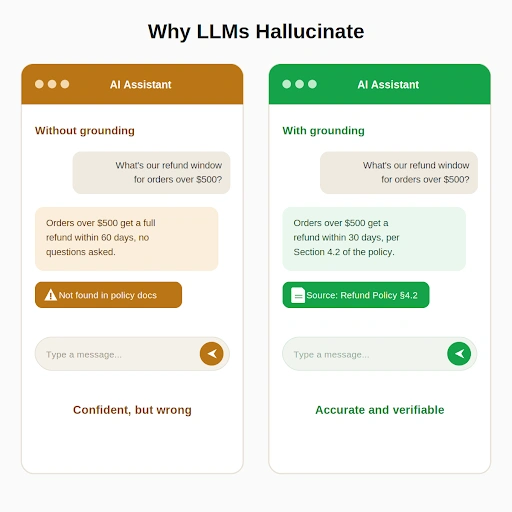
This matters more in business settings than in casual chat, because the output often reads as authoritative even when it is invented. On Vectara’s public hallucination benchmark, which tests how often a model introduces unsupported claims while summarizing a real document, even the strongest models still hallucinate on a small but real share of tasks, and weaker models hallucinate far more. The gap between “sounds right” and “is right” is exactly what a business has to close before trusting the output.
A support chatbot is one of the most common places this shows up, and it’s the kind of build most artificial intelligence services providers price based on how much grounding work goes in before launch.
The failure rarely announces itself. A hallucinated answer usually reads as smoothly as a correct one and often cites details that sound specific enough to be true, which is why teams trying to reduce LLM hallucinations cannot rely on a human simply noticing something is off. The fix has to sit further upstream, in what the model is allowed to see and how its output gets checked before a person ever reads it.
A hallucinated answer in a casual tool is an inconvenience. In finance, healthcare, or legal work, the same fabricated detail becomes a compliance problem, because the output can be treated as advice or as a matter of record.
A financial services firm citing a made-up regulation, or a healthcare assistant inventing a drug interaction, does not just embarrass the business. It creates exposure under whatever regulatory framework governs that industry, whether that is a data protection law, a sector-specific regulator, or a general product liability standard. The stakes rise further for businesses operating across multiple regulatory environments at once, since a hallucinated output that is merely inconvenient in one market can trigger a formal reporting obligation in another.
The industries under the most pressure share a common trait: the AI’s output gets treated as a record, not a draft. A marketing team can catch a slightly off blog paragraph before it publishes. A loan officer relying on an AI-generated summary of a client’s financial history has far less room to catch a fabricated figure before it shapes a real decision.
Businesses handling compliance-heavy workflows increasingly turn to regulatory technology to keep monitoring and reporting accurate, since a hallucinated figure in that pipeline is a compliance problem, not just an error.
Cost scales with how deeply a technique changes what the model has to work with. Prompt-level fixes are cheap because they only change the instructions. RAG and fine-tuning cost more because they change the model’s actual inputs or weights.
| Technique | What It Changes | Cost (USD) | Cost (India, ₹) |
| Prompt engineering | Instructions and structure, not the model’s knowledge | $1,800-$3,600 for 15-30 hours of expert time | ₹1.5 lakh-₹3 lakh for the same scope of work |
| RAG implementation | Grounds answers in retrieved business documents | $15,000-$50,000 for a single-source system | ₹15 lakh-₹45 lakh for a RAG-powered tool |
| Fine-tuning | Retrains part of the model on business-specific data | $20,000-$150,000+ for a full implementation | ₹50 lakh-₹80 lakh+ for a fine-tuned enterprise system |
| Guardrail and monitoring tooling | Catches ungrounded answers before they reach users | $20-$250 a month for small teams, scaling past $10,000 a year for enterprise compliance needs | Same tooling cost applies globally since providers bill in USD; the saving shows up in the engineer running it, typically ₹8-20 lakh a year for that role in India |
Prompt engineering alone rarely holds up once a business scales past a handful of use cases, which is why most production systems eventually add at least one deeper layer. This sits on top of whatever the base LLM development cost in India already runs, since grounding and monitoring are additions to a working system, not a replacement for it.
The right technique depends on what happens if the model gets something wrong, not on which method sounds most sophisticated.
This kind of tiered thinking mirrors how NIST’s AI Risk Management Framework frames AI oversight generally, matching the intensity of the safeguard to the actual stakes of the system rather than treating every AI deployment the same way.
Neither technique solves the problem alone. RAG gives the model real facts to draw from, but it does not stop the model from misreading or straying from those facts once they are in context. Guardrails catch that drift, but only if the model had something accurate to check against in the first place.
Production systems that actually reduce LLM hallucinations at scale layer both together with a third piece: an evaluation loop that scores real outputs and feeds the failures back into the next prompt or retrieval fix. A support system might ground every answer in retrieved policy documents, run a guardrail check that flags any claim the retrieved text does not support, and route flagged answers to a human before they reach a customer.
That layered pattern costs more to set up than any single technique, but it is the difference between a system that reduces hallucinations in a demo and one that holds up after six months of real traffic.
There is no single fix that makes a model stop hallucinating, because the underlying cause, generating plausible text without a built-in way to verify it, is not something a better prompt alone can undo. The realistic goal is matching the depth of the safeguard to what a wrong answer would actually cost the business.
Zethic works with founders and CTOs across fintech, healthcare, and software businesses to size that safeguard correctly, scoping whether prompt engineering covers a use case, where RAG earns its cost, and when a regulated output needs guardrails and human review layered on top, and Zethic builds that grounding into the system from the first deployment rather than patching it in after an incident.
Ram brings deep expertise in product strategy and system architecture across fintech, SaaS, and AI platforms. He specializes in pre-execution planning to help teams build scalable technology foundations and avoid costly rebuilds.
