


Start Your Project Today
Tell us about your project — we’ll get back within 24 hours

Founder
User Interface Design
FinTech app development services
Digital transformation for an SME means changing how the business actually operates using digital tools, not just replacing paper with a spreadsheet. Digitizing a process, like scanning invoices into PDFs, is a small part of it. Real transformation means the business makes decisions, serves customers, and runs operations differently because of the data and automation now available to it.
For a small business, this usually shows up in three places: how customers are served, how daily operations run, and how decisions get made. A retailer moving from a paper ledger to a connected point-of-sale system that also tracks inventory in real time has taken a genuine step, not just a cosmetic one.
Budget is the barrier most SMEs mention first, but it’s often less about total cost and more about not being able to see a clear line between a specific tool and a specific financial outcome. The OECD’s research on SME digital adoption identifies financial constraints, skills gaps, and limited infrastructure access as the most consistent barriers across countries, not just a single business’s situation. Owners who hesitate for this reason are usually right to be cautious, since an unclear return is a real risk on a small budget, and a wrong bet on the wrong tool can set a small business back months.
None of these barriers require an enterprise-sized team or budget to overcome, but they do require picking a starting point deliberately rather than trying to fix everything at once.
The lowest-cost, fastest-return tools are usually the right place to start, since they prove out the value of digital transformation before any larger investment gets committed. Cloud storage and basic workflow automation typically cost very little and require almost no technical skill to adopt, and for many SMEs digital invoicing is already a compliance requirement rather than a choice.
Once these tools are in place and the business has real usage data to show for it, the case for a bigger investment, like dedicated ERP development cost in India or a custom-built system, becomes much easier to make with confidence rather than guesswork.
| Factor | Off-the-shelf tools | Custom software |
|---|---|---|
| Upfront cost | Low, often subscription-based | Higher, one-time development cost |
| Time to start using it | Days to weeks | Months |
| Fit for a specific process | Generic, built for broad use cases | Built around the business’s exact workflow |
| Scalability as the business grows | Limited by the vendor’s feature set | Extends as the business’s needs change |
| Ongoing cost | Recurring subscription fees | Maintenance and hosting only |
ndia’s Ministry of MSME runs the Digital MSME Scheme specifically to help registered MSMEs adopt information and communication technology in their business processes. The scheme is open to any MSME registered under the MSME Act, and its stated objective is to help MSMEs build digital skills and improve their competitiveness in national and international markets.
The scheme has historically supported cloud computing adoption with a subsidy structure covering a share of ICT costs for eligible businesses, administered through implementing agencies set up specifically for this purpose. Awareness programs and workshops under the scheme also help SMEs understand which digital tools actually fit their business, rather than leaving that evaluation entirely to the business owner. An SME evaluating its first real digital investment should check current eligibility and application details directly, since scheme terms and implementing agencies can change.
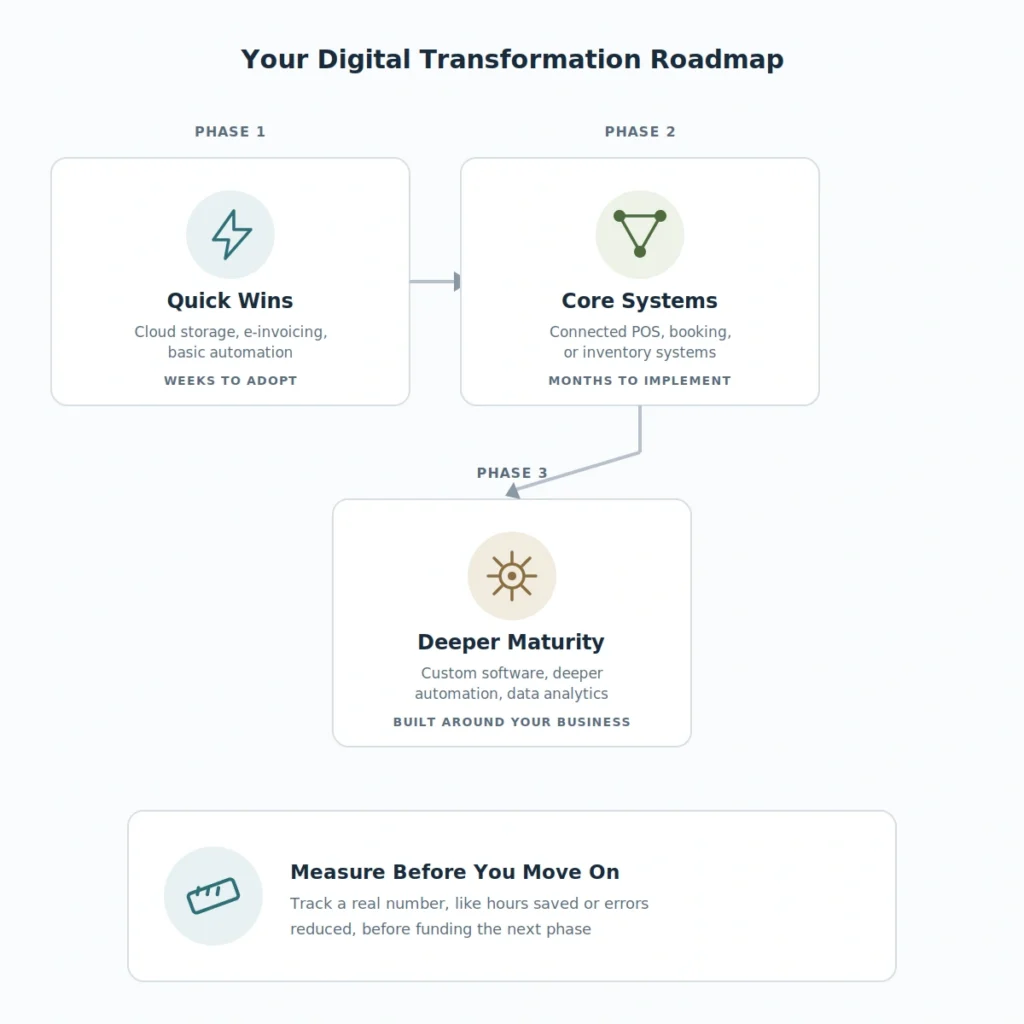
A roadmap that tries to digitize everything within a year usually fails, since it spreads limited budget and attention too thin to show results anywhere. A phased approach, where each stage funds the next through the efficiency it creates, tends to hold together much better.
Each phase should be measured against a real number, such as hours saved per week or orders processed without error, before the business commits budget to the next one.
The right starting point isn’t the most talked-about tool on the market. It’s an honest look at which single process, if digitized first, would free up the most time or reduce the most errors for the business right now, the same groundwork that goes into any well-scoped custom application development project.
When an SME’s needs have outgrown what off-the-shelf tools can support, Zethic works with growing businesses through exactly this evaluation, mapping the actual workflow before building software suited to how the business really operates rather than a generic template.
Let Zethic help you build smarter Not just faster
No. A phased approach starting with low-cost tools like cloud storage and e-invoicing can show real results before any larger investment is needed.
Digitization means converting an existing process into a digital format, like scanning paper records. Digital transformation means changing how the business actually operates using the data and automation those digital tools provide.
It depends on the phase. Quick-win tools can be adopted within weeks, while core systems and custom software typically take several months to plan and implement properly.
Ram brings deep expertise in product strategy and system architecture across fintech, SaaS, and AI platforms. He specializes in pre-execution planning to help teams build scalable technology foundations and avoid costly rebuilds.

Adding {{itemName}} to cart
Added {{itemName}} to cart