


Start Your Project Today
Tell us about your project — we’ll get back within 24 hours


Getting a straight answer on LLM development cost is hard because the term covers three fundamentally different approaches with very different price tags. LLM here means large language model, the technology behind tools like ChatGPT and Claude, not a law degree, and the approach a business picks (calling an existing model’s API, self-hosting an open-source model, or fine-tuning one) matters more than any other factor. Once a project is scoped against these three paths, LLM development cost in India settles into a fairly predictable range: ₹3 lakh for a simple API-based build, up to ₹60 lakh or more for a self-hosted, fine-tuned deployment.
LLM development cost in India breaks down into three approaches for AI development, and the difference between them matters more than any single number quoted in isolation.
| Approach | Cost Range (INR) | What It Typically Includes |
| API-based build | ₹3 lakh – ₹15 lakh | Integration with a hosted model, prompting, basic application logic |
| Self-hosted open-source | ₹20 lakh – ₹45 lakh | GPU infrastructure, inference setup, ongoing DevOps capacity |
| Fine-tuned open-source | ₹35 lakh – ₹60 lakh+ | Training data preparation, fine-tuning compute, evaluation, self-hosted deployment |
These ranges cover the initial build only: scoping, integration or infrastructure setup, testing, and deployment. A business connecting to an existing model’s API for a straightforward use case lands at the low end, while a business fine-tuning and self-hosting an open-source model for a specialized, high-volume workload lands at the high end.
The range within each approach reflects concrete variables: which model size is targeted, how much GPU capacity the workload actually needs, and how much internal DevOps capacity already exists versus needing to be built from scratch.
These ranges also do not scale linearly with company size. A small team with a well-scoped, low-volume use case can complete an API-based build at the low end of the range, while a larger team pursuing a high-volume, data-sensitive workload can land well into the fine-tuned tier even without a particularly exotic use case, simply because the model choice and infrastructure requirements are what set the cost, not headcount.
This is the single decision that has the largest effect on both cost and architecture. A hosted API, such as one from OpenAI or Anthropic, charges per token and requires no infrastructure of a business’s own.
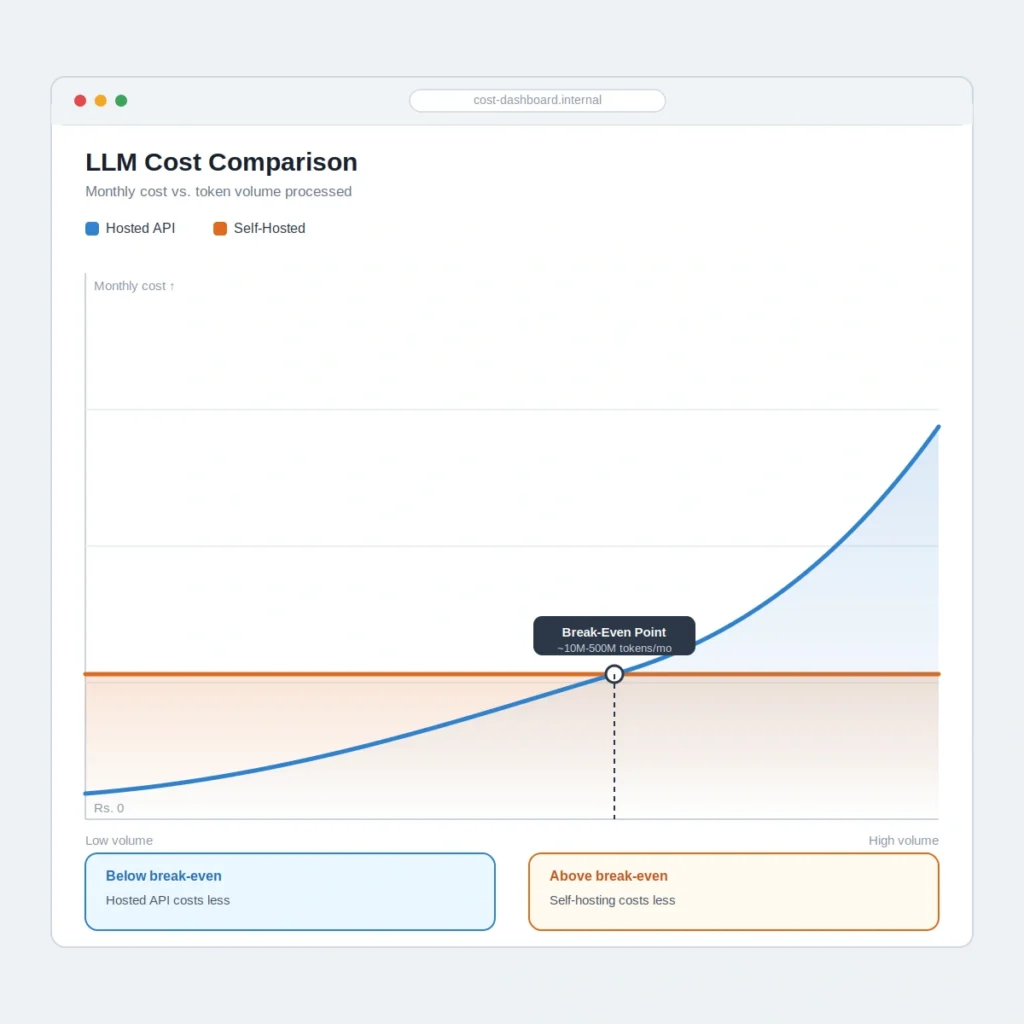
Self-hosting an open-source model shifts the cost structure entirely: instead of paying per token, a business pays a largely fixed monthly cost for GPU capacity, regardless of how much or how little that capacity gets used. The crossover point where self-hosting starts costing less than an API typically falls somewhere between 10 million and several hundred million tokens processed per month, depending on model size and GPU pricing.
Most businesses evaluating this decision overestimate how close they are to that crossover point, since the volume needed to justify self-hosting is higher than it first appears once real usage patterns are mapped out.
A middle path also exists that most cost comparisons skip entirely: hosted open-source models, where a provider runs an open-weight model on shared infrastructure and still charges per token. This option often sits between the two extremes on both cost and control, without requiring a business to manage its own GPU infrastructure at all, and it applies whether the underlying build is a straightforward content tool as agentic AI development project.
Self-hosting looks attractive on a spreadsheet that only counts GPU rental against API token prices, but that comparison leaves out the largest hidden cost: the engineering time required to keep a self-hosted model running reliably.
A useful test before committing to self-hosting is to calculate the fully loaded monthly cost, GPU rental plus engineering time, and compare that fixed number against twelve months of projected API spend at current usage. Businesses that skip this comparison often find the self-hosted option costs more in year one than the API alternative would have.
Power, cooling, and networking add a further layer that pure GPU rental figures tend to leave out. Running high-end GPUs continuously draws more electricity than standard compute, and moving large volumes of inference output through cloud networking carries its own recurring egress cost. Some of this hardware burden shifts when a business can tap into India’s National Supercomputing Mission, which already supports HPC-based projects for startups and MSMEs rather than requiring every self-hosting effort to build its own infrastructure from zero.
For most businesses, the answer to the previous question settles the decision on cost alone. Compliance requirements can override that math entirely when the data involved is sensitive.
If an LLM processes personal data covered under India’s DPDP Act, questions around data residency and consent handling can make self-hosting the only viable option regardless of where the pure cost comparison lands. For financial data specifically, the RBI’s data localization requirement already mandates that payment-related data be stored only in India, a rule that shapes the API-versus-self-hosted decision well before DPDP considerations even enter the picture. Sending sensitive data to a third-party API provider outside India introduces compliance considerations that a self-hosted deployment, kept entirely within a business’s own infrastructure, avoids by design.
This is why LLM development cost in India should never be decided on cost alone for regulated industries. A fintech or healthcare business handling personal data may need to self-host even at a usage volume where an API would otherwise be cheaper, simply because the compliance requirement removes the API option from consideration entirely.
Whichever approach a business chooses, LLM development cost in India does not stop at the initial build. Both paths carry distinct ongoing costs that continue well past deployment.
A reasonable starting point is to budget 15 to 25 percent of the initial development cost per year for these ongoing needs, with the self-hosted path typically landing at the higher end due to the added DevOps component. For teams starting with the lightest API-based tier, this pattern looks similar to what a typical MVP development cost structure carries: a lower upfront number paired with an ongoing budget line that easily gets overlooked during initial planning.
The API-versus-self-hosted decision should be made with real numbers, not general advice. It comes down to actual token volume, data sensitivity, and how much DevOps capacity a business already has in place.
Zethic works through this decision with businesses directly, mapping projected usage against the real break-even point rather than defaulting to whichever approach sounds more sophisticated. Zethic scopes LLM development cost in India against the fully loaded cost of each path, including the engineering time self-hosting requires, so the number a business budgets against reflects the actual decision in front of them.
Ram brings deep expertise in product strategy and system architecture across fintech, SaaS, and AI platforms. He specializes in pre-execution planning to help teams build scalable technology foundations and avoid costly rebuilds.
