


Start Your Project Today
Tell us about your project — we’ll get back within 24 hours

Founder
User Interface Design
Offshore software development refers to hiring a development team in another country, such as India, to build or extend software development capabilities for a business headquartered elsewhere. It differs from outsourcing a fixed project, nearshoring to a neighboring time zone, or onshoring within the same country, with each model involving different engagement structures, communication practices, and legal considerations.
The advantages of outsourcing app development extend beyond lower development costs. The engagement model chosen at the outset influences collaboration, delivery speed, knowledge retention, scalability, and long-term product ownership, making it an important strategic decision rather than simply a procurement choice.
India has become one of the leading destinations for offshore software development due to its large pool of skilled engineering talent, mature technology ecosystem, and strong English-language business communication. At the same time, businesses should carefully address contracts, intellectual property, data protection, taxation, and regulatory compliance before entering into any cross-border development partnership.
Businesses generally choose between three models when setting up an offshore team in India, each trading control against setup speed differently, a decision a custom software development company in Bangalore typically helps scope before any contract gets signed.
| Model | What it means | Best fit |
|---|---|---|
| Team extension | Add India-based engineers to an existing in-house team | Businesses with an architect or PM already in place, needing more hands |
| Dedicated team | A fully assembled team working exclusively on one product | Businesses building a new product from scratch without in-house technical leadership |
| Project-based ODC | A fixed-scope project delivered by an offshore development center | Businesses with a well-defined, bounded project rather than ongoing product work |
Whichever model fits, the underlying vendor evaluation is similar to choosing a software development company for any other kind of project; verification matters more than the pitch deck.
Getting this choice wrong is rarely catastrophic on its own, but it does create friction that compounds. A business that picks a dedicated team when it actually needed a team extension often ends up paying for coordination overhead it didn’t need, while the reverse mistake leaves an in-house team stretched too thin to manage the offshore side properly.
Real-time collaboration depends entirely on which market a business operates from, and the overlap varies more than most offshore pitches suggest. Based on a standard 9 AM to 6 PM working day in each location, UK clients (GMT/BST, roughly 4.5 to 5.5 hours behind India) get a genuine overlap of about 1 PM to 6 PM IST, and EU clients (CET, roughly 3.5 to 4.5 hours behind) get a similar 12 PM to 6 PM IST window.
Both are wide enough for live standups and design reviews on a normal working day. US East Coast clients (EST, roughly 9.5 hours ahead of India) get a much narrower live window, typically around 6 PM to 8 PM IST, which falls in the early morning for the US side. Australian clients (AEST, roughly 4.5 hours ahead) get a workable window from about 9 AM to 1:30 PM IST, in their afternoon.
For US-based teams especially, this narrow live window means async communication (recorded demos, written updates, a clearly scheduled daily overlap slot) needs to be built into the working process from day one rather than assumed away. Teams that treat the live-overlap window as the only communication channel tend to see the biggest friction with a US time difference.
Copyright in code created in India exists automatically the moment it’s written, since software is classified as a literary work under Section 2(o) of India’s Copyright Act. The catch is that automatic copyright vests in the actual creator or their employer, not automatically in the foreign client, unless the contract explicitly assigns those rights.
A properly structured contract needs an explicit IP assignment clause, not just a confidentiality agreement, since an NDA protects secrets but doesn’t transfer ownership of what gets built. This is a specific clause to check for, not something a generic outsourcing contract template can be assumed to cover correctly.
Work-for-hire assumptions that apply automatically in some countries don’t necessarily carry over the same way under Indian law, which is precisely why relying on a template rather than a reviewed clause is a common, avoidable mistake.
Software development services supplied from India to a client located outside the country generally qualify as an export of services under GST, which India treats as a zero-rated supply. In practice, this means an international client generally shouldn’t see GST added to an Indian offshore team’s invoice, provided the arrangement meets the standard export conditions (supplier in India, recipient outside India, payment in convertible foreign exchange).
This is worth confirming directly with a prospective offshore partner rather than assuming it by default, since the zero-rating depends on the invoicing and payment structure being set up correctly from the start.
A partner unfamiliar with export documentation might invoice incorrectly or fail to maintain the records needed to support the zero-rated treatment, which can create complications well after the fact even if the underlying work itself was delivered properly.
If the offshore team will handle a foreign client’s end-customer personal data, India’s Digital Personal Data Protection framework applies to how that data gets processed, even when the end customers themselves are outside India. The Digital Personal Data Protection Rules require Significant Data Fiduciaries to run independent audits and follow specific safeguards, obligations worth understanding before data starts flowing into an Indian team’s systems.
The checks that catch most real problems are concrete and easy to skip under time pressure, which is exactly when they matter most.
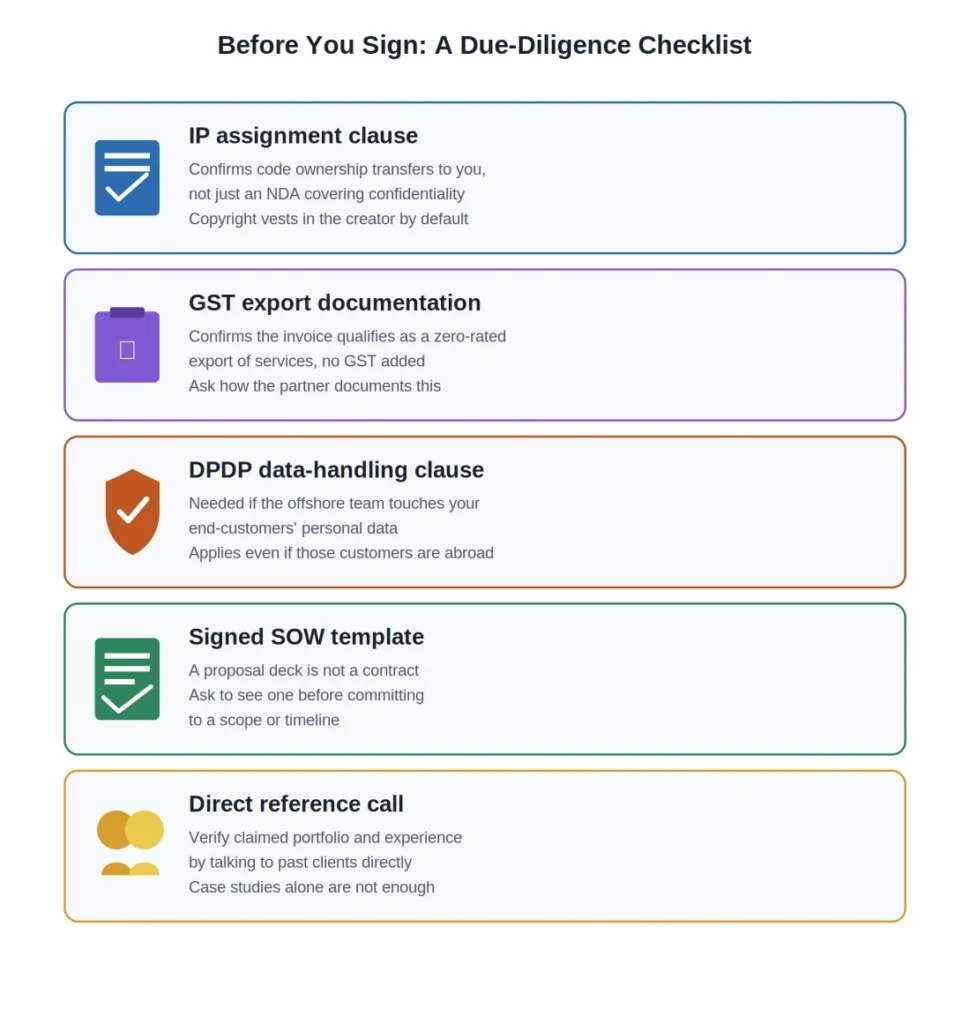
Each of these is a specific, checkable item rather than a vague impression from a sales call, making a vendor management platform useful for organizing and tracking the evaluation. A partner who hesitates on any one of them, particularly the IP assignment clause or the SOW template, is worth pausing on before signing anything.
This kind of scrutiny is exactly what mobile app outsourcing decisions require at the executive level, since the cost of getting it wrong compounds well past the original contract value.
Getting offshore development in India right comes down to matching the team structure to the actual need, structuring IP assignment and GST correctly from the first contract, and being clear-eyed about what data protection obligations apply before any customer data changes hands. None of this requires exotic legal work; it requires asking the right questions at the contract stage instead of discovering the gaps after work has already started.
Zethic sets up client work this way, treating vendor selection as a due-diligence process rather than a sales pitch to get through quickly. For businesses evaluating offshore development in India, Zethic can walk through what a specific arrangement should actually look like on paper before any code gets written.
Let Zethic help you build smarter Not just faster
Ram brings deep expertise in product strategy and system architecture across fintech, SaaS, and AI platforms. He specializes in pre-execution planning to help teams build scalable technology foundations and avoid costly rebuilds.

Adding {{itemName}} to cart
Added {{itemName}} to cart