


Start Your Project Today
Tell us about your project — we’ll get back within 24 hours


This financial year, SEBI’s BRSR Core assurance requirement finally reaches all of India’s top 1,000 listed companies, not only the largest 500. Many sustainability teams still gather the underlying data through Excel sheets, email threads, and WhatsApp messages sent department by department. That gap between a demanding new assurance standard and an informal data-collection process is where ESG in India compliance most often breaks down.
In practice, ESG in India runs through two separate legal requirements rather than one voluntary standard. The Securities and Exchange Board of India requires large listed companies to file the Business Responsibility and Sustainability Report (BRSR), while the Companies Act separately requires many companies, listed or not, to spend on corporate social responsibility programs.
These two requirements measure different things. BRSR asks for detailed environmental, social, and governance data across a company’s own operations, while the CSR mandate is narrower and governs only a fixed share of profit directed toward social programs.
A company can be subject to one requirement, both, or neither, depending on its size and whether it is listed. A large unlisted manufacturer might owe CSR spending under the Companies Act without ever filing a BRSR, while a mid-size listed company just below the top 1,000 threshold might file BRSR voluntarily to satisfy investors even though the law does not yet require it.
For a CTO or finance leader, the practical question is rarely which law applies in theory. It is whether the company’s existing systems, enterprise resource planning (ERP), HR, payroll, and vendor records, among them, can actually produce the specific figures either requirement asks for, on a schedule that matches the filing calendar rather than a best-effort basis. Many finance leads start by bringing in sustainability consulting support to map that gap before deciding where to invest first.
The Securities and Exchange Board of India introduced BRSR in 2021, replacing an earlier Business Responsibility Report that had applied to a smaller group of companies since 2012. BRSR is the single biggest driver of ESG in India today, and full disclosure became mandatory for the top 1,000 listed companies by market capitalization starting the 2022-23 financial year.
That assurance requirement is what changed this year: BRSR Core now reaches all top 1,000 listed companies, not only the largest few hundred. For companies newly in scope, that means an external auditor or assessor will now trace disclosed figures back to source documents in the same way financial statements are already checked, which is a materially higher bar than simply filling in a disclosure template once a year.
Companies that also report to international investors often need to reconcile BRSR with a broader global framework such as GRI. The two exist for different reasons, and knowing which one governs which audience keeps a reporting team from duplicating the same work twice.
BRSR is built specifically for SEBI’s disclosure requirements and the nine principles of India’s National Guidelines on Responsible Business Conduct. GRI, by contrast, was designed for cross-border comparability and is often what an international investor or parent company expects to see, even when it plays no role in an Indian company’s own regulatory filings.
A company with only domestic listing obligations can usually treat BRSR as the complete requirement. One with foreign parent reporting or international investors on its cap table often ends up preparing both, which is exactly the situation where a shared underlying data system saves the most duplicated effort.
| Framework | Applicable To | Mandatory or Voluntary |
| BRR (SEBI, 2012) | Top 100 listed companies (original scope) | Superseded by BRSR in 2021 |
| BRSR (SEBI, 2021) | Top 1,000 listed companies by market capitalization | Mandatory from FY 2022-23 |
| BRSR Core (SEBI, 2023) | Phased by market-cap rank, reaching all top 1,000 by FY 2026-27 | Mandatory assessment or assurance |
| GRI (independent global standard-setter) | Companies reporting to international investors | Voluntary in India |
Many sustainability teams gather BRSR data the same way they gather any internal report: through email requests, shared spreadsheets, and informal messages sent to department heads. That approach works when only a handful of numbers are needed, but BRSR asks for data across environmental, social, and governance categories from departments that rarely share a common system.
None of these problems are about whether a company takes sustainability seriously. They are about whether its existing systems were ever built to produce this specific kind of report, and most were built for financial data, not for tracking emissions or supplier wage data across dozens of sites.
Building that kind of system is a data engineering problem before it is a filing problem. A working BRSR compliance system pulls data from the departments that actually hold it, rather than asking each one to fill out a form by hand every quarter, and maps that data to BRSR’s essential and core indicators well before the filing window opens.
That mapping matters more this year than in past cycles. Once a company’s disclosures move under assessment or assurance, an external reviewer expects to trace each figure back to its source, not just see a finished number on a page.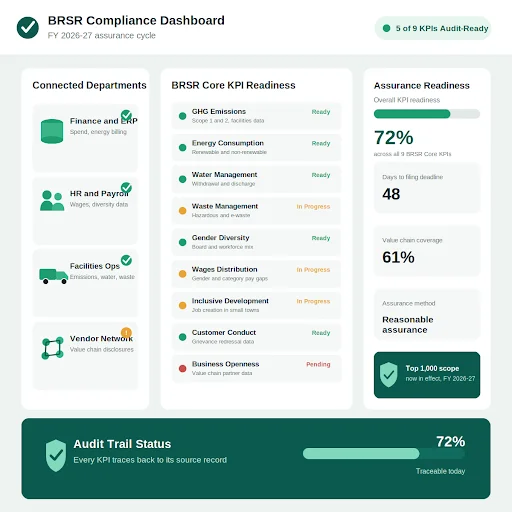
The most useful systems also keep a record of where each figure came from, which matters once a company’s BRSR Core disclosures move from assessment to full assurance.
Meeting SEBI’s BRSR requirements is ultimately a data problem before it becomes a compliance one, and it is the part of ESG in India that determines whether a filing goes smoothly. Zethic designs custom software that connects the departments holding BRSR data into a single, audit-ready system, replacing the spreadsheet-and-WhatsApp starting point with a repeatable process built around SEBI’s own indicators. Businesses preparing for their next filing cycle can start that conversation early.
Ram brings deep expertise in product strategy and system architecture across fintech, SaaS, and AI platforms. He specializes in pre-execution planning to help teams build scalable technology foundations and avoid costly rebuilds.
