


Start Your Project Today
Tell us about your project — we’ll get back within 24 hours


Boards are being asked to publish ESG reporting data pulled from five or six disconnected systems, under a regulatory deadline, using spreadsheets built for financial statements. That mismatch is why so many ESG reports arrive late, get revised after publication, or fail an audit check. The answer starts with treating ESG reporting as a data architecture problem first and a compliance exercise second.
ESG reporting is the practice of disclosing a company’s performance across environmental, social, and governance factors to investors, regulators, and customers. Unlike financial reporting, which measures revenue and profit, it tracks carbon emissions, workforce practices, board oversight, and similar non-financial ESG metrics.
Environmental factors cover emissions, energy use, and waste. Social factors cover labor practices, diversity, and community impact. Governance factors cover board structure, ethics, and anti-corruption controls.
ESG reporting differs from older corporate responsibility reporting in one important way: it relies on measurable, comparable data points rather than narrative descriptions of programs. A corporate responsibility report might describe a company’s community work in prose. An ESG report instead includes specific figures, such as emissions in metric tons or workforce diversity percentages, that can be checked and compared across companies and years.
Investors increasingly weigh ESG performance alongside financial results before committing capital, and regulators in multiple regions now treat ESG compliance as mandatory rather than optional. Larger customers are also asking suppliers for ESG data as part of procurement reviews, which pushes the requirement down the supply chain to mid-size vendors.
Most ESG reporting is built on a small set of recognized frameworks, and each one asks for different data and serves a different audience. Businesses rarely need every framework at once, but they do need to know which one their investors, regulators, or customers expect.
Choosing the right starting framework usually comes down to who is asking for the data. A business responding to investor requests without a specific regulatory deadline can often start with GRI or SASB. At the same time, one operating in or selling into the EU needs to plan around CSRD. For global investor comparability, businesses increasingly turn to the newer ISSB standards alongside these frameworks, and many first work with a sustainability consulting team to measure where their current reporting gaps sit before committing to one.
|
Framework |
Focus Area |
Who Typically Uses It |
Data Complexity to Implement |
|
GRI |
Broad environmental, social, and governance disclosure |
Companies reporting to a general audience of investors and the public |
Moderate, since it covers a wide range of topics |
|
SASB |
Financially material ESG factors by industry |
Public companies reporting to investors |
Moderate, focused on a narrower, industry-specific data set |
|
TCFD |
Climate-related financial risk |
Companies with material exposure to climate risk |
High, requires scenario analysis and risk modeling |
|
CSRD |
Mandatory sustainability disclosure under EU law |
Large EU companies above 1,000 employees and 450 million euros in turnover |
High, requires audited, structured data across many topics |
|
ISSB (IFRS S1/S2) |
Sustainability and climate disclosure aligned with financial reporting |
Companies aiming for global investor comparability |
High, requires close coordination with financial reporting cycles |
Nearly half of large companies in North America and Europe still rely on spreadsheets for ESG data management rather than dedicated systems, according to a 2024 survey of board members and executives at public and private companies in those regions. That approach works for a single report, but it breaks down once data needs to be pulled from multiple departments every reporting cycle.
None of these problems are about the quality of the underlying ESG performance. They are about the process used to collect and present the data, which a business can redesign without changing what it actually does day to day.
Some warning signs are easy to miss until a filing deadline makes them impossible to ignore. Businesses should treat any of the following as a signal that manual processes are close to their limit.
A single warning sign is worth watching. Two or more warning signs appearing in the same cycle usually mean the process has outgrown manual coordination.
OpenESG Data pulls information from internet sources, including company websites and third-party publications like news articles and blogs. The platform can also be customized to integrate directly with private systems such as ERP or HR platforms when companies provide consent and necessary access.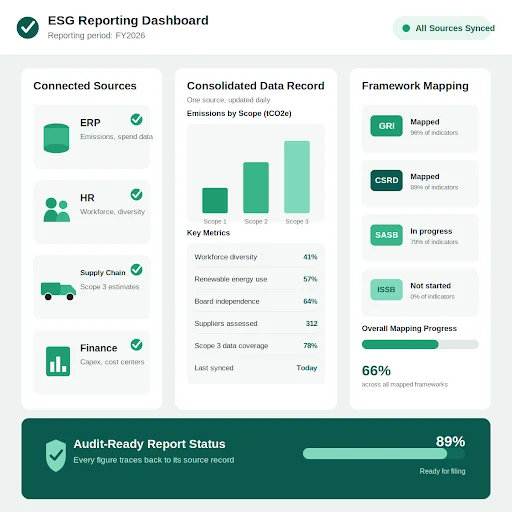
The most useful systems also flag missing or inconsistent data before a filing deadline rather than after, and they let auditors trace any published figure back to its source record without a manual walkthrough.
This is a data engineering task as much as a compliance one. It requires connecting existing business software rather than replacing it, since most companies already have the underlying data somewhere. What they lack is a system that pulls it into one place on a schedule instead of on request.
Closing the gap between rising ESG disclosure requirements and manual, spreadsheet-based processes is ultimately a software problem, not just a compliance one. Zethic designs custom software that connects existing business systems into a single, audit-ready record, replacing the blank-spreadsheet starting point with a repeatable process built around the frameworks a business actually needs. Businesses can start that conversation by outlining their current reporting setup.
Ram brings deep expertise in product strategy and system architecture across fintech, SaaS, and AI platforms. He specializes in pre-execution planning to help teams build scalable technology foundations and avoid costly rebuilds.
