


Start Your Project Today
Tell us about your project — we’ll get back within 24 hours


A sustainability team downloads a generic ESG report template and fills it in without much trouble for the first annual report. By year three, the same file has been copied across several spreadsheets, the person who built it has left the company, and nobody can explain why last year’s emissions figure does not match this year’s opening number. The template was never the hard part: keeping it accurate over time is.
A working ESG report template covers a company’s own performance and the story behind it, not just a list of numbers. With 99 percent of S&P 500 companies now publishing some form of sustainability report, the template itself has become a baseline expectation rather than a differentiator, and what actually separates a useful report from a forgettable one is what goes inside it.
Most ESG report templates converge on the same six sections, though the depth and order shift depending on company size and audience. A first-time reporter might spend a single paragraph on governance, while a company facing mandatory assurance needs board-level detail there instead.
| Section | Purpose | Typical Data Source |
| Executive Summary | Frames the report’s key results for a reader who will not read every page | Pulled together after the rest of the report is drafted |
| Governance | Explains board oversight, policies, and accountability for ESG decisions | Board minutes, policy documents, legal records |
| Environmental Performance | Reports emissions, energy, water, and waste figures | Facilities, operations, and utility billing systems |
| Social Performance | Covers workforce, diversity, and community data | HR systems and payroll records |
| Materiality Assessment | Identifies which ESG topics matter most to the business and its investors | Surveys, interviews, and prior-year disclosures |
| Targets and Progress | Tracks stated goals against actual year-over-year performance | The company’s own prior reports and internal tracking |
The template’s skeleton stays fairly similar regardless of framework, but the specific metrics inside each section usually need to map to a named standard. GRI, SASB, TCFD, and newer standards such as the ISSB’s IFRS S1 and S2 are the most widely used sustainability disclosure standards, and each defines different environmental performance metrics for the same ESG report format, even when the section heading looks identical across frameworks.
A company reporting only to domestic investors can often pick one framework and stay there. One selling internationally, or answering to a parent company abroad, usually ends up mapping the same template to more than one framework at once.
This is where a template built as a static document starts to strain. Adding a second framework to a Word or PowerPoint template usually means duplicating whole sections, since there is no shared underlying structure connecting the two versions, and any later correction has to be made twice by hand.
Ready-made ESG reporting templates from consulting firms, framework bodies, or reporting software vendors save time on structure, since the section list is already decided. The tradeoff is that a generic sustainability report template rarely matches a specific company’s materiality assessment or data sources without some rework.
Neither option is universally right. The better starting point depends on whether a company is reporting for the first time or already has a year or more of disclosure behind it, and how much of that prior data already sits in a usable format, which is exactly what a sustainability consulting review is built to assess.
Many companies end up doing both in sequence: starting from a ready-made structure for the first report, then rebuilding the underlying data connections once the pattern of what gets asked for each year becomes clear.
Even at large, well-resourced companies, sustainability figures do not stay stable once they are published. Nearly half of the companies in the UK’s FTSE 100 stock index restated prior sustainability metrics, with the large majority of those restatements tracing back to greenhouse gas emissions data.
A static template conceals this problem in year one, since there is nothing yet to compare against. The problems become visible later, once a reader lines up three years of reports side by side and finds numbers that quietly shifted with no explanation attached.
None of this reflects poorly on the sustainability team preparing the report. It reflects a document built to hold a single year’s numbers being asked to do a multi-year job it was never designed for.
A template becomes durable once its fields pull from live data instead of being retyped by hand. The ESG report structure stays the same file to file, but the numbers update from source systems rather than from a copy of last year’s report.
Building this does not mean throwing away the template. This is a data engineering exercise more than a design one: the section list, the executive summary, and the materiality framing stay exactly as useful as before. What changes is what feeds the numbers inside it.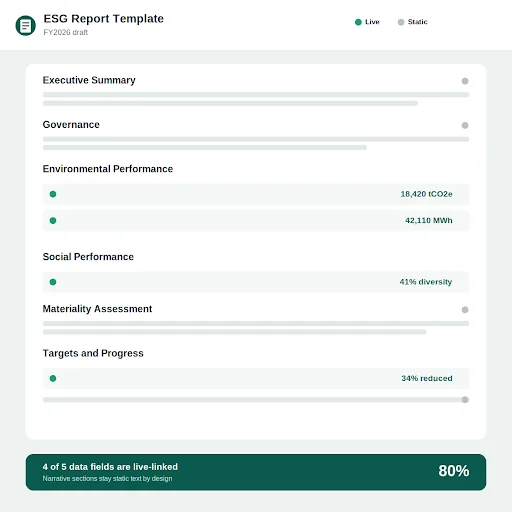
That difference is what actually saves time in year three and beyond, since the section list changes far less often than the underlying data does.
Rebuilding an ESG report template from scratch every year is ultimately a data problem, not a writing problem. Zethic designs custom software that connects a company’s existing data sources to its report structure, so each year’s report pulls updated figures instead of a fresh round of manual entry. Businesses currently maintaining their ESG report as a static file can start by mapping which sections already rely on data that lives somewhere else in the business, since that mapping alone usually reveals most of the work still left to do.
Ram brings deep expertise in product strategy and system architecture across fintech, SaaS, and AI platforms. He specializes in pre-execution planning to help teams build scalable technology foundations and avoid costly rebuilds.
