


Start Your Project Today
Tell us about your project — we’ll get back within 24 hours

Founder
User Interface Design
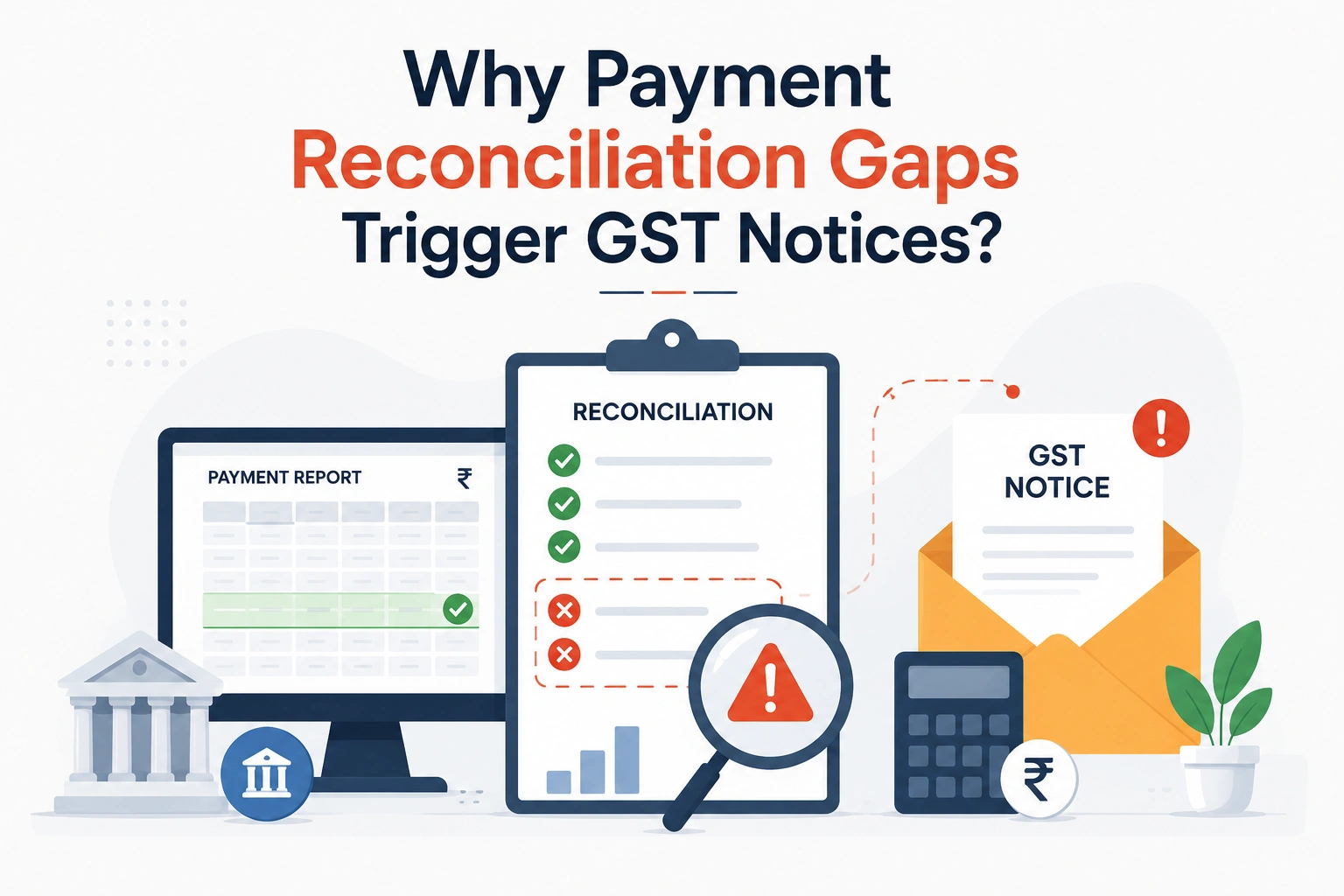
Payment reconciliation is the process of matching what a business actually collected against what its records show it should have collected. For a business running primarily on UPI, that means matching settlement data from every PSP and TPAP against sales records, refunds, and GST returns in one consistent view.
This is a different problem than classic bank reconciliation. A single bank account produces one statement, while UPI collections arrive fragmented across multiple providers, each with its own settlement timing and reporting format. Much of that fragmentation traces back to the underlying payment gateway vs payment aggregator setup a business chose in the first place.
Most businesses already run some version of this manually, cross-checking a spreadsheet against a few settlement reports each month. That works until transaction volume grows past what a manual check can reliably catch.
GST authorities may compare UPI and other digital payment data with turnover reported in GSTR-1 and GSTR-3B during compliance checks. Where they identify significant discrepancies, they may issue a DRC-01 show-cause notice.
The taxpayer then has a 30-day window, as set out in CGST Rule 142, to file a reply in Form DRC-06 with supporting documentation. GST turnover legally covers only the value of taxable supplies, so a payment credit alone does not automatically equal turnover. Demonstrating that distinction, however, often requires detailed day-wise reconciliation that many businesses do not already maintain.
A well-prepared reply typically includes day-wise UPI settlements matched against sales, a refund and failed-transaction log, and reconciliation with bank statements the kind of structured data a solid payment gateway software development setup captures by default. Businesses that already maintain this documentation are generally better positioned to respond within the prescribed timeline.
Building that evidence trail before a notice arrives is closer to regulatory technology solutions than routine bookkeeping, since it relies on structured audit trails, reconciliation logic, and compliance-ready records.
Composition scheme dealers may face greater scrutiny because they operate under prescribed turnover limits, and significant discrepancies can prompt questions about scheme eligibility. If a taxpayer does not respond adequately within the prescribed timeline, the proper officer may proceed in accordance with the CGST Act and Rules, including issuing an order in Form DRC-07 where applicable.
In some cases, unresolved tax demands may eventually progress to recovery proceedings under the GST law. Maintaining accurate reconciliation records helps businesses explain genuine mismatches before they escalate into larger compliance issues.
A single notice reply looks cheap. The real cost shows up in how often it recurs and what it exposes.
| Factor | Reactive Notice Response | Continuous Payment Reconciliation |
|---|---|---|
| Upfront cost | CA-assisted DRC-01 reply from ₹2,999 per notice (Patron Accounting, 2026) | ₹8 lakh to ₹25 lakh to build a reconciliation system with GST matching logic (estimated from India custom software development benchmarks, 2026) |
| Recurrence | Repeats every time settlement data and turnover diverge again | One-time build, then ongoing maintenance only |
| Response window | 30 days to file Form DRC-06 per notice | No filing window pressure, since data stays reconciled continuously |
| Audit exposure | Each notice is a fresh scrutiny event, with composition scheme status at risk | Day-wise records ready before any notice is issued |
The per-notice cost looks small next to a system build, until multiplied across every settlement cycle where the numbers can drift. A business receiving even a handful of mismatch notices a year spends more in recurring CA fees than a one-time build would have cost.
The cost of developing a payment system with reconciliation logic built in scales with transaction volume and channel count rather than a flat rate.
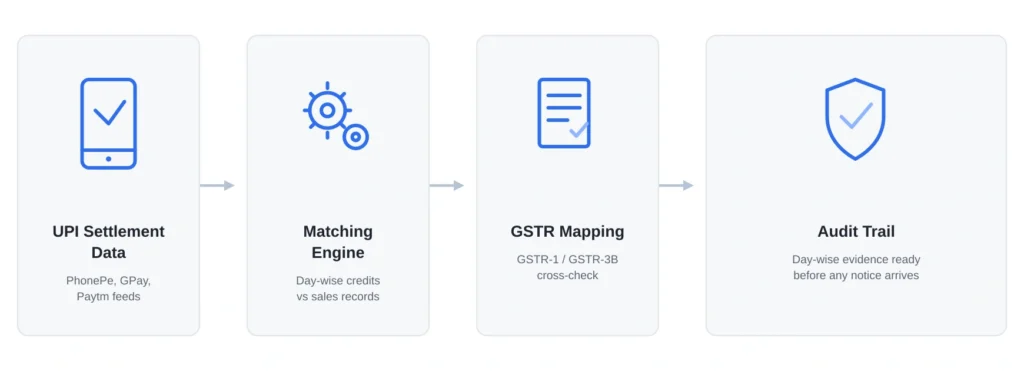
A system built for this problem needs to close the specific gaps that cause mismatches, not just match totals at month-end. Generic accounting tools rarely cover all four by default, since most were built for global markets without UPI’s fragmentation.
Each of these maps to one of the four causes covered earlier, closing the specific gap rather than adding a generic matching layer on top.
The real fix here is closing the gap between fragmented settlement data and reported turnover before a mismatch reaches the GST department’s radar, not getting faster at replying once it does. This sits squarely within fintech software development: building systems that map UPI, NEFT, and gateway settlement data against turnover continuously, so the audit trail already exists the day a question comes in.
For businesses running composition schemes or high UPI volumes, the reconciliation logic accounts for TPAP fragmentation and NPCI’s settlement cycles from the first build phase, not as an afterthought. Zethic’s fintech software development in Bangalore scopes this kind of build around a business’s actual transaction volume and channel mix rather than a one-size-fits-all matching engine.
Let Zethic help you build smarter Not just faster
A basic rule-based system for a single market typically costs in the tens of thousands of dollars, with India-based development often coming in lower than US or UK benchmarks for the same scope.
Buying is usually cheaper upfront, while building can cost less over several years for businesses with steady, predictable transaction volume and in-house engineering capacity.
Yes, real-time monitoring requires more infrastructure than end-of-day batch processing, since transactions must be scored and flagged as they happen rather than in scheduled runs.
Expect annual costs for model tuning, regulatory rule updates, and case management support, generally a percentage of the original build cost each year.
It cannot guarantee zero notices, but continuous reconciliation closes the specific gaps, like TPAP fragmentation and miscounted refunds, that most mismatches come from.
Yes, since PhonePe, Google Pay, and Paytm each report settlement data differently, businesses without a unified reconciliation view are more likely to see gaps between combined UPI credits and reported turnover.
Ram brings deep expertise in product strategy and system architecture across fintech, SaaS, and AI platforms. He specializes in pre-execution planning to help teams build scalable technology foundations and avoid costly rebuilds.

Adding {{itemName}} to cart
Added {{itemName}} to cart