


Start Your Project Today
Tell us about your project — we’ll get back within 24 hours

Agentic AI fintech development means building systems that plan, decide, and execute multi-step financial workflows on their own, rather than simply responding to a single prompt. Most guides describe why this matters and stop there; this article covers which fintech workflows are actually ready to build this way in 2026 and which still need a human holding the wheel.
An agentic AI system perceives data or an event, reasons about what needs to happen, plans a sequence of steps, calls tools or APIs to execute them, and verifies the outcome before closing the loop. That last step matters more than the rest, since a system that cannot verify its own output has no way to know when to stop or escalate.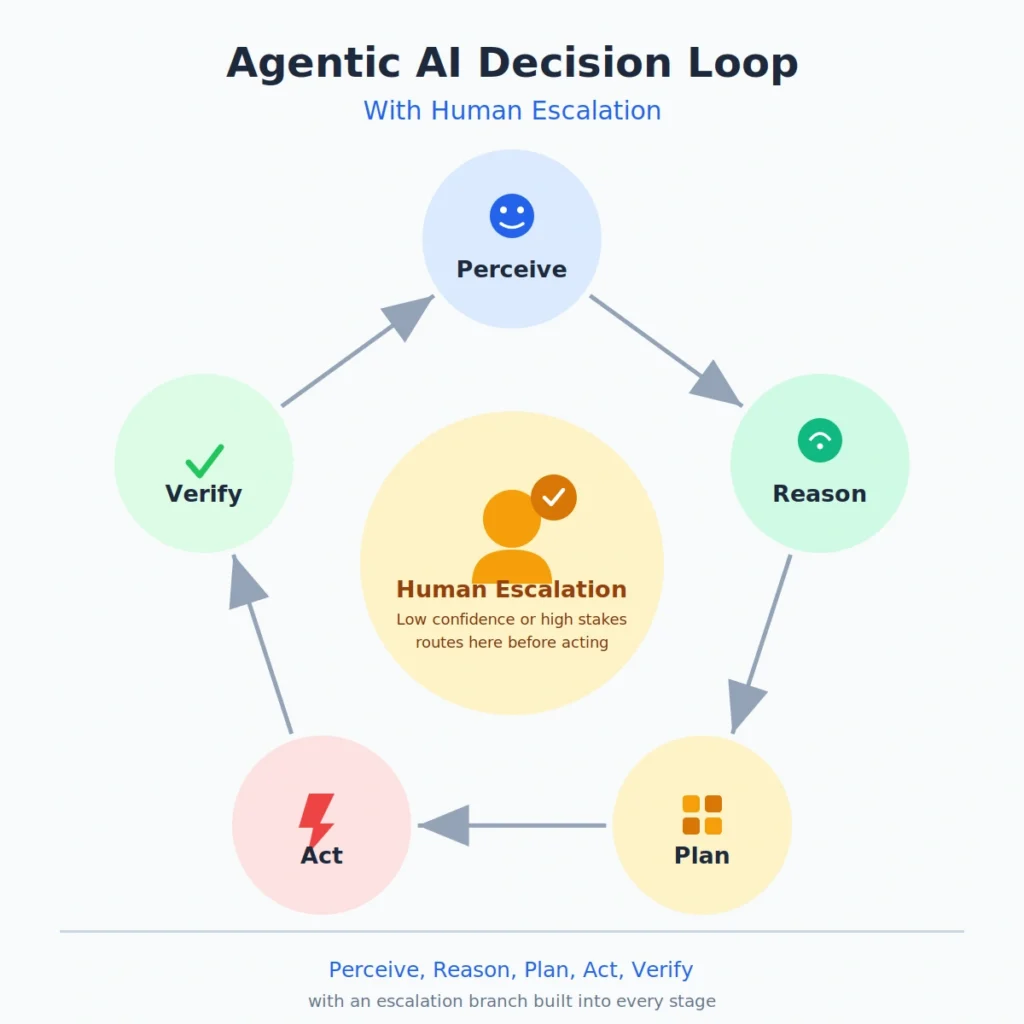
A lot of what gets marketed as agentic AI in fintech today is closer to a rebranded chatbot or a fixed automation script with a language model bolted on the front. The distinction is straightforward to test: a chatbot answers what you ask; an agent decides what to do next based on what it just found, then does it. If a system cannot chain more than one decision without a person re-prompting it at every step, it is automation, not an agent.
Readiness varies sharply by workflow, and treating agentic AI as one uniform capability is where most build plans go wrong. Some financial processes tolerate autonomous action well; others still need a human checkpoint built into every path.
| Fintech Workflow | Readiness in 2026 | Why |
| Fraud pattern monitoring | Production-ready | Reversible actions (flagging, holding) with low cost of a false positive |
| KYC document screening | Production-ready | Well-bounded task with clear pass/fail criteria and human review on edge cases |
| Reconciliation and settlement matching | Production-ready | Deterministic, rule-based matching that an agent can verify against source records |
| Credit underwriting decisions | Pilot-stage | High-stakes, irreversible outcome; regulators expect explainability an agent must still produce |
| Customer-facing financial advice | Pilot-stage | Requires guardrails against overconfident or non-compliant recommendations |
| Autonomous fund movement | Not yet advisable | Irreversible financial action with regulatory and liability exposure too high for unsupervised agents |
The pattern across the table is not about how smart the agent is. It is about how reversible the action is and how expensive a wrong decision would be. Fraud pattern monitoring sits at the top of that list because it overlaps directly with how fintech fraud detection already works: flagging, not fund movement.
An agent that can act autonomously still needs a designed point where it stops and asks. Building that checkpoint after launch costs far more rework than designing it into the architecture from the first sprint.
Cost depends heavily on whether a team is integrating agentic capability into an existing stack built through fintech software development services or building the orchestration layer from scratch. The ranges below reflect production-grade builds for mid-size fintech and lending platforms.
| Build Type | Typical Cost Range (INR) | Timeline |
| Agent integration into existing workflow (single use case) | ₹15,00,000 – ₹35,00,000 | 6–10 weeks |
| Multi-agent orchestration layer (2–3 workflows) | ₹35,00,000 – ₹75,00,000 | 12–18 weeks |
| Full agentic platform with human-in-the-loop governance | ₹75,00,000 – ₹1,50,00,000+ | 20–30 weeks |
Governance infrastructure, meaning the escalation logic, decision logging, and override paths, accounts for a meaningful share of that cost regardless of build size, and skipping it to save budget is usually the decision teams regret first.
Autonomous decisioning changes what a regulator expects from the system, not just what the system does. An agent making a credit or compliance decision still has to produce the same explainability a human decision-maker would.
The teams getting real value from agentic AI in 2026 are not the ones automating everything at once. They start with a small set of reversible, well-bounded workflows, prove the escalation architecture actually works under real load, and expand autonomy only once that trust is earned.
Zethic scopes agentic AI builds around exactly that sequence, starting with the workflows where reversibility and low stakes make autonomous action safe, then building the governance layer that lets a fintech product expand into higher-stakes decisions with confidence rather than guesswork. That approach is why founders and CTOs come to Zethic before deciding which workflow to automate first.
Ram brings deep expertise in product strategy and system architecture across fintech, SaaS, and AI platforms. He specializes in pre-execution planning to help teams build scalable technology foundations and avoid costly rebuilds.
