


Start Your Project Today
Tell us about your project — we’ll get back within 24 hours

Founder
User Interface Design
FinTech app development services
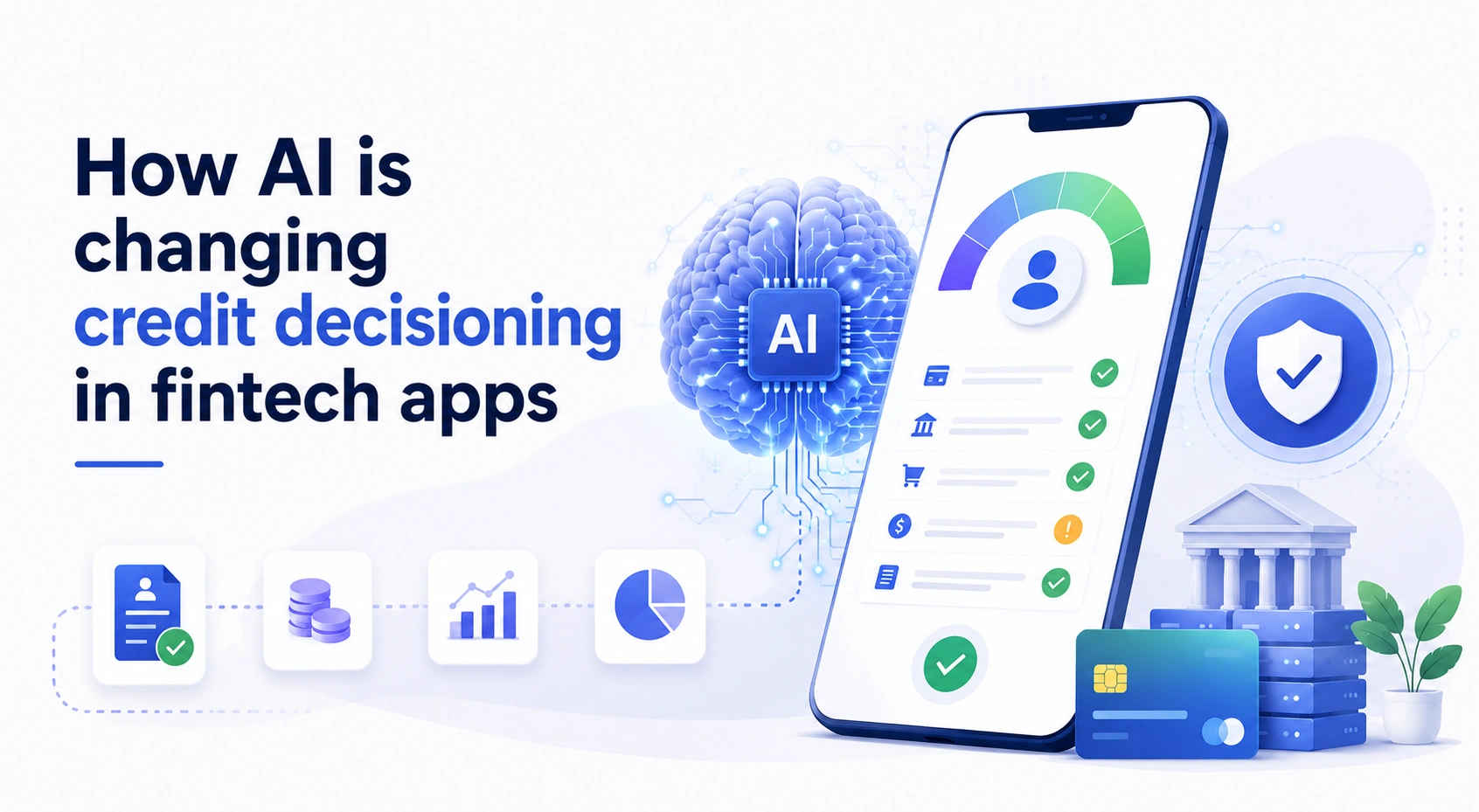
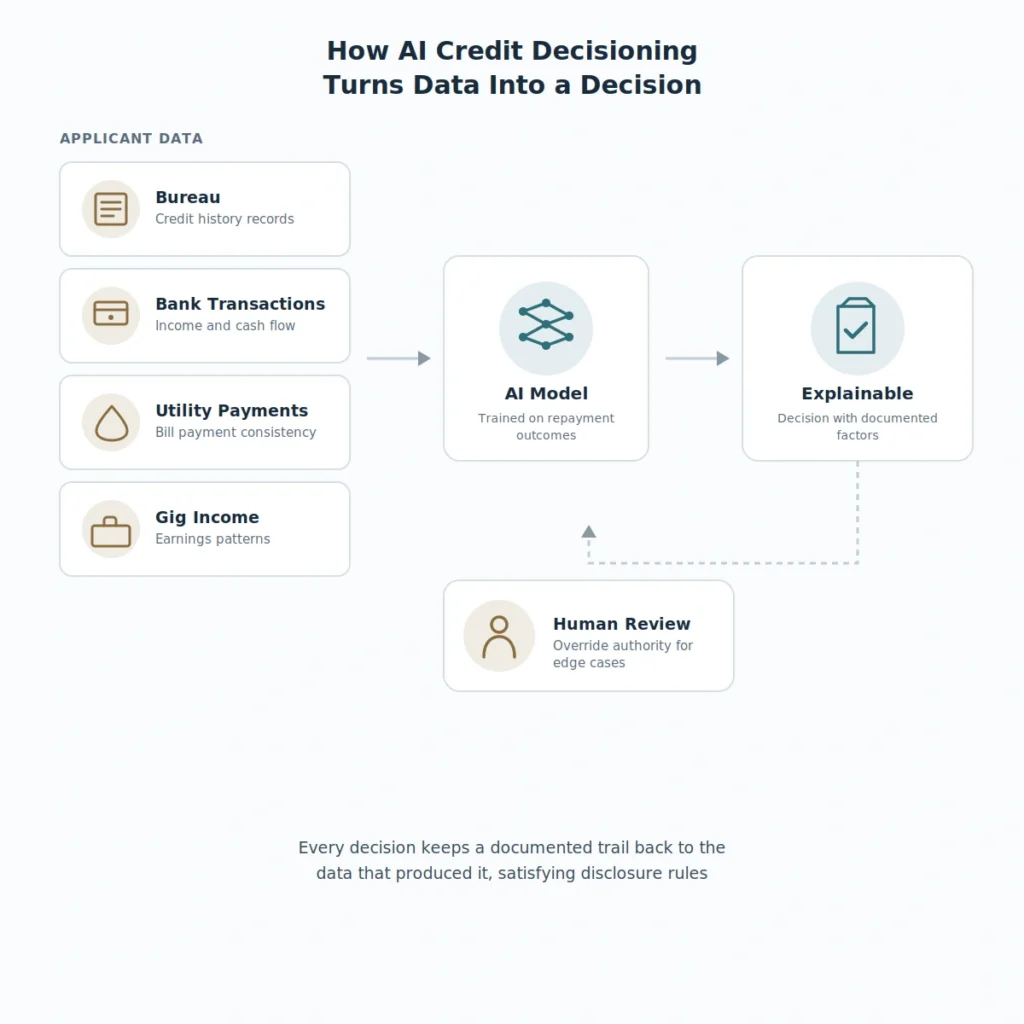
AI credit decisioning takes an applicant’s data, from bureau records to bank transactions to behavioral signals, and runs it through a trained model that predicts the likelihood of repayment as part of a broader custom loan origination process. The model then applies a business’s own policy rules to turn that prediction into an actual decision: approve, decline, counter-offer, or flag for review.
Most fintech implementations don’t remove people from the loop entirely. A model surfaces a recommendation, and the lending team retains override authority for edge cases, which keeps a human accountable for the final call even as the model does the heavy lifting on speed and consistency.
Traditional credit scoring runs an applicant’s bureau history through a fixed scorecard built on a handful of variables, updated infrequently and applied the same way to everyone. AI credit decisioning instead trains on much larger, more varied datasets and updates as new repayment data comes in, which lets it catch patterns a static scorecard misses.
This shift matters most for applicants a scorecard would otherwise reject outright for lack of history, rather than for applicants who already score well under the old system.
Alternative data is what makes AI credit decisioning genuinely useful for markets with a large thin-file population, since it gives a model something to work with when bureau history is missing entirely. In India, where roughly 11 percent of adults still lack a formal financial account according to the World Bank’s Global Findex 2025 report, this isn’t a minor edge case; it’s a meaningful share of the addressable market.
A fintech scoring a gig worker with little or no bureau history might combine UPI transaction frequency with utility payment consistency to build a picture of income stability that a traditional scorecard would never see. Neither signal alone tells the full story, but together they can support a credit decision a bureau-only model would have declined outright.
Combining these sources with bureau data, where it exists, generally produces a fuller picture than either source alone. The tradeoff is that alternative data needs the same bias testing and validation that any credit variable requires before it goes into production.
A lender in the United States has to give an applicant a specific, auditable reason for a credit denial under the Equal Credit Opportunity Act, and “the model said no” does not satisfy that requirement. This is why explainability tools like SHAP and LIME, which identify exactly which factors drove a given score, have become a standard part of production credit models rather than a nice-to-have.
Explainability isn’t only a regulatory checkbox. A lending team that can see why a model declined an application can catch a biased or broken pattern before it scales across thousands of decisions, which protects both the
Most fintech teams don’t need to train a credit model from scratch. Bureau and vendor-provided scoring APIs cover a wide range of standard use cases, and using one gets a fintech to market fast without the data volume a custom-built model needs to perform well, a tradeoff that shows up across most build vs integrate decisions in fintech development.
| Factor | Integrating a vendor model | Building a custom model |
|---|---|---|
| Time to launch | Weeks | Several months to a year |
| Data required | Vendor’s existing training data | The fintech’s own historical loan outcomes |
| Fit for a specific customer segment | Generic, built for broad use cases | Tuned to the fintech’s actual applicant pool |
| Explainability | Depends on the vendor’s tooling | Fully controlled by the fintech’s own team |
| Ongoing cost | Per-decision or per-API-call fees | Data science and infrastructure overhead |
| Ownership of the model | Vendor controls updates and logic | Fintech owns the model and its training data |
A vendor-based model makes sense for a fintech still validating its lending product. Building a custom model, often through dedicated AI development services, starts to make sense once a fintech has enough of its own repayment data to train on, and its applicant pool is different enough from the vendor’s general population that a generic model leaves real accuracy on the table.
Any regulated entity using AI to assess an applicant’s creditworthiness in India has to follow the Reserve Bank of India’s Digital Lending Directions, 2025, which require lenders to obtain and keep on record the applicant’s economic profile, minimum age, occupation, and income, before extending any loan. The same Directions require a Key Fact Statement to be provided to every borrower, laying out the loan terms in a standardized, comparable format regardless of which model produced the decision.
This matters for AI credit decisioning specifically because these are documentation obligations a lender has to meet regardless of how the underlying credit decision was made. A fintech building its own model in India needs its system to capture and retain the applicant data these Directions require, rather than treating recordkeeping as an afterthought once the compliance team asks for it.
The right starting point isn’t which vendor has the flashiest accuracy claims. It’s a clear picture of the fintech’s applicant pool, how much historical repayment data it actually has, and how disclosure and explainability requirements apply to its specific market, the same groundwork that goes into any well-scoped AI fintech app.
When a fintech’s applicant base, data maturity, or compliance needs go beyond what a generic vendor model handles well, Zethic works with product and risk teams through exactly this evaluation, weighing data readiness and regulatory scope before building a decisioning approach suited to the fintech’s actual lending product rather than a one-size-fits-all model.
Let Zethic help you build smarter Not just faster
Ram brings deep expertise in product strategy and system architecture across fintech, SaaS, and AI platforms. He specializes in pre-execution planning to help teams build scalable technology foundations and avoid costly rebuilds.

Adding {{itemName}} to cart
Added {{itemName}} to cart