


Start Your Project Today
Tell us about your project — we’ll get back within 24 hours


Every founder exploring AI agents eventually hits the same wall: should you buy a pre-built vendor platform, or build a custom agent from scratch? The build vs buy AI agent decision looks like a pricing question at first, but the real cost shows up later, in vendor lock-in, compliance gaps, or an internal team stretched too thin to maintain what it built. Here is how to score the build vs buy AI agent decision properly instead of guessing.
Buying an AI agent means subscribing to a vendor platform or customer support automation software built for common customer support or workflow use cases, and configuring it to your workflows rather than writing the underlying logic yourself.. Building means developing a custom agent, using a foundation model as the reasoning layer, with your own orchestration, integrations, and business rules on top.
Neither path means training a foundation model from scratch. Building an AI agent almost always means building the application layer around an existing model, not the model itself. This is really the same question that comes up in how businesses decide build vs buy for software generally: who ends up owning that application layer, a vendor, or your own team.
Most companies treat build vs buy as a one-time, company-wide choice, when it is actually a per-use-case judgment that should be revisited as requirements change. A platform that looked cheap in year one can become the most expensive line in a tech budget by year three, once integration fees, usage costs, and customization work pile up.
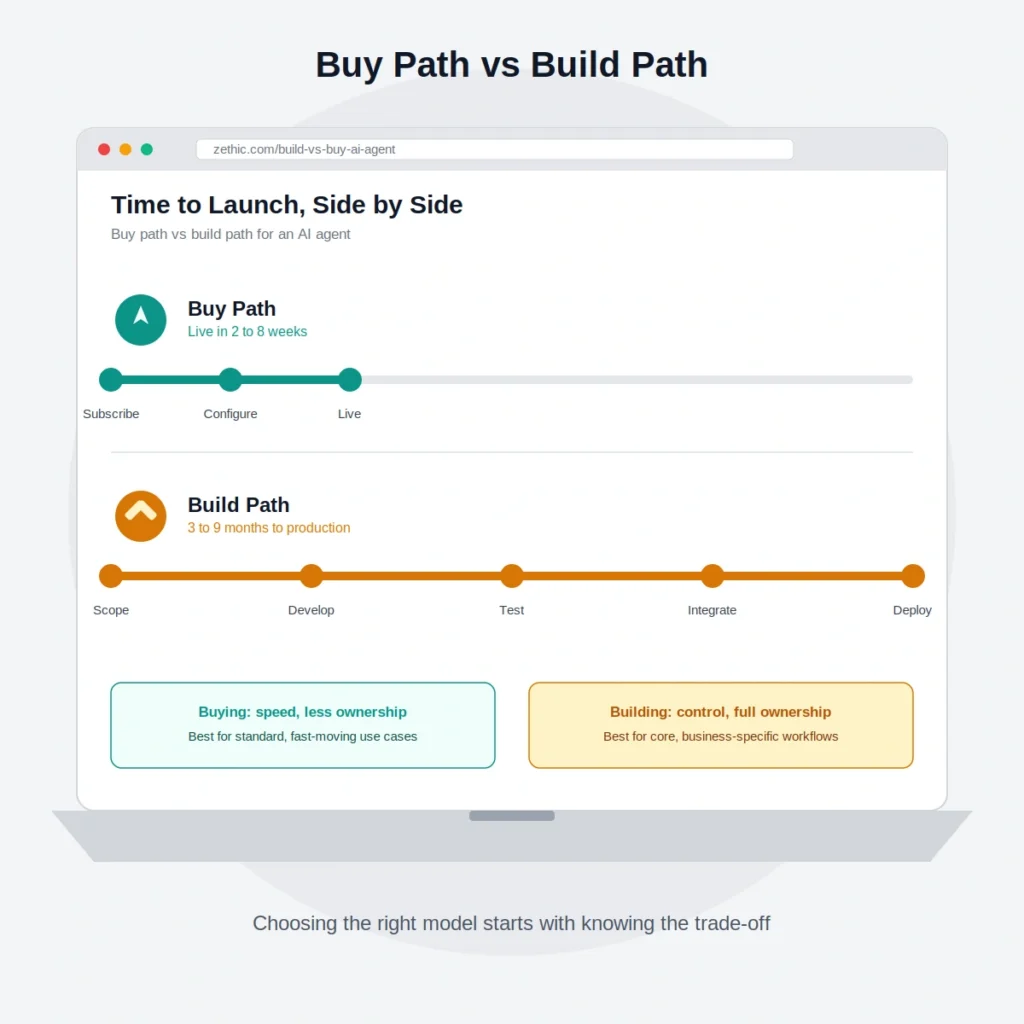
Buying an AI agent platform makes sense when speed matters more than customization, and the workflow you are automating is standard rather than unique to your business, such as an AI sales automation platform. In most build vs buy AI agent evaluations, a platform can typically be live in two to eight weeks, compared to three to nine months for a custom build.
Building pays off when the agent touches sensitive company data, needs to integrate deeply with legacy systems, or is central to what makes your business hard to copy. This is where the build vs buy AI agent decision usually tilts toward building. A fintech company building a custom fraud-detection agent needs reasoning logic a generic platform cannot replicate without heavy customization, which is exactly the shape agentic AI in fintech app development tends to take once a workflow gets this specific.
Rather than debating in the abstract, score your specific use case against the factors that actually decide the outcome. The table below reflects the criteria most build vs buy AI agent frameworks converge on. The actual rupee numbers behind each tier are worth knowing too, since AI agent development cost in India varies enough by complexity that this table alone won’t tell you what to budget.
| Factor | Favors Buy | Favors Build |
| Time to launch | Live in 2 to 8 weeks | 3 to 9 months to production |
| Upfront cost | Lower, subscription-based | Higher, one-time development cost |
| Long-term cost at scale | Rises with usage, can exceed build cost | Stable once built, mainly maintenance |
| Customization depth | Limited to vendor’s workflow model | Full control over logic and integrations |
| Compliance and data control | Depends on vendor’s certifications | Full ownership of audit trail and data handling |
| Vendor dependency | High, tied to vendor’s roadmap | Low, you control upgrades and changes |
Most businesses that get this right do not choose one path exclusively. They buy the underlying infrastructure, model access, hosting, and monitoring, while building the workflow logic, integrations, and business rules that make the agent actually useful for their specific operation.
This hybrid model captures the speed advantage of buying without giving up ownership of the parts that matter most, the logic that reflects how your business actually works. It also shows why the build vs buy AI agent question rarely has a single, permanent answer. Usage grows, a use case proves its value, and at some point a fuller software development effort makes more sense than the vendor platform you started with.
Most businesses do not need a permanent answer to build vs buy on day one. They need a clear-eyed look at their specific use case, an honest cost picture, and a partner who can execute whichever path actually fits.
Zethic works with founders and CTOs across fintech, logistics, and software services to score each build vs buy AI agent decision against real requirements, not a generic checklist, and every custom build is scoped with a detailed cost breakdown so a business knows exactly what it is signing up for before committing engineering budget.
Ram brings deep expertise in product strategy and system architecture across fintech, SaaS, and AI platforms. He specializes in pre-execution planning to help teams build scalable technology foundations and avoid costly rebuilds.
