


Start Your Project Today
Tell us about your project — we’ll get back within 24 hours

Founder
User Interface Design
FinTech app development services
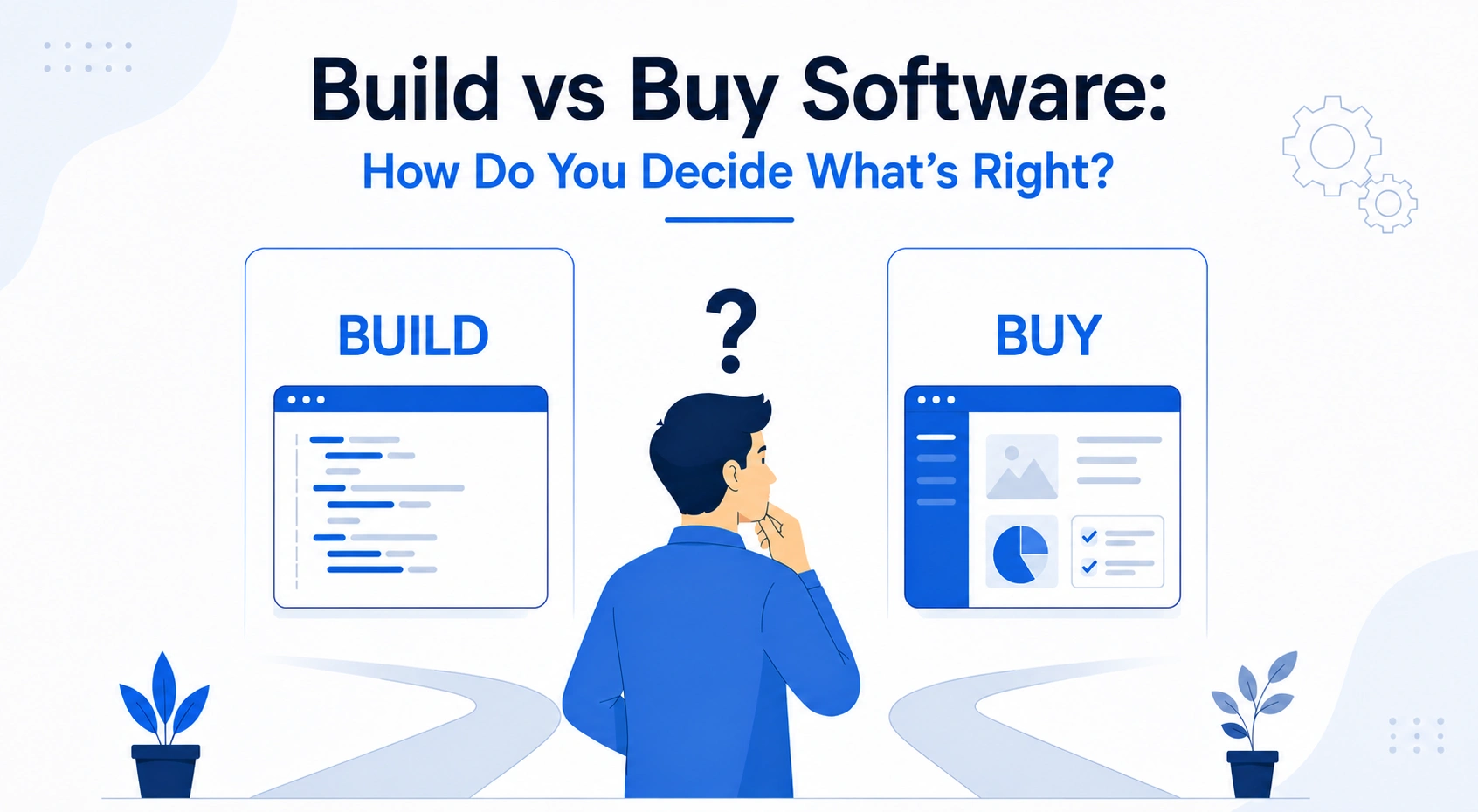
Build vs buy software comes down to one trade-off: control and long-term ownership versus speed and lower upfront cost. Building fits when the software is your competitive edge, and buying fits when the function is standard across your industry. The right call depends on your budget, timeline, and how central the workflow is to your business.
Build vs buy software describes the choice between developing a custom application from scratch or purchasing an existing solution such as a SaaS product. Building gives a company full ownership of the code, data, and architecture. Buying means adopting a vendor’s product and working within its features and limits.
A third path, hybrid, has become common. It means buying a flexible platform with a strong API and building custom extensions on top of it. Most mid-size businesses end up somewhere between the two extremes rather than at either pole.
Building makes sense when the software is not a commodity function but the actual mechanism that sets a business apart, or when compliance and data control needs limit which third-party tools qualify as safe options. A business evaluating fintech app development often finds this signal decisive when compliance requires full visibility into how data moves.
Buying makes sense when the function is standard and well understood, not something that sets the business apart from competitors. Speed and lower upfront cost matter more than deep customization here.
Hybrid is not a compromise so much as a separate strategy within the build vs buy software decision: buy a platform with a strong integration layer for the standard function, then build custom features on top for the parts that matter most.
A common example is buying a CRM platform for lead and contact management, then building a custom reporting layer that reflects the business’s own sales process. This gives speed on the standard part and control where it matters most. A logistics team weighing delivery management software often ends up buying the core platform, then building the dispatch features specific to its own routes.
Hybrid tends to work best when only one or two processes truly need customization, while the rest are standard. It avoids the cost of building everything and the rigidity of buying everything.
Cost comparisons that look only at year one are misleading, since licensing fees compound annually under a buy model while a build model carries a larger upfront cost followed by lower recurring spend.
The table below is an illustrative model for a mid-size business application over five years, including integration and training. Here’s what that breakdown looks like when the three approaches are placed side by side:
Table: Illustrative 5-year cost of ownership
| Cost factor | Build (India team) | Buy (SaaS) | Hybrid |
|---|---|---|---|
| Year 1 setup | ₹25L to ₹45L | ₹1L to ₹5L | ₹8L to ₹18L |
| Annual cost, years 2 to 5 | ₹6L to ₹10L | ₹10L to ₹18L | ₹7L to ₹12L |
| Integration and training | ₹2L to ₹4L | ₹2L to ₹3L | ₹3L to ₹5L |
| Approx. 5-year total | ₹51L to ₹89L | ₹53L to ₹95L | ₹51L to ₹83L |
Buy costs rise the most because SaaS pricing typically scales with users and add-on features. Build costs concentrate early but flatten once the core system is stable, which is why the breakeven point usually favors building for businesses expecting to scale past a certain user count. A payment orchestration layer is a common example of where this five-year math shifts once transaction volume grows past a certain point.
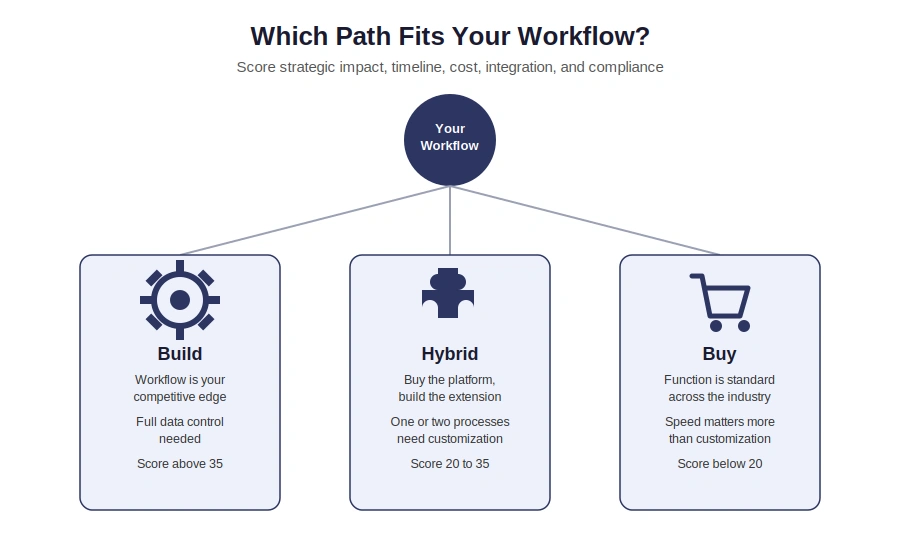
A structured framework prevents personal preference from driving the decision. Score each factor from 0 to 10 based on how strongly it applies to your situation.
Add the scores together. Above 35 generally points toward building, 20 to 35 suggests hybrid is worth exploring, and below 20 buying is usually the more practical choice. Growing teams often run this scoring exercise alongside a custom software development company in Bangalore before committing budget to either path.
India’s Digital Personal Data Protection Act, 2023 takes a more permissive approach than many businesses expect when making a build vs buy software decision. The rules on processing of personal data outside India allow personal data to be transferred to any country except those the central government specifically restricts, and no country has been placed on that restricted list so far.
That said, the Act still places direct compliance obligations on the business itself, including consent management, breach notification, and accountability for how a vendor’s subprocessors handle data. Sector-specific rules can be stricter. The Reserve Bank of India’s rules on storage of payment system data require payment system operators to store complete transaction data only on systems located in India, with any foreign processing brought back within 24 hours.
For businesses in payments, banking, or other regulated sectors, this sectoral rule often becomes the real build or hybrid signal, more than the general data protection law itself. Most other businesses can meet DPDP compliance with either build or buy, provided the vendor contract addresses consent and data handling clearly.
The build vs buy software decision is not a formula to solve once and forget. Markets, vendor pricing, and internal skills change, so a decision made two years ago is worth revisiting.
Start by mapping the specific workflow, scoring it against the five factors above, and involving both technical and business leaders before committing. A short scoping exercise with an experienced custom software development services partner often surfaces integration or compliance issues that are easy to miss from the outside.
The clearest path forward is talking to someone who has scoped both approaches on dozens of projects, since that experience adds clarity a generic checklist cannot. Zethic works with founders through this exact process before writing a single line of code, mapping the actual workflow so the recommendation reflects what you need.
Let Zethic help you build smarter Not just faster
It can require managing two systems instead of one, but it is often simpler than a full custom build while still covering the parts of the workflow that need real customization.
Ram brings deep expertise in product strategy and system architecture across fintech, SaaS, and AI platforms. He specializes in pre-execution planning to help teams build scalable technology foundations and avoid costly rebuilds.

Adding {{itemName}} to cart
Added {{itemName}} to cart