


Start Your Project Today
Tell us about your project — we’ll get back within 24 hours


A health app can meet every compliance check and still need work on usability when a task takes longer than a nurse or patient can spare. Healthcare UX design addresses that gap by shaping each screen around real workflows, consent rules, and accessibility needs. For teams planning healthcare app development, these decisions are easier to make before engineering starts than after launch.
Healthcare UX design is the research and design of digital health products around clinical workflows, patient needs, and regulatory rules. Healthcare UI UX design covers both the interface and the wider experience across patient apps, clinician dashboards, and admin portals. Medical UX design usually refers to software and devices where each input can affect patient safety.
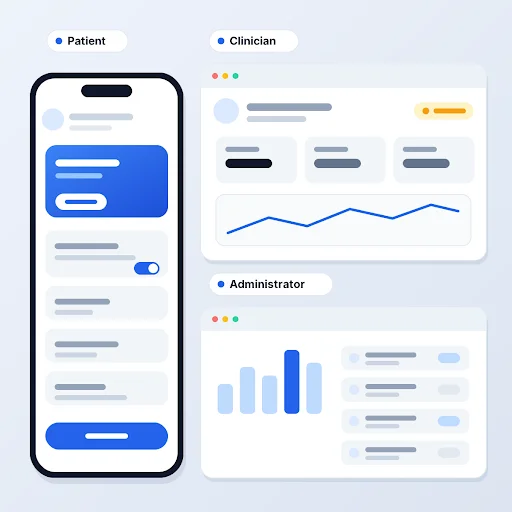
Standard UX focuses on speed and conversion. Healthcare products must also protect sensitive data and support accuracy, so a patient record needs a different approach from a shopping app.
Teams learning how to develop a healthcare app will find that these three groups often share one system but need separate screens. Role planning therefore belongs in the design phase, before development starts.
Healthcare users work under conditions specific to clinical settings. The same product may serve a patient at home and a clinician on a hospital round, each with different goals and time limits. Mapping those roles is a standard early step in healthcare software development.
In a consumer app, screen clarity affects sales. In a health app, it also affects data accuracy and patient safety, so each design choice matters more.
Healthcare UX design starts by mapping these conditions before any layout work, which keeps later decisions tied to real tasks.
Compliance rules shape what a screen must show, record, and allow. The table links four common requirements to the design decision each one drives.
| Requirement | What It Governs | Design Decision |
| HIPAA Security Rule (US) | Access control, audit controls, authentication, and transmission security for electronic patient data | Unique logins, views by user role, activity logs, and session timeout screens |
| India’s DPDP Act and Rules | Clear notice, consent, and withdrawal for personal data | A separate consent screen that states the purpose, with a visible withdrawal option |
| Ayushman Bharat Digital Mission (ABDM) consent flow (India) | Patient-approved sharing of health records between providers | A consent request screen showing who requests which records |
| WCAG 2.2 Level AA | Accessibility of web and mobile interfaces | Buttons and links of at least 24 by 24 pixels and a login with an alternative to memory tests |
According to the Press Information Bureau (2025), the Digital Personal Data Protection (DPDP) Rules give organizations an eighteen-month phased period for compliance. The same release states that access and erasure requests need a response within ninety days, which affects how a settings page handles them. Web Content Accessibility Guidelines (WCAG) 2.2, published by the World Wide Web Consortium (W3C) in October 2023, adds the button size and accessible login criteria listed above (W3C, 2023).
The Health Insurance Portability and Accountability Act (HIPAA) Security Rule, set out by the US Department of Health and Human Services (HHS), lists access control, audit controls, authentication, and transmission security as technical safeguards. The regulation lists automatic logoff as an addressable item, meaning an organization applies it or documents an equivalent alternative, so a session timeout is a deliberate design decision. Healthcare UX design therefore treats login, timeout, and consent screens as core flows instead of later additions.
Clinical work follows a sequence, and a screen should match it. A medication entry screen, for example, should show the patient, the drug, and the dose together so a clinician can confirm all three at once.
Medical UX design applies the same logic to clinical software, where an entry can inform a care decision. UI/UX design for clinical screens also covers finer details, such as readable type, clear units, and consistent placement of patient identifiers across screens.
Testing these flows with a few real clinicians before development adds practical detail to internal reviews.
UX design for healthcare startups works best when the first release is narrow and follows a clear UI UX design process. Budgets and regulatory checks make one well-tested workflow more valuable than a long feature list.
Scoping healthcare UX design this way keeps the first release small enough to launch and tested enough to rely on.
Healthcare UX design justifies its cost when clinicians finish tasks faster, patients complete consent and booking without help, and the product passes compliance review without a redesign. Those outcomes depend on decisions made before development starts, from the consent flow to the views for each role. Each of those decisions is easier to adjust on a prototype than in released code.
Teams that treat healthcare UI UX design as part of healthcare app development from the start are more likely to release products that people can use from the first day. Cost follows the same logic: user roles and screen complexity are the main drivers of UI UX design cost in India.
Healthcare UX design decisions made late tend to reach engineering as late changes, which add work to every development cycle. Settling the flow, roles, and consent screens first gives developers clear requirements to build from.
At Zethic, healthcare UX design sits inside the same four stages as development (discover, design, build, and support), so the patient and clinician experience is designed alongside the system structure.
Ram brings deep expertise in product strategy and system architecture across fintech, SaaS, and AI platforms. He specializes in pre-execution planning to help teams build scalable technology foundations and avoid costly rebuilds.
