


Start Your Project Today
Tell us about your project — we’ll get back within 24 hours

Quoting AI integration cost for existing software is hard because the number depends almost entirely on what “existing” actually means. A modern, API-ready platform and a decade-old legacy system carry completely different price tags for what sounds like the same request. Once a business identifies which category its system falls into, AI integration cost for existing software settles into a fairly predictable range: ₹4 lakh for a modern system with clean APIs, up to ₹40 lakh or more for a legacy system needing custom middleware.
AI integration cost for existing software breaks down primarily by integration path rather than by AI feature, since the condition of the system being integrated into moves the number more than what the AI development itself involves.
| Integration Path | Cost Range (INR) | What It Typically Includes |
| Modern, API-ready system | ₹4 lakh – ₹12 lakh | Native API connection, minimal architecture changes, single feature |
| Partially modern system | ₹12 lakh – ₹25 lakh | Some custom middleware, multiple integration points, data cleanup |
| Legacy system | ₹25 lakh – ₹40 lakh+ | Custom middleware, data access layer built from scratch, extensive testing |
These ranges cover a single AI feature added to one existing system: scoping, integration work, testing, and deployment. A business connecting AI to a platform already built with modern APIs lands at the low end, while a business integrating the same feature into a legacy system with no clean data access lands at the high end.
The gap between tiers is rarely about the AI itself. Two businesses adding an identical chatbot feature can see costs differ by five times or more, purely based on whether their existing system already exposes clean, documented endpoints or requires custom work just to make the AI layer reachable.
This is also why quotes that only ask “what AI feature do you want” without asking detailed questions about the existing system tend to be unreliable. A vendor that skips a discovery phase focused on the system being integrated into is pricing the AI feature alone, not the actual project.
Yes, and by a wide margin. A legacy system was built before AI integration was a consideration, so the data it holds is rarely structured in a way that a model or API can use directly.
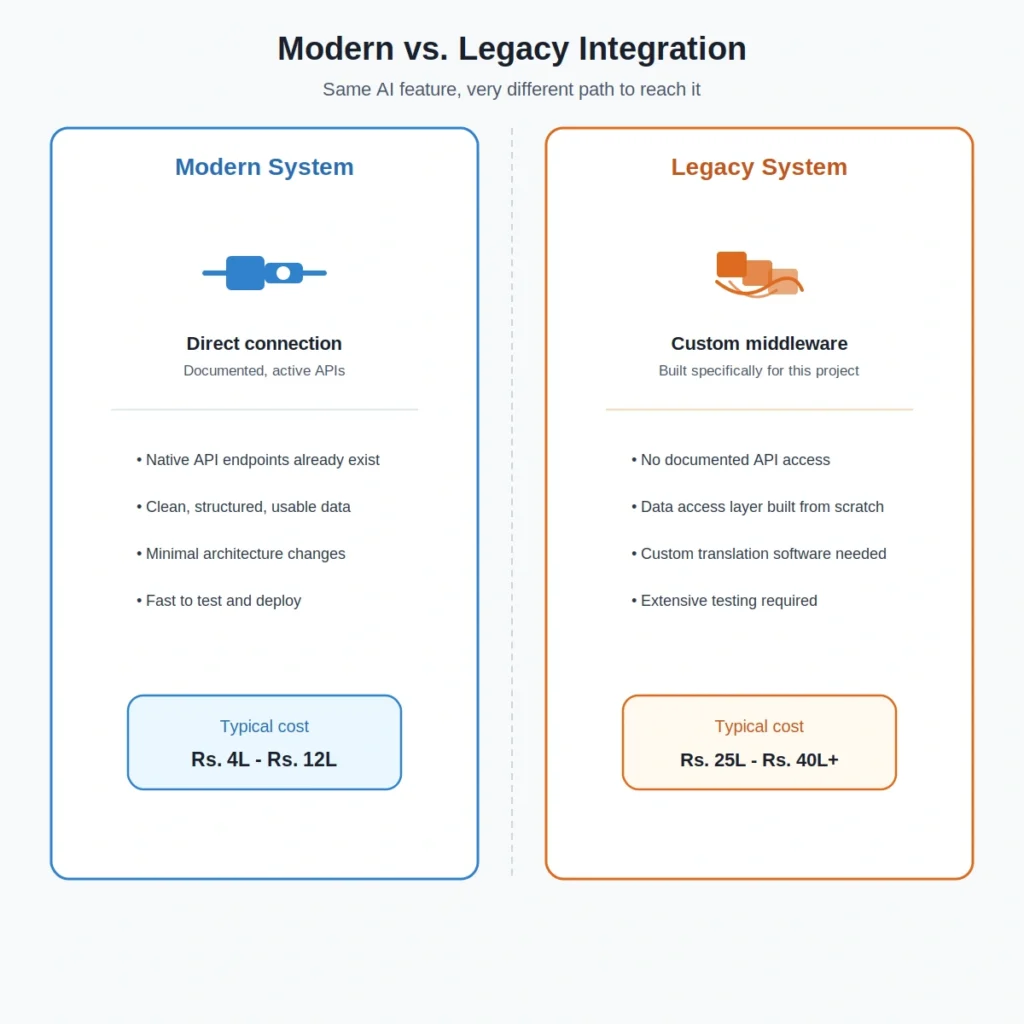
A business is not paying more because the AI is harder to build. It is paying more because the path to reach the existing system’s data is longer and less predictable.
This distinction matters when comparing quotes. A vendor quoting a low number for a legacy integration is either underestimating the middleware work or planning to discover it mid-project, a version of the same tradeoff in custom software vs off-the-shelf comparisons, where the sticker price rarely tells the full story.
This is the risk that makes AI integration different from a greenfield AI build, and it deserves more attention than most cost guides give it. The software being integrated into is already live, already trusted, and already carrying real business operations.
A poorly scoped integration can introduce new failure points into a system that previously worked reliably. An API call that occasionally times out, a middleware layer that silently drops data, or a new dependency that goes down without warning can all disrupt a business process that had no such vulnerability before AI was added.
This risk is a real cost, even when it does not show up as a line item on a quote. Scoping and testing that account for it upfront cost less than fixing a production incident after launch, a principle that RBI’s IT governance requirements for system changes formalize directly, requiring regulated entities to assess business impact and maintain a recovery mechanism before any change to a live system goes live.
A useful practice is to treat the existing system’s current behavior as a baseline to protect, not just a starting point to build on. Testing that specifically checks whether the AI integration changed anything about the system’s pre-existing behavior catches problems that testing focused only on the new AI feature would miss entirely.
Rather than assuming a tier, a business can check its own system against a short set of markers that map fairly reliably to the cost ranges above.
A system matching most of the legacy markers should budget toward the higher end of the range from the outset, rather than anchoring on a lower quote and discovering the gap once the integration work has already started. Running the same kind of code audit services perform, looking at API surface, data structure, and technical debt, before requesting quotes gives a business its own independent read on which tier applies.
The integration cost covers the initial connection only. A live system with AI integrated into it carries ongoing costs tied to keeping that connection stable.
A reasonable starting point is to budget 15 to 20 percent of the initial integration cost per year for these ongoing needs, with legacy integrations typically landing at the higher end due to the added middleware component. This holds whether the integrated feature is a straightforward automation of agentic AI development effort layered onto the existing system.
A fair quote should be traceable back to the actual condition of the system being integrated into, not a generic AI feature price list. It should account for API availability, data structure, and the testing needed to protect what already works.
Zethic scopes AI integration projects against the actual existing system rather than a flat rate card. Zethic evaluates API readiness, data access, and integration risk before quoting, so the number a business receives reflects the real condition of the system being integrated into.
Ram brings deep expertise in product strategy and system architecture across fintech, SaaS, and AI platforms. He specializes in pre-execution planning to help teams build scalable technology foundations and avoid costly rebuilds.
