


Start Your Project Today
Tell us about your project — we’ll get back within 24 hours

Founder
User Interface Design
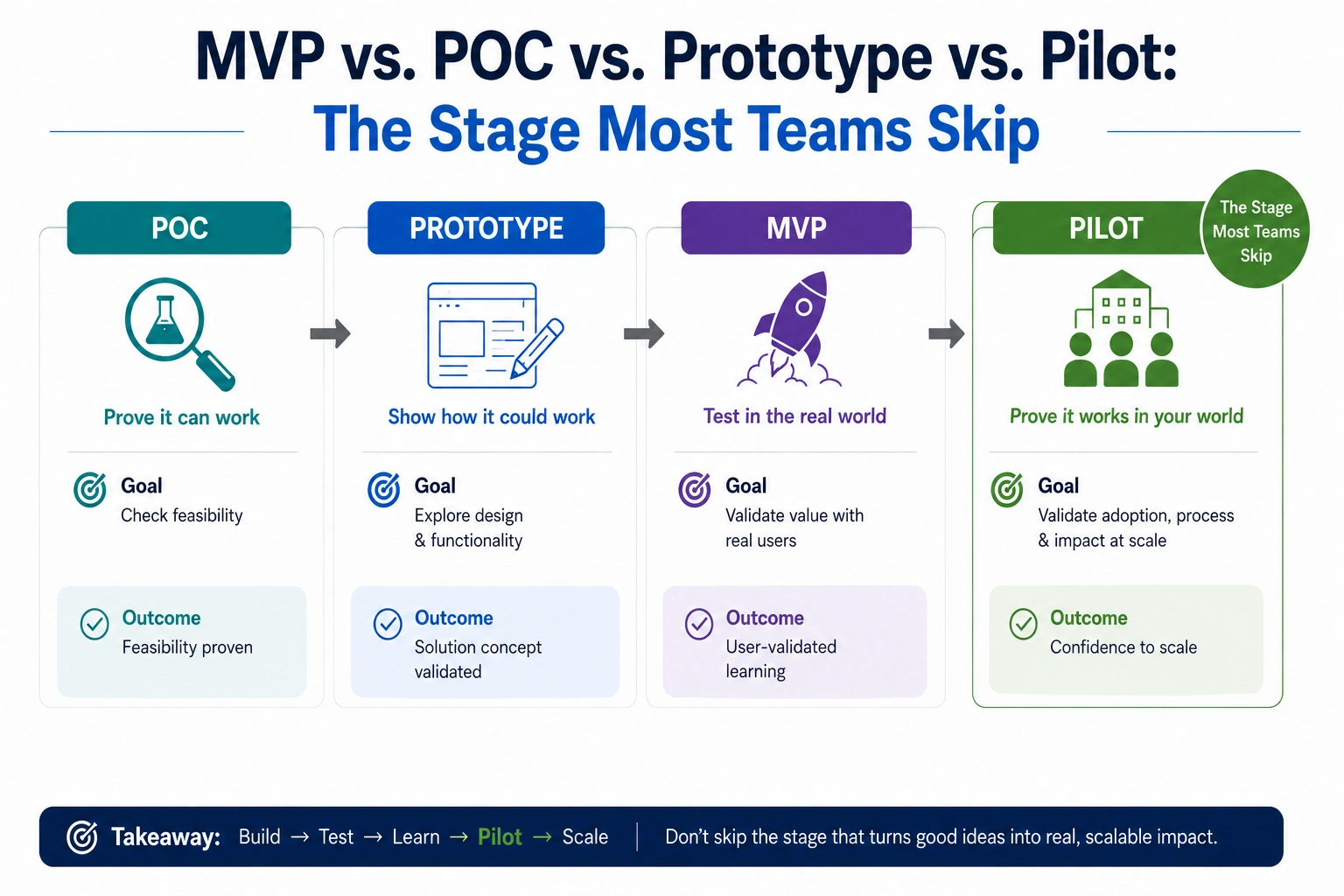
Most teams validate whether their product can be built, how it should look, and whether anyone wants it. Then they roll it out to everyone at once and discover at full scale what a small rollout would have shown them early. The stage that prevents this is the pilot, and almost nobody budgets for it.
The usual MVP vs. POC vs. prototype comparison stops at three stages. There is a fourth, and including it is what carries validated products safely to full launch.
A proof of concept (POC) is a small internal experiment that proves a technical idea can work. A prototype is a visual or interactive model that tests design and user flow before real code is written. An MVP is the smallest functional product that real users can adopt, and a pilot is a controlled rollout of a finished product to a limited segment before full launch.
| Stage | Question it answers | Audience | Risk it removes |
|---|---|---|---|
| POC | Can we build it? | Internal team | Technical |
| Prototype | Should we build it this way? | Stakeholders, test users | Design and usability |
| MVP | Will users adopt and pay? | Early adopters | Market |
| Pilot | Does it survive real operations? | One limited segment | Operational |
The POC vs prototype confusion happens because both exist before the product does. They answer different questions, and knowing which one you need means every rupee of validation buys a different answer.
Most teams treat their MVP launch as the pilot, which tests demand but leaves post-go-live operations untested.
Each stage removes a different class of risk, so the stage you run decides the risk you retire. According to CB Insights (2026), poor product-market fit shows up in 43% of FinTech startup failures, which is exactly the risk an MVP exists to remove.
Research by McKinsey and the University of Oxford across more than 5,400 IT projects found large builds run 45 percent over budget while delivering 56 percent less value than predicted. The pattern repeats at every stage.
| Stage skipped | Risk that survives | Typical failure |
|---|---|---|
| POC | Technical | Months of development on an unworkable core |
| Prototype | Usability | Expensive UI rework after the code is written |
| MVP | Market | A polished product nobody buys |
| Pilot | Operational | Support and infrastructure collapse at full rollout |
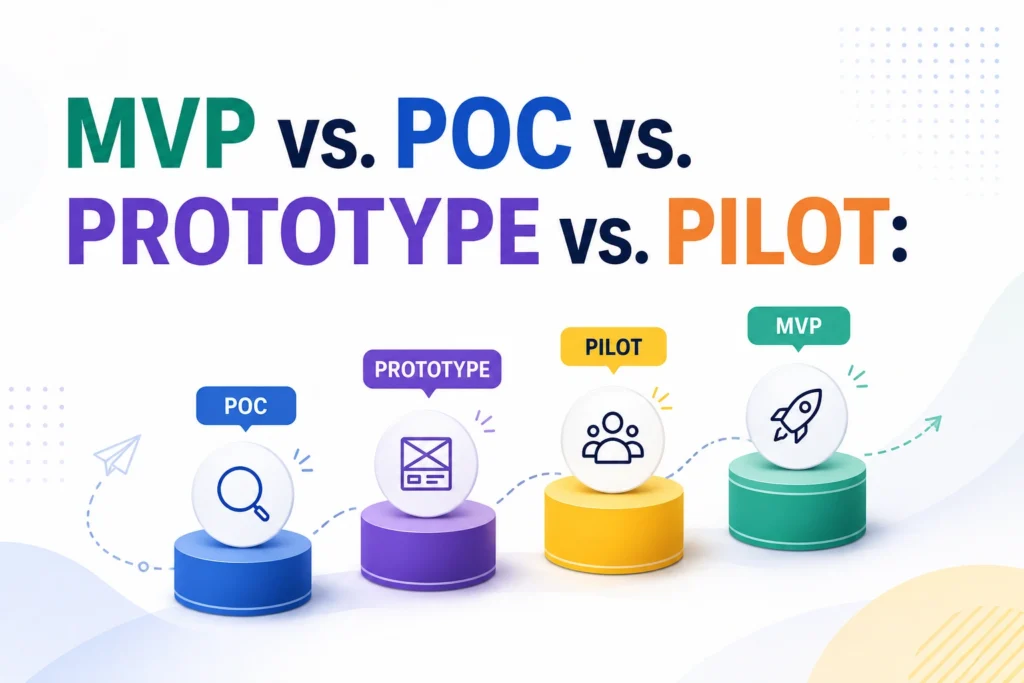
Moving between stages should be a gate, not a drift. Each stage needs written exit criteria before work starts on the next one.
Start from the risk, not the stage. The artifact worth building first is the one that answers your biggest open question for the least money.
Zethic Technologies is a trusted Web & Mobile App Development Company providing Custom Software Development Services to startups and growing businesses. We combine planning, development, and long-term thinking to deliver stable digital products.
Let Zethic help you build smarter Not just faster
Sometimes. If the POC was built on clean, scalable architecture, it can seed the MVP, but most POCs are quick experiments and should be treated as throwaway code.
Yes, provided the vendor holds RBI authorisation as a payment aggregator or has a licensed acquiring partner in India. Merchants inherit the vendor’s PCI DSS coverage, but data localisation obligations under RBI’s 2025 Master Direction still apply to the data infrastructure regardless of which model you use. For merchants piloting a payments feature specifically, working with dedicated payment gateway software development services ensures these compliance obligations are built into the pilot from day one, rather than discovered at full rollout.
No. Skip the POC when your technology is proven and skip the prototype when your interface follows standard patterns, but never skip market validation.
A POC typically takes 2 to 4 weeks, and an MVP takes 1 to 3 months. Prototype timelines run 1 to 3 weeks, and pilot length depends on your product’s usage cycle.
Ram brings deep expertise in product strategy and system architecture across fintech, SaaS, and AI platforms. He specializes in pre-execution planning to help teams build scalable technology foundations and avoid costly rebuilds.

Adding {{itemName}} to cart
Added {{itemName}} to cart