


Start Your Project Today
Tell us about your project — we’ll get back within 24 hours

Founder
User Interface Design
CRM development cost in India depends heavily on tier, team, and integration scope, broken down in detail in the table below. The bigger budgeting risk isn’t the base build cost; it’s India-specific integrations like GST invoicing and UPI payments, which generic cost guides mention only in passing.
A CRM isn’t just a contact list with a nicer interface. It’s a system built around a sales or service pipeline, with permission rules for who sees which leads, activity logging, and reporting that reflects how a specific business actually sells.
Most businesses don’t start here. They start on a spreadsheet, move to a subscription tool once the spreadsheet breaks, and only consider a custom build once the subscription tool’s assumptions stop matching how the team actually works.
That pipeline logic is what separates CRM cost from generic software cost. A basic web app might need a handful of screens and a database. A CRM needs role-based visibility, stage-based automation, and integrations with the tools a sales team already uses, the kind of scoping work software development teams treat as a distinct discipline from building a generic internal tool.
Cost scales predictably with how many roles, integrations, automation rules, and AI sales automation software features a CRM needs to support. The table below breaks down what’s realistic at each tier for an India-based build in 2026, the kind of scoping a custom software development company in Bangalore would typically walk through before quoting a number.
| Tier | What’s included | Cost (₹) | Timeline |
|---|---|---|---|
| Starter | Leads, pipeline, tasks, basic reports, single role | ₹3-6 lakh | 6-9 weeks |
| Business | Role-based access, workflow automation, WhatsApp/telephony integration, quotation module | ₹8-15 lakh | 3-4.5 months |
| Enterprise | Multi-branch support, AI lead scoring, ERP integration, mobile apps, audit logs | ₹18-25 lakh+ | 5-7 months |
Permission depth is the most underestimated cost driver. A CRM where every user sees everything is cheap to build; one where a telecaller sees only assigned leads, a branch manager sees their branch, and a director sees consolidated numbers needs a permission engine that touches nearly every screen.
Integration count compounds from there. Each additional system, whether it’s cloud telephony, WhatsApp Business API, or an ERP, adds its own scoping, testing, and ongoing maintenance burden rather than a flat one-time fee, the same layered cost structure that shows up when a business looks at what it actually takes to create a payment gateway in India rather than just plugging in an existing one.
For any business whose CRM generates customer-facing invoices, GST e-invoicing isn’t optional once turnover crosses the GST e-invoicing turnover threshold of ₹5 crore. Below that threshold, a simple invoice template inside the CRM is fine. Above it, every invoice needs a validated Invoice Reference Number (IRN) from a government-authorized portal before it’s legally valid.
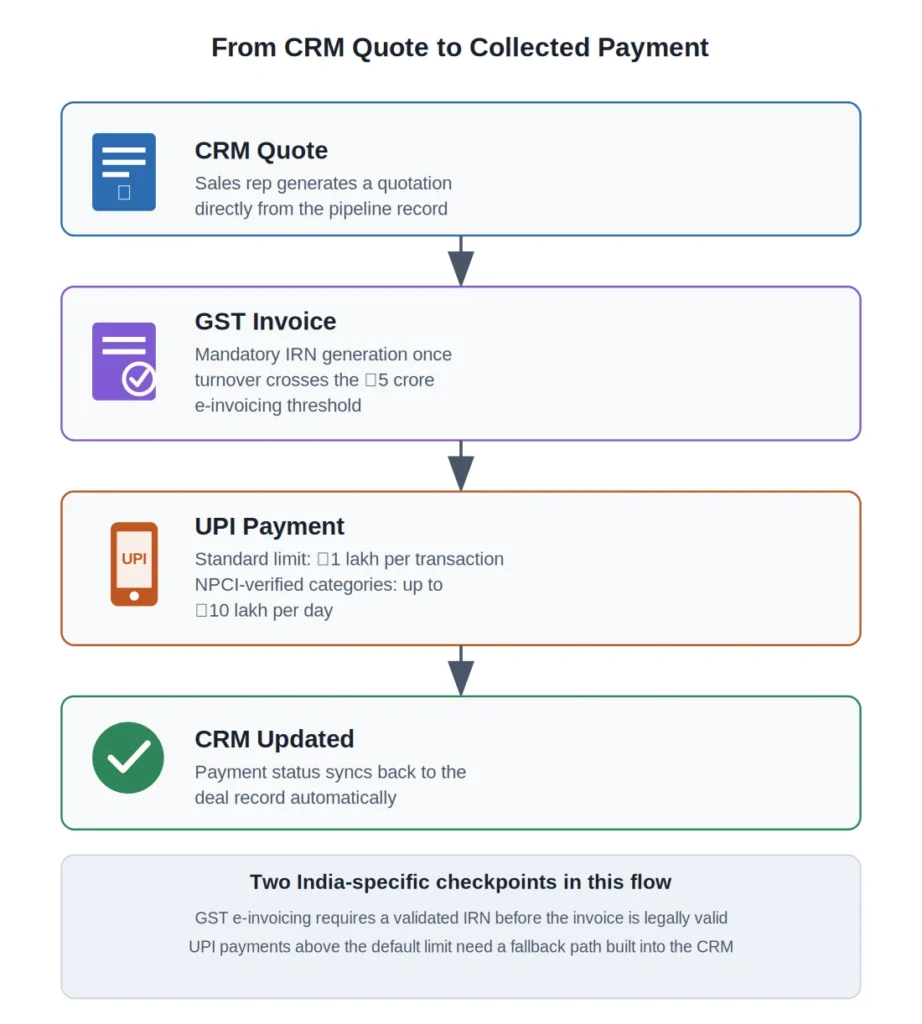
Building this into the CRM from the start, rather than bolting it on later, is meaningfully cheaper. Retrofitting IRN generation into an existing quotation module usually means reworking the data model that quotes and invoices already depend on.
This is also where the ₹5 crore threshold catches growing businesses off guard. A business that built its CRM’s invoicing module when it was well under the threshold often has to revisit that same module a year or two later once turnover crosses it, which is a predictable cost if it’s planned for and an unplanned one if it isn’t.
A CRM quotation module that ends in a UPI payment link needs to account for actual transaction limits rather than assuming every payment can be completed through a single UPI request. Standard UPI merchant payments are generally subject to a default limit of ₹1 lakh per transaction, while the NPCI-approved higher limit of up to ₹10 lakh per transaction applies only to specified merchant categories approved by NPCI.
A B2B quotation for a large order can easily exceed the default limit, so the CRM’s payment workflow should support fallback options such as partial payments, bank transfers, or eligibility for a higher-limit merchant category instead of assuming every quote will be settled through a single UPI link. UPI integration itself typically adds ₹50,000 to ₹1.5 lakh to a CRM project, depending on the complexity of the payment workflow. In practice, the architecture required to handle transaction limits, retries, reconciliation, and alternate payment paths often drives more effort than the integration itself.
Reviewing these scenarios early, alongside broader payment gateway security practices, helps ensure the payment flow remains reliable even for high-value transactions.
Annual maintenance is one of the most commonly underestimated line items, typically running 15–20% of the original build cost for bug fixes, security patches, software updates, and minor enhancements. A ₹10 lakh CRM, for example, may require ₹1.5–2 lakh annually to remain secure, reliable, and aligned with changing business needs, even though this expense is often overlooked during initial budgeting.
Validating requirements with MVP development cost benchmarks before committing to a full CRM build is a practical way to confirm that the core sales workflow delivers value before investing in advanced integrations and custom features.
Let Zethic help you build smarter Not just faster
Annual maintenance, typically 15-20% of the original build cost, is the line item businesses most consistently leave out of their initial budget.
Ram brings deep expertise in product strategy and system architecture across fintech, SaaS, and AI platforms. He specializes in pre-execution planning to help teams build scalable technology foundations and avoid costly rebuilds.

Adding {{itemName}} to cart
Added {{itemName}} to cart