


Start Your Project Today
Tell us about your project — we’ll get back within 24 hours

Founder
User Interface Design
SaaS development covers building a product that customers access as a subscription rather than something they install and own outright. That distinction adds real cost: multi-tenancy to keep each customer’s data isolated, subscription-billing logic, and ongoing hosting that must scale as customers sign up.
A one-off custom application can often skip these requirements entirely. A SaaS product cannot, which is why comparing SaaS development costs directly to a generic app quote tends to understate the actual cost.
The subscription model itself adds cost too. Supporting trials, plan upgrades and downgrades, failed-payment retries, and prorated billing all require dedicated engineering work that a one-time-purchase app never has to build, work that often gets missed in an early back-of-envelope estimate.
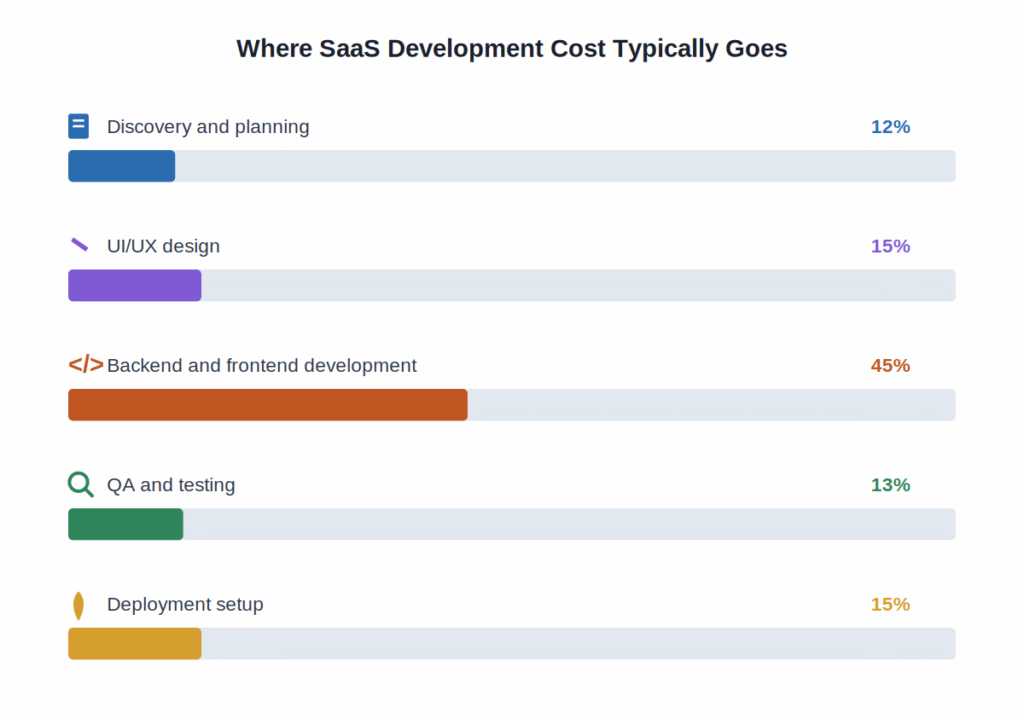
Skipping or compressing the discovery phase is where most budgets go wrong first. A rushed discovery phase produces an unclear requirement document, and unclear requirements are what turn a fixed-scope quote into a moving target once development starts.
QA and deployment carry more weight than most founders expect too. A product that looks finished after development still needs real testing across edge cases, load conditions, and security checks before it can carry paying customers, and deployment itself involves more than pushing code live, covering environment setup, monitoring, and a rollback plan if something breaks.
Feature complexity is the most visible driver: a basic SaaS with login, storage, and a dashboard costs a fraction of one with real-time analytics, AI features, or complex third-party integrations. Compliance requirements add a second, less visible layer, since GDPR, HIPAA, or India’s Digital Personal Data Protection Rules each touch authentication, data storage, and audit logging in ways that extend both timeline and cost.
Team structure is the third major driver. An in-house team carries fixed overhead whether fully utilized or not, while a software development partner scales cost with actual project needs, which is usually the more predictable choice for a team still validating product-market fit.
India-based development typically costs a fraction of US or Western European rates for comparable work, without necessarily compromising on quality, since India’s software talent pool serves clients across every major market already. A custom software development company in Bangalore is often the natural starting point for scoping this, given the concentration of SaaS engineering talent in that market. The table below breaks down typical cost by product tier, in both USD and India-grounded ₹ figures.
| Tier | Typical USD range | Typical India (₹) range | Timeline |
|---|---|---|---|
| Simple MVP | $20,000 – $60,000 | ₹15 lakh – ₹45 lakh | 6-12 weeks |
| Mid-complexity product | $60,000 – $150,000 | ₹45 lakh – ₹1.1 crore | 3-6 months |
| Complex or compliance-heavy platform | $150,000 – $500,000+ | ₹1.1 crore – ₹3.7 crore+ | 6-18 months |
India-specific note: these ₹ figures are grounded in typical Indian development team rates (roughly ₹1,500-₹4,000 per hour for a mid-to-senior engineering team as of 2026) rather than a straight USD-to-INR conversion, since labor cost is the primary driver behind the gap, not currency alone.
None of the tiers above fully price in one specific compliance layer that only applies to Indian customers: how a SaaS product actually processes recurring payments.
Any SaaS product billing Indian customers regularly has to build around RBI’s e-mandate framework, not around a generic subscription-billing library built for a different market. The framework requires a one-time authenticated mandate registration, a pre-transaction notification at least 24 hours before every debit, and specific transaction limits before additional authentication is required.
This adds genuine engineering scope beyond what a US-market SaaS billing system needs: mandate registration flows, a notification scheduling system, and opt-out handling all become part of the core build rather than an afterthought bolted on post-launch. This is the same regulatory groundwork that shapes building a payment gateway in India, since both share the same underlying RBI compliance layer. Budgeting for this from the start keeps a SaaS billing system compliant without a costly retrofit once Indian customers are already on the platform.
Maintenance is the cost most founders underbudget, typically running 15-25% of the original build cost annually for security patches, bug fixes, and infrastructure scaling as user numbers grow. Cloud infrastructure itself starts modestly but scales with traffic, which is worth modeling into a 12-month financial plan rather than treating as a fixed line item.
For an Indian founder validating cost with MVP development cost benchmarks first, layering in these ongoing costs before committing to a full build tends to produce a far more realistic financial model than pricing the initial build alone.
Let Zethic help you build smarter Not just faster
Ram brings deep expertise in product strategy and system architecture across fintech, SaaS, and AI platforms. He specializes in pre-execution planning to help teams build scalable technology foundations and avoid costly rebuilds.

Adding {{itemName}} to cart
Added {{itemName}} to cart