


Start Your Project Today
Tell us about your project — we’ll get back within 24 hours

Founder
User Interface Design
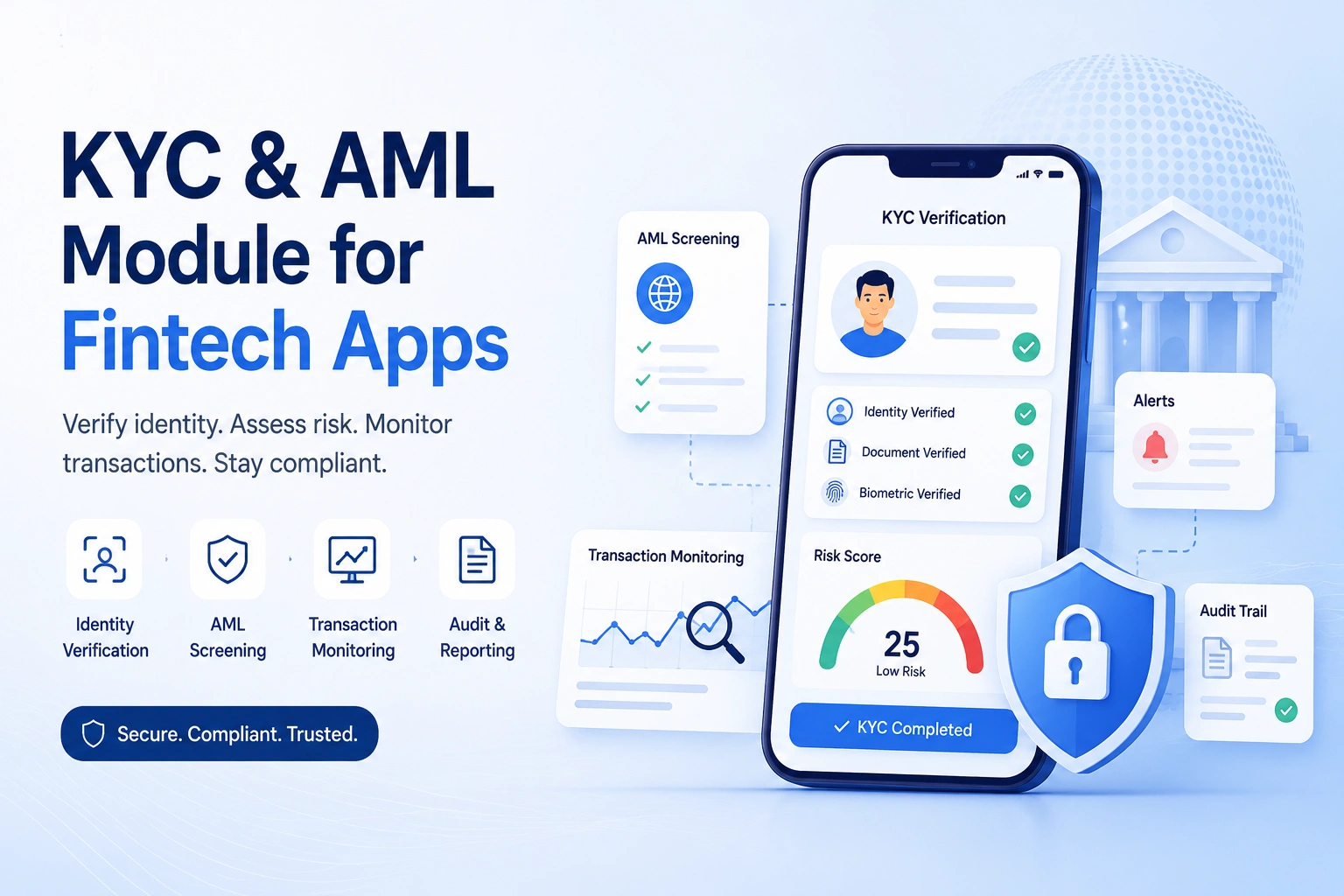
Global AML, KYC, and sanctions penalties totalled $3.8 billion in 2025, down 18% year-on-year but still representing sustained enforcement pressure across every institution type. Digital asset firms and money transmitters accounted for the largest share of fines, with regulators consistently citing weak KYC in fintech onboarding as the root cause rather than transaction-layer failures. For any product that touches user identity or money movement, KYC in fintech is a product engineering decision with direct regulatory consequences.
KYC in fintech verifies a user’s identity at onboarding and assesses the risk they bring to the platform. AML monitors transactions across the user lifecycle to detect suspicious patterns. A well-built module treats both as one system with shared data, scoring, and audit trails.
The three core functions are:
Most major AML fines in 2025 traced back to inadequate identity verification at onboarding, not transaction-layer failures. Compliance architecture is now a core part of fintech app development, not a layer bolted on before launch.
Five components, treated as connected services that share a common risk engine:
The risk score at onboarding must directly inform transaction monitoring thresholds. Otherwise, the module flags too much or too little, which is also where KYC architecture intersects with payment gateway software development services, since fraud rules and transaction routing share the same risk signals.
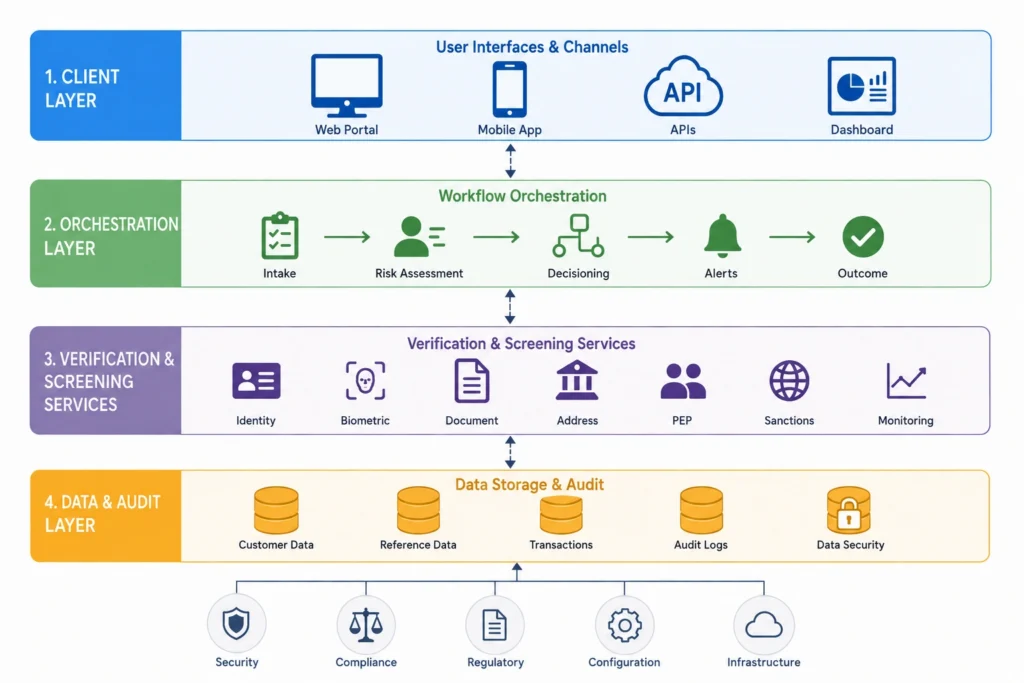
Four layers:
The orchestration layer is where a custom build earns its value. Vendors handle individual checks well; combining their outputs into one coherent decision is where the product differentiates. The KYC module also sits next to the payment stack; the same architectural discipline that underpins payment gateway security applies to how identity data flows through the verification layer.
| Component | Build or Integrate | Reason |
|---|---|---|
| Document verification (OCR, authenticity) | Integrate (Digio, Onfido, Sumsub, AuthBridge) | Vendor maintains templates across 200+ countries |
| Face match and liveness detection | Integrate | Specialist models; vendor handles deepfake updates |
| AML screening (sanctions, PEP, adverse media) | Integrate (ComplyAdvantage, Refinitiv, Dow Jones) | Watchlists update daily; data licensing is the cost |
| Aadhaar eKYC and DigiLocker (India) | Integrate via licensed KUA/AUA partner | UIDAI access requires direct licensing |
| Risk scoring engine | Build | Your scoring logic on your data is the differentiator |
| Transaction monitoring rules | Build base rules, integrate ML detection | Custom rules reflect your product’s risk profile |
| Case management workflow | Build | Investigator UX and escalation are operational IP |
| FIU-IND reporting (goAML) | Build the integration | Standardised format; one-time work |
The principle: integrate where data, certification, or scale are the value. Build where the logic and workflow are the product, the same boundary line that defines custom fintech app development across the rest of the product stack.
RBI replaced the 2016 KYC Master Direction with a new sector-specific framework on 28 November 2025, consolidating roughly 3,500 directions into 238 Master Directions across 10 institution types, including commercial banks, NBFCs, and payment banks.
Three rules carry the most engineering weight:
PMLA (2002) remains the parent legislation. Records must be retained for at least five years, and suspicious transactions must be reported to FIU-IND. V-CIP, tiered KYC, and document upload flows all sit in front of the user, which is why onboarding UX in a regulated product is now a working concern for any fintech design agency and not just an engineering question.
Perpetual KYC replaces fixed re-verification intervals with continuous monitoring that triggers re-verification only when signals change.
Three patterns:
This satisfies the continuous monitoring expectation in the RBI 2025 framework and the FATF risk-based approach guidance that underpins it. Continuous compliance built into the product layer is now one of the defining requirements of regulated fintech software development.
Engineering cost-only vendor API fees scale with verification volume separately.
| Scope | Cost (Rs) | Cost ($) | Timeline |
|---|---|---|---|
| Basic KYC (identity verification + AML screening, single jurisdiction) | Rs 15 to 30 lakh | $20,000 to $40,000 | 8 to 12 weeks |
| Full module (identity + AML + risk scoring + transaction monitoring) | Rs 35 to 70 lakh | $50,000 to $100,000 | 14 to 20 weeks |
| Enterprise (multi-jurisdiction, perpetual KYC, FIU reporting, case management) | Rs 70 lakh to 1.5 crore | $100,000 to $250,000+ | 22 to 36 weeks |
Vendor API fees run Rs 30 to Rs 100 per verification at low volumes, dropping to Rs 10 to Rs 30 at higher volumes. At 10,000 verifications per month, vendor fees can add Rs 3 to Rs 10 lakh monthly to operating costs. Vendor API spend is one line in a wider picture of hidden costs in fintech app development that most cost models miss until year two.
A KYC and AML module is one of the few parts of a fintech product where the cost of getting it wrong is much higher than the cost of building it well from the start. The components, data flows, and integration choices made at the architecture stage determine how cryptocurrency exchange software handles its first audit, its first volume spike, and its first cross-border expansion.
Teams that get this right treat the KYC and AML module as a product decision with its own roadmap, not a compliance task to ship before launch. The vendor choices for document verification, the design of the risk scoring engine, and the way ongoing monitoring connects to transaction flows are all decisions worth making with the full context of where the product is going. That is the kind of fintech product engineering work Zethic is built around. or banks and regulated institutions specifically, this falls under our dedicated banking software development services.
For fintechs outside the banking-specific track, this same architecture-first approach is available through Zethic’s fintech software development in Bangalore practice, covering KYC, AML, and the risk-scoring layer as one connected system rather than a set of separate vendor integrations.
Zethic Technologies is a trusted Web & Mobile App Development Company providing Custom Software Development Services to startups and growing businesses. We combine planning, development, and long-term thinking to deliver stable digital products.
Let Zethic help you build smarter Not just faster
KYC verifies who a customer is at onboarding. AML monitors what they do afterwards. KYC is one input into the broader AML programme.
Basic verification: 8 to 12 weeks. Full module with risk scoring and transaction monitoring: 14 to 20 weeks. Enterprise builds with multi-jurisdiction support: 22 to 36 weeks.
Yes, through a licensed KUA or AUA partnership. RBI has clarified that Aadhaar is not mandatory, so the module must support alternative documents alongside Aadhaar eKYC.
A hybrid usually works best: integrate vendor APIs for document verification, AML screening, and biometrics, then build the risk scoring engine, transaction rules, and case management in-house.
Ram brings deep expertise in product strategy and system architecture across fintech, SaaS, and AI platforms. He specializes in pre-execution planning to help teams build scalable technology foundations and avoid costly rebuilds.

Adding {{itemName}} to cart
Added {{itemName}} to cart