


Start Your Project Today
Tell us about your project — we’ll get back within 24 hours

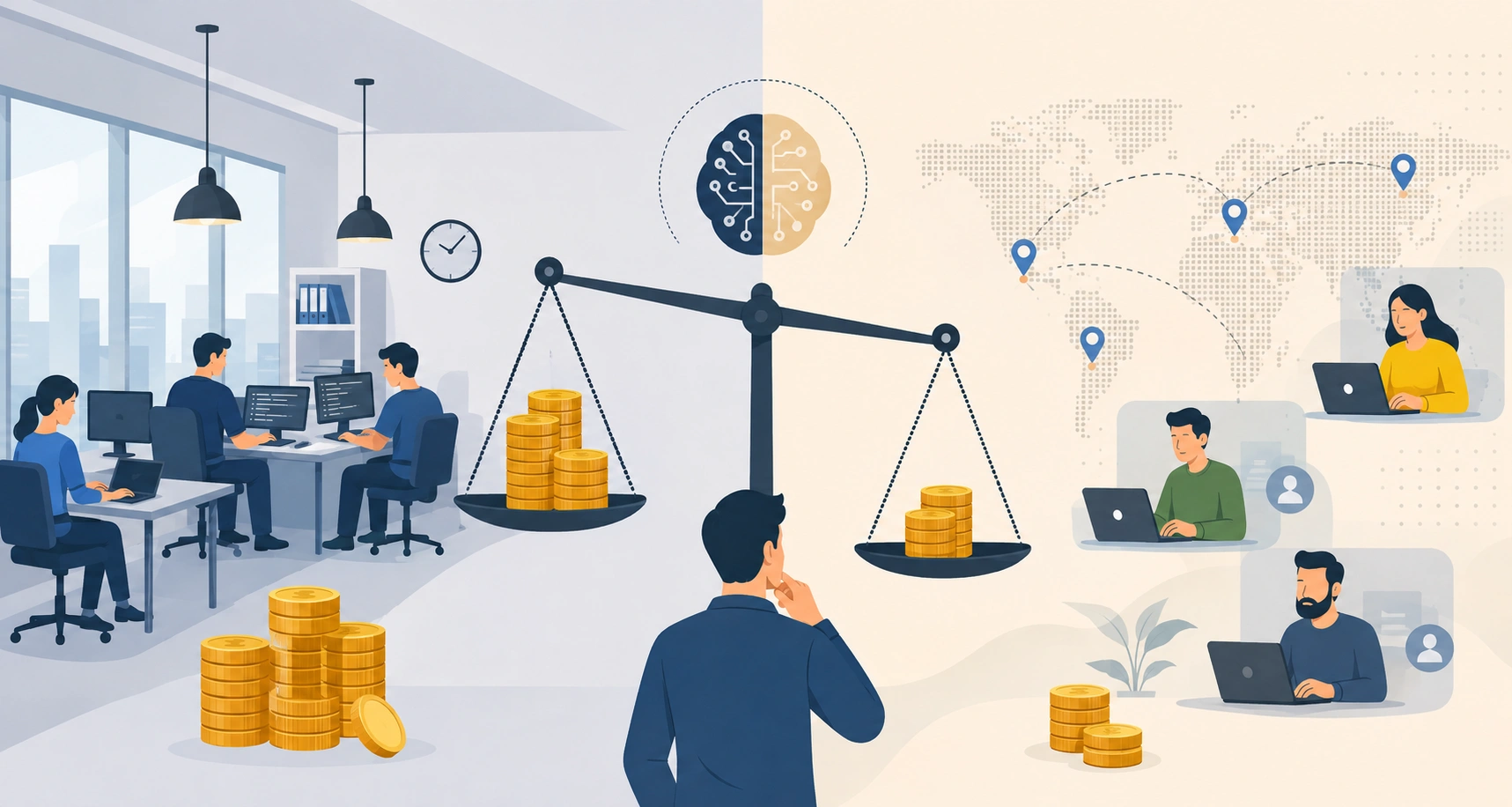
Every CTO evaluating AI eventually faces a critical choice: build an in-house AI team, or bring in outside specialists to move faster. The decision between in-house vs outsourced AI development in India changes depending on your budget, data sensitivity, and how central AI actually is to your product. Here is what each path really costs, backed by real numbers instead of global averages.
In-house AI development means employing full-time engineers, data scientists, and ML specialists who work only for your company, using your own infrastructure and reporting directly to your leadership. Outsourced AI development means engaging an external team, typically a specialized development company, to design, train, and deploy AI models on a project or retainer basis, similar to how businesses may use supplier lifecycle management software for specialized supplier operations.
Both paths can produce the same working AI model. What differs is who owns the development process, how the cost is structured, and how fast you can actually start building. Understanding the trade-offs between in-house vs outsourced AI development requires looking beyond just price.
Neither model is inherently better. A fintech company building its own fraud detection engine has very different needs than a logistics business that wants a one-time route planning tool. The right choice depends on how often you need AI work done, not just how much the first project costs.
Most businesses treat the in-house vs outsourced AI development decision as a pure cost comparison and miss the timeline and ownership risks underneath it. A slow internal hire can cost an entire product cycle before a single model reaches production, a risk that grows as India’s AI talent demand-supply gap widens, and a rushed outsourcing choice can leave a company dependent on a vendor that never fully understands the product.
The most common mistakes when evaluating in-house vs outsourced AI options are:
India remains one of the most competitively priced markets for AI talent, whether you hire directly or partner with a development company. When comparing AI development costs in India across models, the numbers vary significantly by experience level and specialization. Mid-level AI/ML engineers in India typically earn between ₹12 lakh and ₹20 lakh per year, while senior engineers with 7 or more years of experience earn ₹25 lakh to ₹50 lakh per year.
| Cost Component | In-House (Annual) | Outsourced (Project-Based) |
| Mid-level AI/ML engineer | ₹12L to ₹20L per year | Not applicable |
| Senior AI/ML engineer | ₹25L to ₹50L per year | Not applicable |
| Basic chatbot or NLP tool | Not applicable | ₹3L to ₹10L per project |
| Custom ML model (fraud detection, recommendation engine) | Not applicable | ₹15L to ₹25L per project |
| Infrastructure and cloud | Billed separately, scales with usage | Often bundled into project fee |
| Typical time to first deployment | Several months, including hiring and onboarding | Several weeks once scope is confirmed |
The difference grows when you factor in specialization. Generative AI and LLM engineers typically earn 25 to 40 percent more than generalist ML profiles at the same experience level, which pushes in-house AI development costs even higher for the exact skills most businesses need right now. This is why the in-house vs outsourced AI development comparison often favors outsourcing for short-term projects.
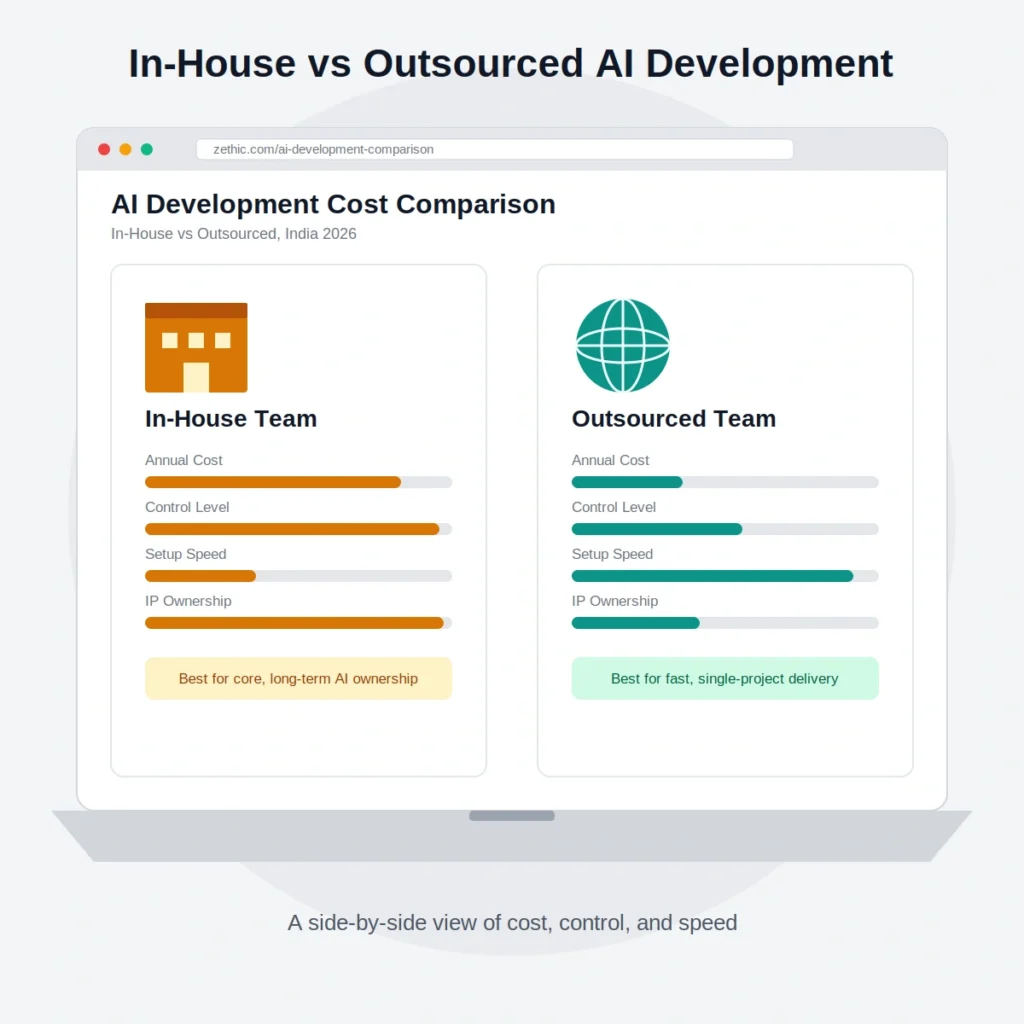
The right choice between in-house and outsourced AI development depends less on price and more on how central AI is to what you sell. A strategic evaluation helps settle the ambiguity. Start by asking yourself whether your AI project is a one-time AI application development effort or a permanent, recurring function.
A hybrid approach to in-house vs outsourced AI development keeps a small internal team responsible for architecture, data governance, and product direction, while an external partner handles execution and scaling work. This setup is becoming more common because it captures much of the cost advantage of outsourcing AI development without giving up strategic control.
It works best when a company has enough recurring AI work to justify one or two internal specialists, but not enough yet to justify a full team from day one. Many businesses that eventually build a full in-house function start this way. The internal hire owns direction and quality standards, the external partner absorbs the workload spikes, and the internal team grows only once there is a clear, sustained case for expanding in-house AI capacity.
Cost is not the only risk to weigh. The bigger risk is choosing a partner or hire that cannot execute once the contract or offer letter is signed, and that risk applies regardless of which model you choose in your in-house vs outsourced AI development decision.
Most businesses do not need a permanent AI department on day one. They need a working model, a clear cost picture, and a partner who can hand over ownership once the time is right. When deciding between in-house vs outsourced AI development, many companies benefit from starting with external execution while building in-house AI functions in parallel.
Zethic works with founders and CTOs across fintech, logistics, and software services to scope AI projects around clear, India-specific pricing, and every project is structured so a business can bring the work in-house later without rebuilding what has already been done.
Ram brings deep expertise in product strategy and system architecture across fintech, SaaS, and AI platforms. He specializes in pre-execution planning to help teams build scalable technology foundations and avoid costly rebuilds.
