


Start Your Project Today
Tell us about your project — we’ll get back within 24 hours


Most companies start their AI roadmap by picking the biggest model they can access, then discover the monthly bill has little to do with how much value that model is actually creating. The real decision was never about raw model size; it was about matching the size of the model to the size of the job. The LLM vs SLM for business decision in India comes down to workload, compliance, and cost, not which model sounds more impressive in a pitch deck.
A large language model is trained on broad, general-purpose data and can handle almost any language task a business throws at it, from drafting contracts to answering unfamiliar customer questions. A small language model is trained on a narrower dataset and tuned for a specific job, trading general knowledge for speed, lower cost, and the ability to run on modest hardware. Parameter count is the rough proxy for this difference: LLMs commonly run into tens or hundreds of billions of parameters, while SLMs typically stay under 10 billion, and sizing that tradeoff correctly is usually the first thing artificial intelligence servicesproviders walk a business through.
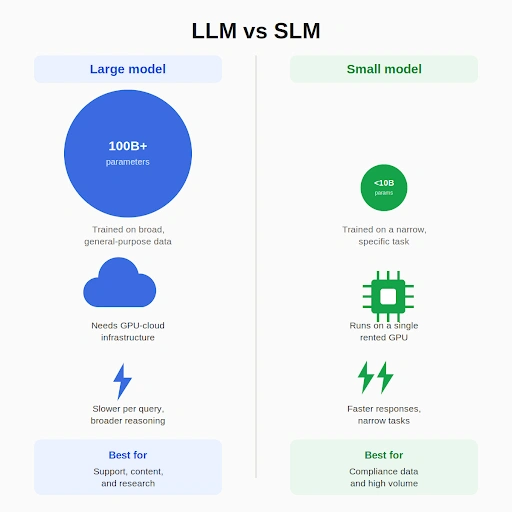
That size gap shows up operationally, not just on a spec sheet. An LLM’s parameter count means it needs specialized GPU infrastructure to run at all, which is why most businesses access it through an API rather than hosting it themselves. An SLM’s smaller footprint means it can run on a single rented GPU or even modest on-premises hardware, which is what makes self-hosting a realistic option in the first place, and it’s the same infrastructure tradeoff a custom software development company in Bangalore weighs before recommending either approach.
The decision carries more weight in India than the parameter-count debate suggests, because data handling rules change which option is even available. The DPDP Act permits personal data to leave India by default, using a negative list that only restricts specific countries the government names. Sector regulators set their own rules on top of this: the RBI’s payment data localization circular keeps payment transaction data on servers inside India, independent of what the DPDP Act’s general allowance covers.
For a lending platform or a payments company, that single rule can settle the LLM vs SLM for business question well before cost enters the conversation, since a self-hosted SLM may be the only option that keeps regulated data on Indian infrastructure. Lending platforms and payments companies typically have this decision made for them before development starts.
These rules will keep shifting too. India’s data protection rules are still being operationalized through the DPDP Rules, and sector regulators add new circulars on their own timelines. A business that plans its LLM vs SLM for business decisions only against today’s rules risks rebuilding its architecture the moment a regulator tightens a requirement, so it is worth checking which category a workload falls into before committing to either path.
Cost only becomes a real decision variable once compliance clears both paths, and here the two diverge sharply. An LLM accessed through an API charges per token with no infrastructure to manage; LLM development cost in India for a straightforward integration typically starts near ₹3 lakh, scaling with usage from there. A self-hosted SLM instead carries a fixed monthly infrastructure bill on Indian GPU cloud capacity, and fine-tuning a smaller model to add domain accuracy stays comparatively inexpensive.
| Approach | Setup | Cost in India | Best Suited For |
| LLM via API | No infrastructure, billed per token | Starts near ₹3 lakh for initial integration; breakeven versus self-hosting typically falls near 10 million tokens a month | Low-to-moderate volume, fast launch, broad reasoning tasks |
| Self-hosted SLM | Rented GPU capacity on Indian cloud infrastructure | Roughly ₹35,000 to ₹2.6 lakh a month, depending on GPU class, running continuously | High-volume, latency-sensitive, or compliance-bound workloads |
| Fine-tuned SLM | One-time LoRA fine-tuning on rented compute | ₹800 to ₹25,000 in compute for models under 8 billion parameters | Domain-specific accuracy on a narrow task |
These figures are not one-time costs either. Ongoing costs after launch, covering monitoring, retraining, and infrastructure upkeep, typically run 15 to 25 percent of the initial build cost every year, regardless of which path a business picks. That ongoing bill is why the workload’s expected volume matters more than the sticker price of getting started.
The cost table only tells half the story for any LLM vs SLM for business decisions, because the function a model is doing matters as much as the price per query. A workload that runs the same few thousand queries a day looks completely different from one that spikes unpredictably or needs judgment calls a narrow model was never trained to make. A support chatbot or sales automation software is a clear example of this, since the cost of running one shifts considerably depending on whether it calls an LLM API for every message or leans on a self-hosted SLM for routine ones.
Most production systems in 2026 do not settle the LLM vs SLM debate for business questions by picking one exclusively. They route work between the two instead. A common pattern sends the bulk of predictable, high-volume requests to a self-hosted SLM and escalates only the queries that need wider reasoning or unfamiliar context to an LLM.
This hybrid setup keeps the SLM’s fixed infrastructure busy enough to justify its monthly cost, while reserving the pricier LLM calls for the smaller share of requests that need them. It also gives a business a way to start with one model and add the other later, rather than committing to a single architecture upfront.
A retail support desk, for instance, might route order-status and return questions to a self-hosted SLM trained on that company’s own policies, then hand off anything unusual, like a multi-order dispute or a question in an uncommon language, to an LLM. Neither model has to be perfect at everything, which is why the pairing works better than forcing one model to cover the whole range of requests. Some businesses combine this model-size decision with retrieval-augmented generation, which extends whichever model handles a request with the business’s own external data instead of relying on training data alone.
The right choice rarely comes down to picking a side in the LLM vs SLM for business debate. It comes down to mapping each workload to whichever model handles it at the lowest cost without crossing a compliance boundary. A business holding fintech-grade data usually starts the conversation with self-hosting constraints already fixed, while a general customer support function has more room to weigh API cost against control.
Zethic works with founders and CTOs across fintech, logistics, and software businesses to run this workload-by-workload assessment before any infrastructure gets built, scoping which functions justify a self-hosted SLM, which are better served by an LLM API, and where a hybrid setup pays for itself, and Zethic builds the resulting architecture around data the business already controls.
Ram brings deep expertise in product strategy and system architecture across fintech, SaaS, and AI platforms. He specializes in pre-execution planning to help teams build scalable technology foundations and avoid costly rebuilds.
