


Start Your Project Today
Tell us about your project — we’ll get back within 24 hours

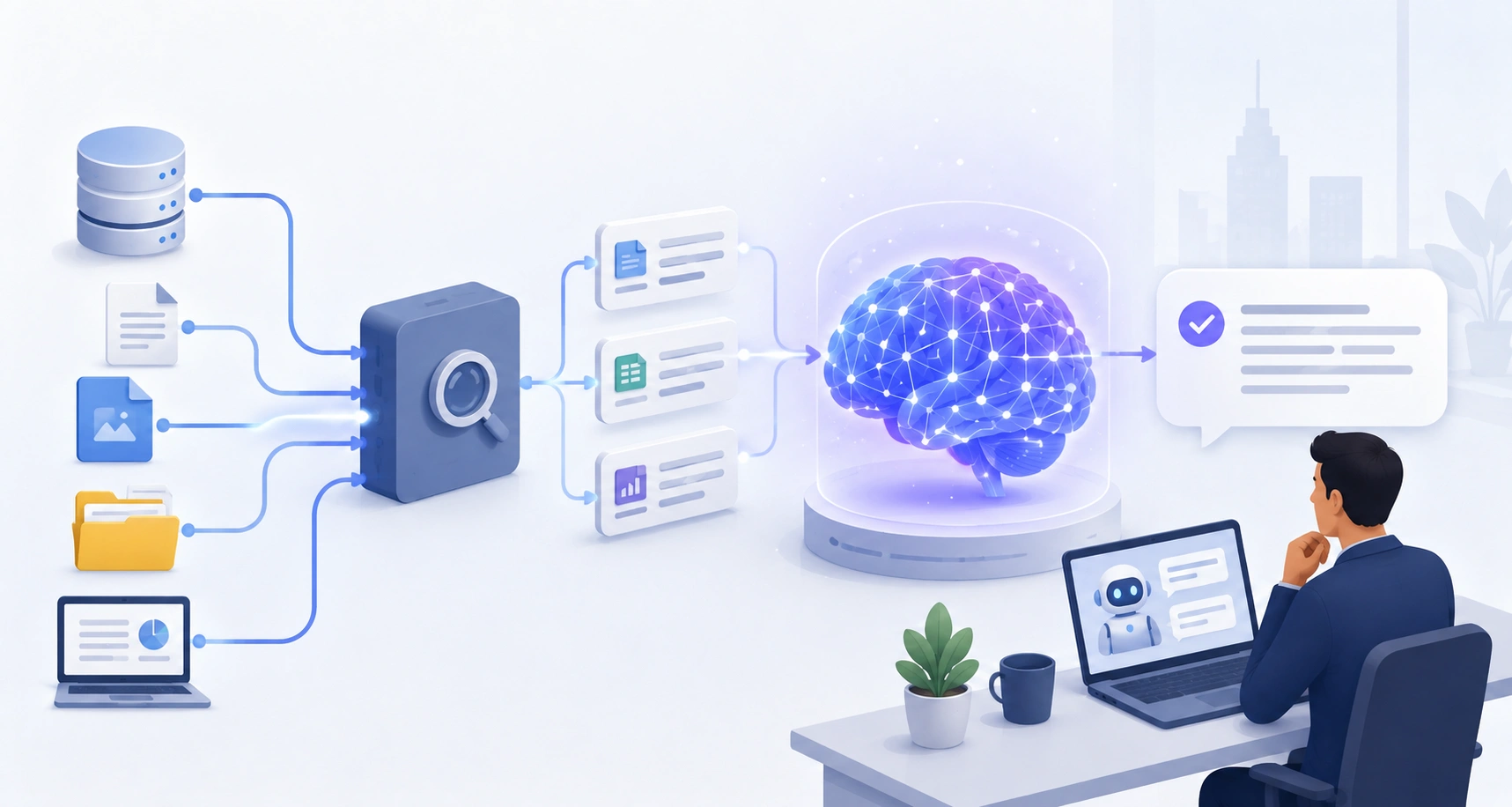
A support team asks an AI assistant about a policy that changed last week, and it confidently answers with the old policy instead. This is the core limitation that retrieval-augmented generation exists to solve: language models only know what they were trained on, and that training data eventually goes stale. Here is what retrieval-augmented generation actually is, how it works, and when it makes more sense than the alternatives.
Retrieval-augmented generation, or RAG, connects a language model to an external source of information when a question is asked, rather than relying only on what the model learned during training. Instead of answering purely from memory, the model first retrieves relevant material from a document set, then uses that material to generate its response.
This distinction matters because a language model’s training data has a cutoff date and cannot be updated without retraining the entire model. Retrieval-augmented generation sidesteps that limitation entirely by keeping the knowledge outside the model, in a document store that can be updated any time without touching the model itself, one of a few distinct paths that shape LLM development cost in India depending on which approach a business picks.
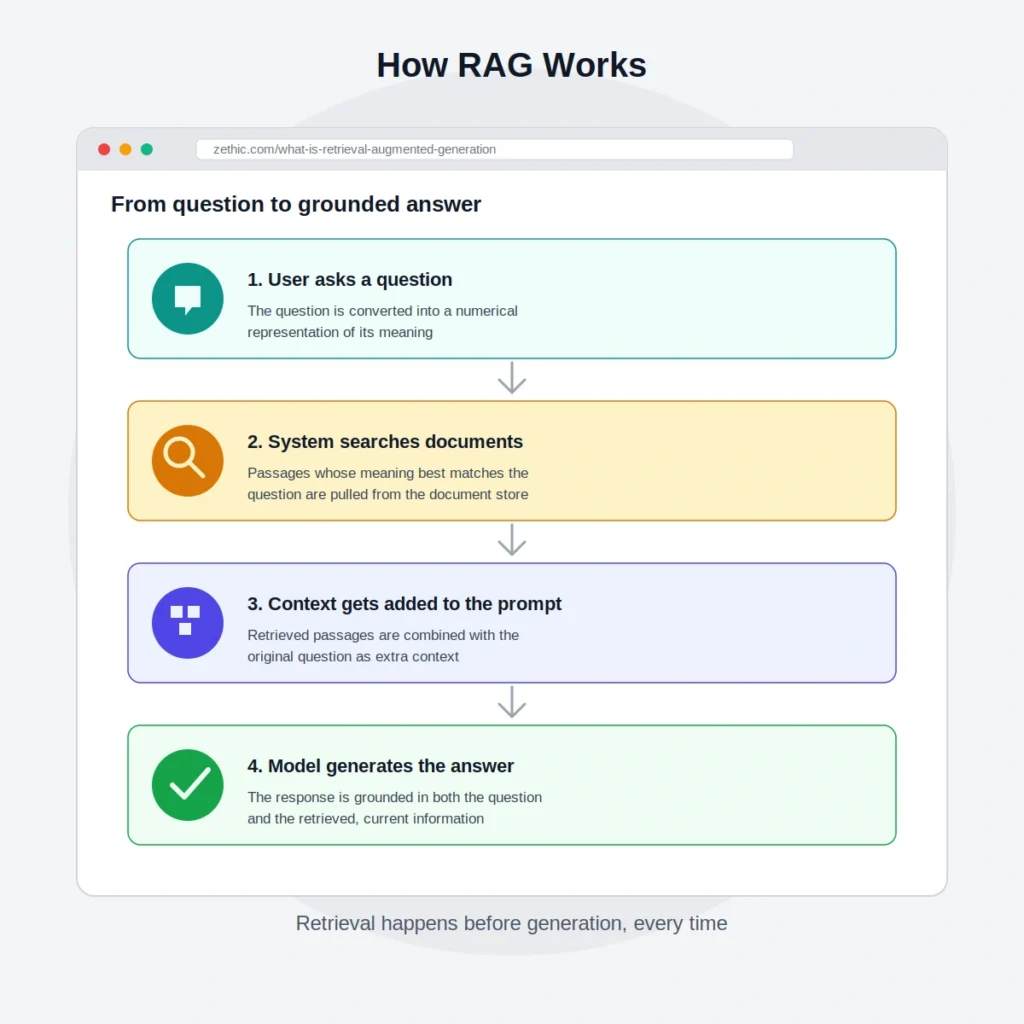
Retrieval-augmented generation follows a consistent pattern regardless of which model or document store sits underneath it. A user’s question triggers a retrieval step before the model ever generates a response, and that ordering is what makes the whole approach work.
A standalone language model can only draw on what it learned during training, so it has no access to a company’s internal documents, recent updates, or anything published after its training cutoff. Retrieval-augmented generation fixes this without the cost or delay of retraining a model every time something changes.
Retrieval-augmented generation and fine-tuning solve different problems, even though both get raised in the same conversation about customizing a language model for a business. Confusing the two is one of the most common mistakes businesses make when budgeting generative AI development costs in India, since the two approaches sit in genuinely different parts of a project.
| Factor | RAG | Fine-Tuning |
| What it changes | What information the model can access | How the model behaves or responds |
| Best for | Facts and data that change often | Consistent tone, format, or domain vocabulary |
| Setup speed | Faster, no retraining required | Slower, requires a training run |
| Keeping data current | Update the document store any time | Requires retraining to reflect new information |
| Data exposure | Documents stay in a separate store | Data becomes part of the model’s training |
Retrieval-augmented generation is not a universal fix, and businesses that treat it as one often end up disappointed by results that seemed easy on paper; the same lesson a software development company sees repeated across most AI-adjacent projects, not just RAG. Its value depends heavily on how well the retrieval half of the system actually works.
For fintech, healthcare, and other regulated businesses in India, retrieval-augmented generation offers a specific advantage beyond accuracy: sensitive data stays inside a business’s own document store rather than becoming part of a model’s training data. This distinction matters directly under the DPDP Act, where how personal data is processed and where it resides carries real compliance weight.
A retrieval setup that keeps documents on infrastructure within India, with clear audit logs of what was retrieved for each response, gives a compliance team something concrete to review. That is a meaningfully different conversation than trying to audit what a fine-tuned model may have absorbed from training data it can no longer show you directly.
Most businesses do not need to choose between RAG and fine-tuning in the abstract. They need a working system scoped against their actual data, their actual compliance requirements, and how often that data actually changes.
Zethic works with founders and CTOs across fintech, logistics, and software services to assess whether retrieval-augmented generation, fine-tuning, or a hybrid of both fits a specific use case, and builds the retrieval pipeline around data that a business can control and audit directly.
Ram brings deep expertise in product strategy and system architecture across fintech, SaaS, and AI platforms. He specializes in pre-execution planning to help teams build scalable technology foundations and avoid costly rebuilds.
