
Skip links

PWA vs Native App: Which Should You Build First?

Picture of By Ram Nethaji

By Ram Nethaji

Founder

FinTech app development cost

User Interface Design

Custom software development

FinTech app development services

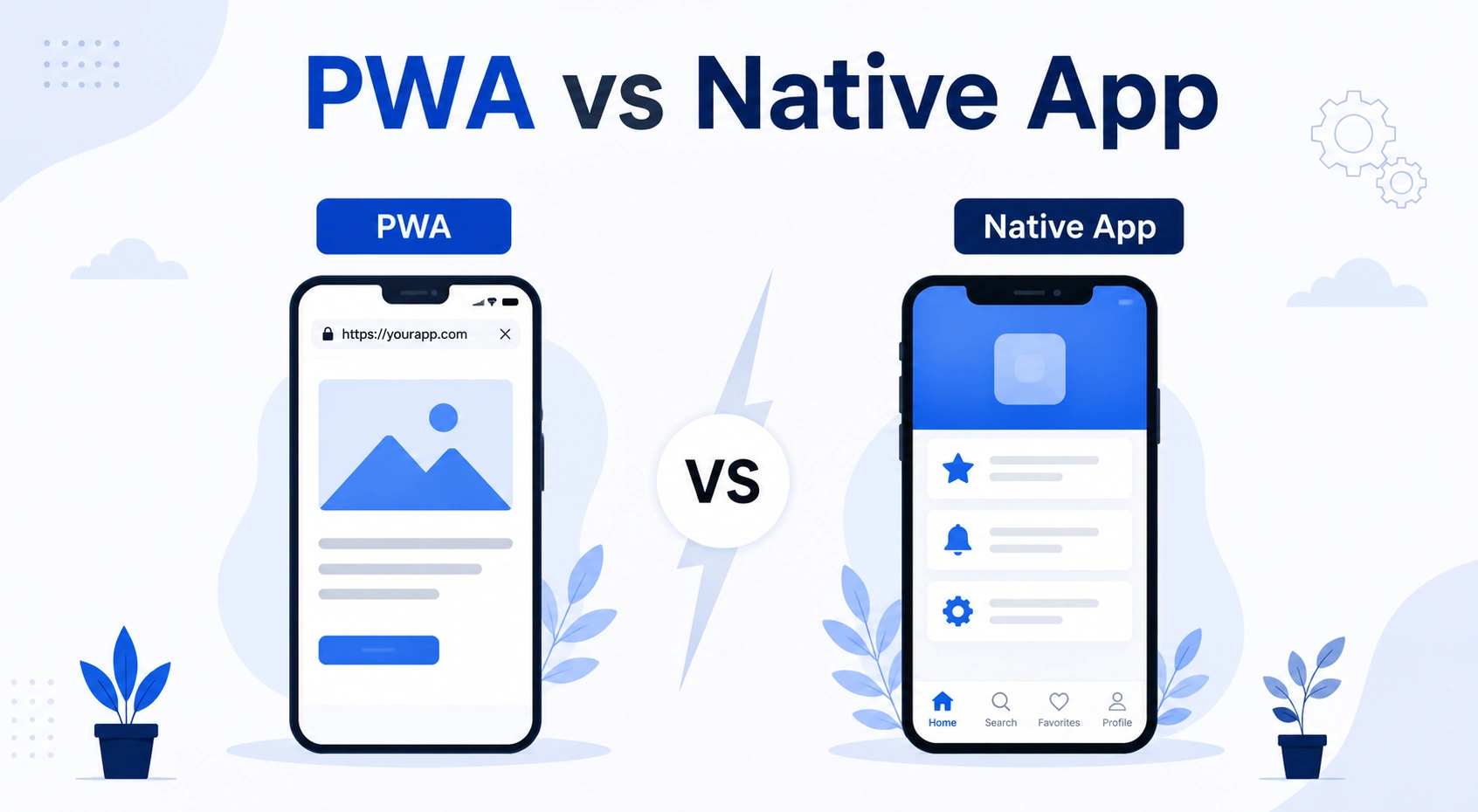
PWA vs native app
A PWA is usually the faster and cheaper starting point, since it runs from one codebase across every device with a browser. A native app becomes the better choice once you need deep hardware access, app store presence, or performance a browser cannot match. The right first move in the PWA vs native app decision depends on your budget, timeline, and how central mobile experience is to your product. Many businesses end up building both at different stages.

What Is a PWA vs a Native App?

A progressive web app is a specific kind of web application development built with standard web technology that adds app-like behavior through service workers, offline caching, and a home screen icon. It runs inside a browser engine, so one build works across Android, iOS, and desktop without separate codebases. Users can open it directly from a shared link, with no install step required before first use.

A native app is built in the specific language of its platform, such as Kotlin for Android or Swift for iOS, and is distributed through the app store for that platform. This gives it full access to device hardware and the performance ceiling of the operating system itself, at the cost of maintaining a separate build for each platform. Every update also passes through app store review before it reaches users.

The PWA vs native app choice is rarely permanent. Many products start on one path and add the other once specific needs, such as hardware access or app store visibility, become clear enough to justify the investment.

What Are the Real Trade-Offs Between the Two?

Neither option wins across every factor in the PWA vs native app comparison. Each is a better fit depending on what your business needs most right now, and the right answer changes as your product grows.
  • Development cost: One shared codebase for a PWA versus separate builds for each native platform
  • Distribution: Instant access through a URL versus discovery through an app store listing, a channel that has come under gatekeeper obligations for major platforms under EU digital regulation
  • Device access: Browser-level permissions for a PWA versus full hardware access for native
  • Performance: Strong for most business apps, though native still leads for graphics-heavy or real-time work
  • Search visibility: PWAs are indexed by search engines, while native apps depend on app store search
  • Update speed: PWA updates push instantly from the server, while native updates go through app store review, a difference that shapes mobile app development timelines more than most teams expect
None of these trade-offs make one option universally better. They simply point toward which approach fits a specific product at a specific stage.

What Can't a PWA Do on iOS Today?

Apple’s Safari has expanded PWA support over the past few years, but real gaps remain that matter for planning. These limits are specific to iOS rather than PWAs generally, since Android’s browser support is more complete, and they are worth checking against your specific feature list before committing to either path.

  • No Background Sync API, so data cannot sync automatically once the app is closed
  • Storage can be cleared by the system after extended periods of inactivity
  • No access to Bluetooth or NFC hardware
  • Push notifications became available only in newer iOS versions for apps added to the Home Screen, with narrower reach than Android

None of these gaps rule out a PWA outright. They matter most for products that depend heavily on background data sync or hardware connections on iOS specifically.

What Does the Cost and Timeline Actually Look Like?

Budgets and timelines shift significantly depending on whether you build one shared codebase or separate native platforms, and this gap is usually the deciding factor in the PWA vs native app decision for early-stage products. Working with a custom software development services partner early helps translate these ranges into a realistic estimate for your specific scope.

FactorPWANative (single platform)Native (iOS + Android)
Typical build cost₹4L to ₹12L₹15L to ₹40L₹25L to ₹70L
Typical timeline4 to 8 weeks3 to 5 months5 to 8 months
Annual maintenanceAround 15% of build costAround 20% of build costAround 20% to 25% of build cost

India’s internet base is overwhelmingly wireless, with wireless connections accounting for the vast majority of internet subscribers compared to wired access nationally. A PWA’s single, browser-based build reaches that base directly without the added cost of maintaining separate native codebases for each platform.
When Does a Native App Make More Sense?

Some products genuinely need what only native development provides, regardless of the cost difference described in the PWA vs native app comparison above. These signals matter more than budget alone when making the call, and any one of them can outweigh the cost savings of a PWA.
  • The product depends on hardware such as Bluetooth accessories, precise camera control, or background location tracking
  • Your audience expects an app store listing as a baseline signal of trust
  • Offline features need background data sync rather than sync only while the app is open
  • Performance requirements involve gaming, augmented reality, or other graphics-intensive work
For products that need hardware access without maintaining two fully separate codebases, React Native app development is often the middle ground businesses choose before going fully native. If none of these apply strongly to your product, a PWA is very likely the more practical starting point.

Can You Start With a PWA and Add Native Later?

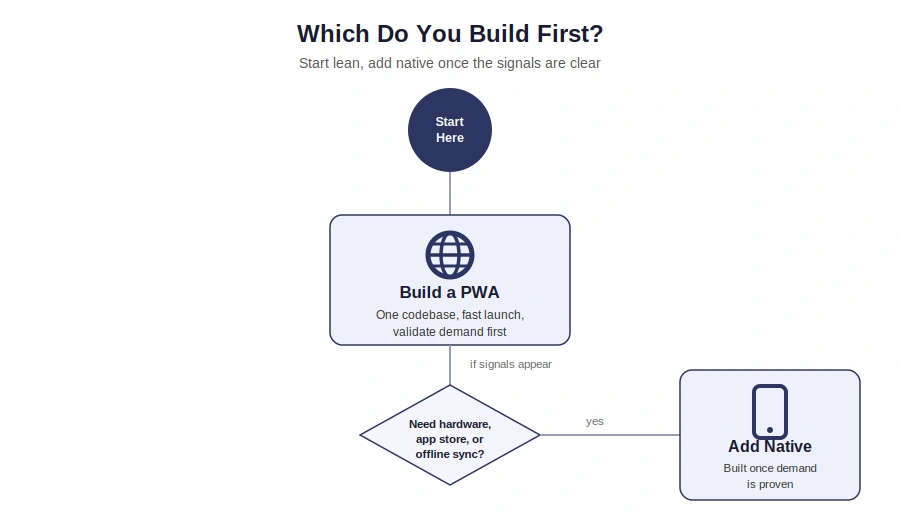
Yes, and it is often the more sensible path rather than a compromise in the PWA vs native app decision. A PWA lets you validate demand, reach users instantly through a link, and gather real usage data before committing to the higher cost of native development.
PWA vs native app

Once the product proves it needs hardware access, deeper offline support, or app store presence to grow further, native development becomes a justified next investment rather than a guess made before launch. This staged approach reduces the risk of overbuilding for a product that has not yet found its audience, and it also means the native build can be scoped around real usage patterns instead of assumptions made at day one. Planning this path with a custom software development company in Bangalore early on makes the eventual transition to native smoother, since the PWA’s architecture can be built with that future migration in mind from the start.

How Do You Decide Which One Fits Your Business?

Map the decision against four factors before committing. Most early-stage products lean toward a PWA on the first three factors alone.
  • Budget available right now for development
  • Timeline pressure, or how soon you need something live
  • How much your product depends on device hardware
  • Whether app store presence matters to your specific audience
A team that has scoped both paths across multiple projects can help weigh these factors against your specific product rather than a generic checklist. Zethic works with founders through exactly this evaluation, mapping the real workflow and hardware needs before recommending a path.

Let Zethic help you build smarter Not just faster

Frequently Asked Questions

Yes, but only on newer iOS versions, and the reach and reliability are narrower than push notifications on Android.
It helps. PWAs are standard web pages that search engines can crawl and index, unlike native apps, which depend entirely on app store search.
Some users still associate app store presence with legitimacy, though this gap is narrowing as more established brands use PWAs alongside or instead of native apps.
A PWA typically runs ₹4L to ₹12L versus ₹15L to ₹40L for a single native platform, as shown in the cost breakdown above, largely because it uses one codebase instead of separate development for each platform.
Yes, browsers support camera and location access, though deeper hardware features like Bluetooth and NFC remain native-only.
Generally yes, since two native codebases mean two sets of updates, bug fixes, and platform-specific testing, while a PWA maintains one codebase for all devices.

Let’s build your app together

Table of Contents

zethic-whatsapp