


Start Your Project Today
Tell us about your project — we’ll get back within 24 hours

Founder
User Interface Design
Shopify vs WooCommerce comes down to a single tradeoff: how much operational responsibility a business wants to hand off versus keep. This same consideration applies to specialized systems such as employee transport management software. Shopify is a fully hosted platform that runs the infrastructure for you. WooCommerce is a free plugin on top of WordPress that hands over full control of the code and hosting instead.
Both platforms are genuinely major players in e-commerce. Exact market share figures vary widely depending on measurement methodology, but both power millions of live stores. Platform choice is one piece of a bigger picture that includes ecommerce UX and revenue growth, so this breaks down real cost differences, performance, SEO, and 2026’s AI features, then gives a clear way to decide between them.
Shopify is a SaaS ecommerce platform: hosting, security, PCI compliance, and uptime are all handled on Shopify’s infrastructure, and merchants pay a monthly subscription for that convenience. Shopify development website service means working within that hosted structure rather than owning the server it runs on. WooCommerce is an open-source plugin added to a WordPress site, which means the store owner chooses the hosting, manages updates, and owns the underlying code outright.
That single structural difference explains almost every other tradeoff between them. Shopify’s guardrails make it faster to launch and lower-maintenance to run. WooCommerce’s openness makes it easier to tailor and cheaper at a small scale, at the cost of needing someone to actually manage that flexibility.
Worth noting for 2026 specifically: WooCommerce’s own AI-related and performance tooling has expanded significantly on the plugin side, but in-person selling still runs through third-party POS plugins rather than a single first-party option, unlike Shopify’s own built-in POS.
Shopify’s cost is predictable because it’s bundled into one subscription. WooCommerce is free to install but accumulates cost through hosting, paid plugins, and developer time, which is why ecommerce website development cost is a more useful comparison at the total-cost-of-ownership level than either platform’s headline price.
| Revenue Tier | Shopify (Global) | WooCommerce (Global) | Shopify (India) | WooCommerce (India) |
|---|---|---|---|---|
| Startup (under $10K/month) | $39 to $105/month | $20 to $50/month (hosting + plugins) | ₹1,499 to ₹5,599/month + transaction fee | ₹20,000 to ₹60,000 first-year setup |
| Growing ($10K to $50K/month) | $105 to $399/month | $50 to $150/month | ₹5,599 to ₹22,680/month + transaction fee | ₹12,000 to ₹30,000/year ongoing |
| At scale ($500K/year+) | ~$4,800 to $9,600/year | ~$2,400 to $5,400/year | Transaction fees alone can exceed ₹2,00,000/year | No platform transaction fee, only gateway cost |
The India-specific detail worth flagging: Shopify Payments isn’t available in India, so every Shopify store there pays Shopify’s own transaction fee (2% down to 0.5% depending on plan) on top of a separate payment gateway fee like Razorpay. WooCommerce has no equivalent platform-level fee, only the gateway’s own cost, which is why the total cost of ownership gap is wider for Indian merchants than the global numbers alone suggest.
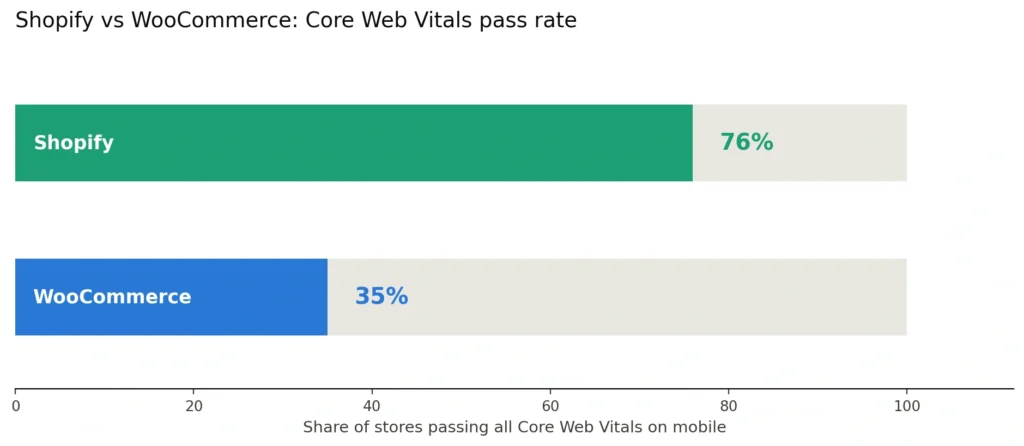
WooCommerce has a real structural advantage here, since it inherits the full content engine behind WordPress design and development: unrestricted blog structure, granular SEO plugin control, and URLs that aren’t locked into a product-first pattern
Shopify has added native schema markup and better meta tag control in 2026, closing some of the gap. Its checkout and product-page conversion strength remain excellent, but businesses building an organic content strategy alongside their store tend to find WooCommerce’s flexibility pays off more over time.
Shopify’s infrastructure is built to work natively with AI shopping agents and machine-driven purchasing flows, since its API and checkout are standardized across every store on the platform. That consistency is exactly what AI agents need to navigate a store reliably. Modern digital commerce intelligence platforms also use AI-generated insights to analyze purchasing patterns, forecast demand, and automate merchandising decisions across ecommerce stores.
WooCommerce can reach the same functionality, but it requires custom engineering to match, since every WooCommerce store has a different theme, plugin combination, and checkout setup. For merchants planning specifically around AI shopping agents in the next few years, that’s a real architectural difference, not just a feature checklist gap.
Custom AI features, like a chatbot handling order status or product questions, are a different story. AI chatbot development cost runs roughly the same regardless of which platform sits underneath it, since a purpose-built assistant is engineered on top of the store rather than depending on native platform support.
Choose Shopify if launch speed matters most, the team doesn’t want to manage hosting, or the business plans to lean into AI shopping agent features as they mature. Choose WooCommerce if content and SEO are core to growth, the budget is tight at a small scale, or full ownership of the code and data matters for the long term. Shopify Payments’ supported countries list changes the real cost picture significantly for businesses based outside the US, UK, or EU.
Ecommerce conversion depends on far more than which platform sits underneath a store, but the platform still shapes how much friction the team fights along the way. Getting that choice right early avoids a costly migration later once a catalog and customer base have grown around the wrong foundation.
Zethic builds on both Shopify and WooCommerce, as part of our broader ecommerce development services, working with merchants to figure out which platform and which specific setup within it fits their catalog size and growth plan. Teams weighing Shopify vs WooCommerce are welcome to talk to Zethic about their specific numbers.
Let Zethic help you build smarter Not just faster
Ram brings deep expertise in product strategy and system architecture across fintech, SaaS, and AI platforms. He specializes in pre-execution planning to help teams build scalable technology foundations and avoid costly rebuilds.

Adding {{itemName}} to cart
Added {{itemName}} to cart