


Start Your Project Today
Tell us about your project — we’ll get back within 24 hours

Founder
User Interface Design
Software development rates in India typically run $15 to $65 per hour depending on seniority, stack, and vendor tier, though the quoted rate alone rarely reflects what a project actually costs once overhead is added. Getting a realistic number means understanding what drives that range, not just picking the lowest figure on a table.
Most businesses researching this topic run into two problems at once: rate tables that vary wildly from source to source, and no clear sense of which number in a given range actually applies to their project. Both are solvable once the underlying drivers are broken down properly.
Here’s what the market actually shows in 2026, broken down by role and seniority:
| Role/seniority | Typical rate (USD/hr) | Typical rate (₹/hr) |
|---|---|---|
| Junior developer (0-2 years) | $15-30 | ₹1,250-2,500 |
| Mid-level developer (3-5 years) | $25-45 | ₹2,000-3,750 |
| Senior developer (5+ years) | $40-65 | ₹3,300-5,400 |
| Specialized roles (AI/ML, DevOps, senior architects) | $55-85+ | ₹4,500-7,000+ |
These figures are cross-referenced across multiple independent sources rather than pulled from a single rate card, since individual vendor quotes vary widely depending on how they structure overhead into the number. A website development cost breakdown shows this variance clearly, since the same hourly rate range produces very different total project costs depending on scope.
Search results for this topic often mix two very different numbers: an employee’s salary and a vendor’s billing rate. A software developer’s average annual salary in India works out to roughly ₹1,000-1,100 per hour if converted directly, but that figure represents take-home pay, not what a client pays a development company.
This distinction matters because the two numbers get compared as if they’re the same thing. A business that reads a “₹1,000/hour” salary figure and expects to hire a vendor at that rate is comparing an employee’s compensation against a company’s billing structure, two fundamentally different calculations.
The billing rate a client actually pays for software development includes the vendor’s margin, overhead, and benefits on top of that base compensation, which is why a $30/hr quoted rate and a ₹1,000/hr salary figure aren’t the same number and shouldn’t be compared directly when budgeting a project.
Seniority is the most obvious driver, but stack specialization and vendor protections matter just as much. A developer working in a common stack for a straightforward CRUD application bills less than one working in a specialized area like AI/ML or DevOps architecture.
Vendors that offer contractual IP assignment, an NDA from day one, named developer placement, and a replacement guarantee tend to bill slightly higher than vendors without these protections, since these terms carry real value that a bare-bones quote doesn’t account for. A Flutter app development cost estimate, for instance, varies meaningfully depending on whether the quote includes this kind of contractual protection or not.
Quality signals matter more than the number itself. Two vendors quoting the same $35/hr rate can produce very different outcomes if one has a genuine track record in the relevant stack and the other is generalizing from adjacent experience.
Software development services supplied from India to a client located outside the country generally qualify as an export of services under GST, which India treats as a zero-rated supply. In practice, this means the quoted rate is typically what an international client actually pays, without GST added on top, provided the standard export conditions are met.
This is worth confirming directly with a prospective vendor rather than assuming it, since correctly documenting the export relationship is what makes the zero-rating apply in the first place. A vendor unfamiliar with export documentation requirements might invoice incorrectly, which can create complications for the client’s own tax filings even if the underlying development work was delivered properly.
Not all offshore development rates in India reflect the same kind of work. A generic CRUD application and a system that needs to handle India-specific compliance, DPDP-compliant data handling, GST e-invoicing integration, or RBI payment-rail work involve meaningfully more engineering judgment, which shows up in the rate.
Businesses in India handling personal data face specific obligations under the Digital Personal Data Protection Rules, and building systems that correctly handle these requirements from the start takes real expertise, not a template.
A provider of custom software development in Bangalore with genuine experience in this kind of work will usually bill at the higher end of a given seniority band, and that higher rate reflects real risk reduction rather than markup for its own sake.
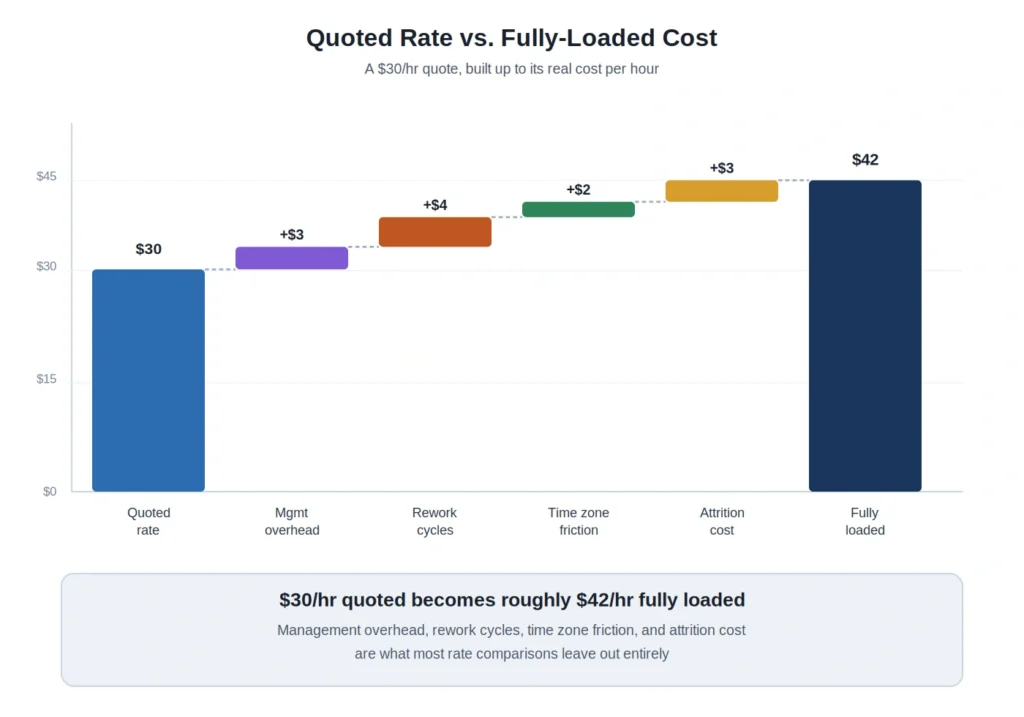
A $30/hr quote can easily land closer to $40-45/hr once these factors are accounted for, which is the actual number worth comparing against a fixed-price or dedicated-team alternative rather than the bare hourly figure. Looking at a real project example, like a mobile app development cost breakdown, tends to make this fully-loaded number more concrete than a rate table alone.
None of this means the lowest quoted rate is automatically the wrong choice. It means the comparison needs to happen at the fully-loaded level, not the headline number, since two vendors quoting different hourly rates can end up costing roughly the same once these factors are priced in honestly.
Getting this right comes down to comparing fully-loaded costs rather than the quoted rate alone, confirming GST and contractual protections upfront, and being clear about which India-specific requirements genuinely justify a higher rate. Zethic prices engage this way, treating a realistic total cost as the number worth planning around rather than the headline rate. For businesses budgeting a project, Zethic can walk through where a realistic number lands for a specific scope and seniority mix.
Let Zethic help you build smarter Not just faster
Junior developers typically bill $15-30/hr, mid-level $25-45/hr, senior developers $40-65/hr, and specialized roles like AI/ML or DevOps can go $55-85/hr or higher.
Yes, usually 60-70% cheaper than the US and 30-40% cheaper than Eastern Europe at comparable seniority, though the real savings shrink once fully-loaded costs (overhead, rework, time zone friction) are factored in.
Generally no, since qualifying software services exported from India to an international client are treated as a zero-rated supply under GST, provided the standard export conditions are met.
Stack specialization, contractual protections (IP assignment, NDA, replacement guarantees), and experience with India-specific compliance work (DPDP, GST e-invoicing) all justify billing higher than seniority alone would suggest.
Salary is what the developer takes home; the billing rate a client pays includes the vendor’s margin, overhead, and benefits on top of that, which is why the two numbers shouldn’t be compared directly.
Management overhead, rework from unclear requirements, time zone friction, and attrition-driven replacement costs all add to the quoted rate, often pushing the real cost per hour noticeably higher.
Ram brings deep expertise in product strategy and system architecture across fintech, SaaS, and AI platforms. He specializes in pre-execution planning to help teams build scalable technology foundations and avoid costly rebuilds.

Adding {{itemName}} to cart
Added {{itemName}} to cart