


Start Your Project Today
Tell us about your project — we’ll get back within 24 hours

Founder
User Interface Design
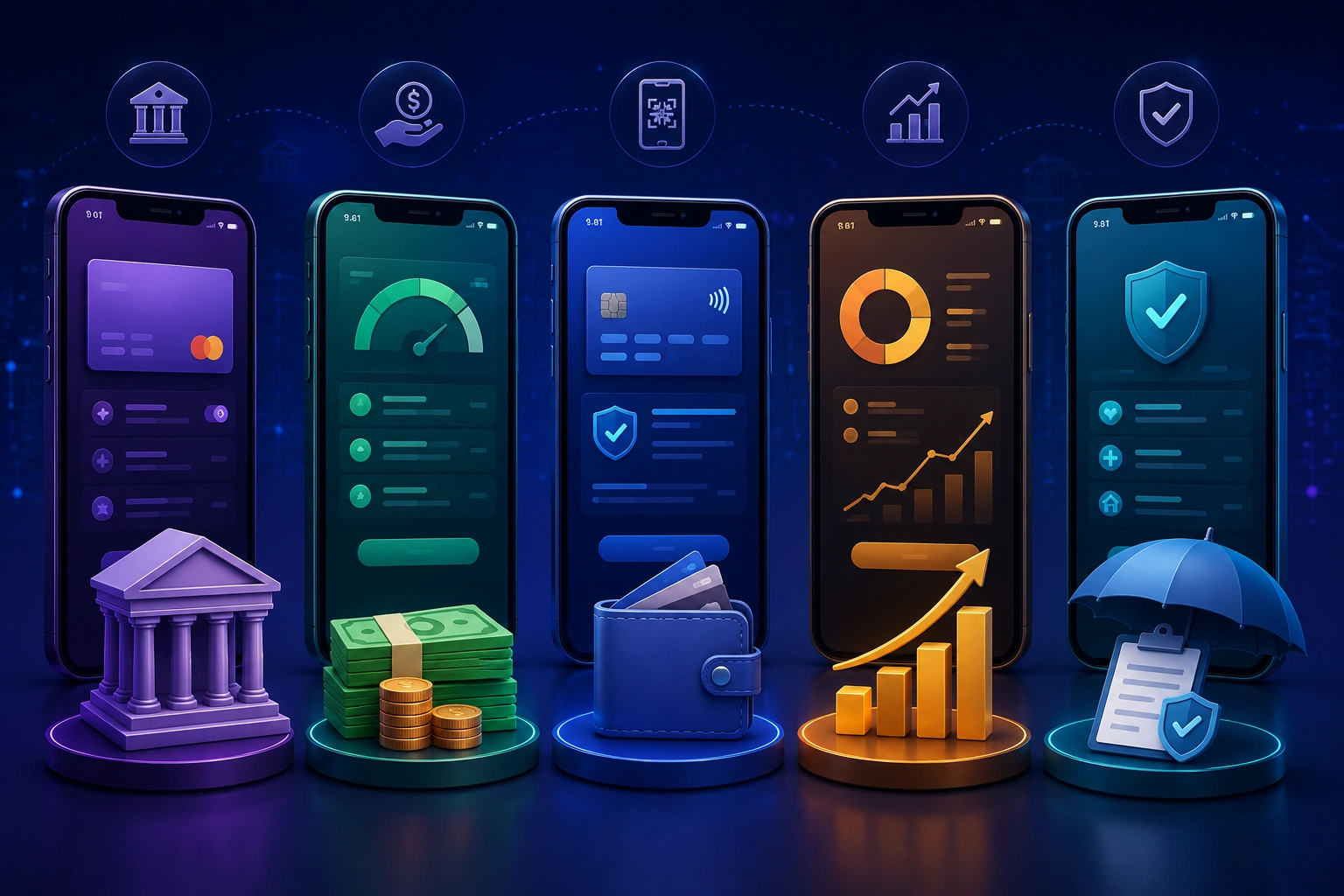
If you’re building a fintech product, the first decision isn’t your tech stack, it’s which of the core types of fintech apps you’re actually building in: neobanking, lending, payments, wealth management, or insurtech. Each one digitizes a different financial function, whether that’s banking, borrowing, transacting, investing, or insuring, and each comes with its own compliance load, infrastructure partners, and reasons a business would buy it. Most modern fintech products don’t stay in one lane either, often blending two or more categories into a single platform.
The fintech sector has grown well beyond a niche corner of the software industry. The global fintech market was valued at $394.88 billion in 2025 and is projected to reach $460.76 billion in 2026, according to Fortune Business Insights. From there, the firm projects an 18.2% compound annual growth rate (CAGR) across the 2026 to 2034 forecast window, a separate, longer-term trajectory rather than a description of the 2025-to-2026 jump itself. Investment in the sector has also turned a corner: global fintech funding rebounded to $116 billion in 2025, up from $95.5 billion in 2024, per KPMG’s Pulse of Fintech H2 2025 report. That growth isn’t concentrated in one type of app. It’s spread across banking, lending, payments, investing, and insurance, each with different users, different regulatory loads, and different reasons to exist.
Neobanks are digital-only banks that operate without physical branches, offering checking accounts, savings, debit cards, and basic money management entirely through an app. They either hold a banking license themselves or partner with a licensed bank in the background to issue accounts and cards.
What makes neobanks stand out:
Because so many neobanks run on the same underlying banking infrastructure, two apps with very different branding can sometimes be operating on the same banking rail behind the scenes. That shared infrastructure is also where a lot of hidden fintech app development costs tend to show up, since the licensing and compliance work behind a neobank rarely shows up in the initial budget the way the app’s design does. On the institutional side, this is also why banks and cooperative banks supporting these partnerships are increasingly moving their own back-office operations onto a unified banking solution rather than running on the disjointed legacy systems many still rely on.
Among the types of fintech apps in this list, lending platforms have seen some of the sharpest growth, driven largely by automated underwriting. Lending apps handle loan origination, credit assessment, disbursal, and repayment digitally, replacing what used to be a paperwork-heavy, weeks-long bank process with something that can be resolved in minutes.
What a typical lending app stack includes:
Alternative-data underwriting is what lets lenders assess thin-file borrowers, people with little or no formal credit history, rather than relying purely on traditional credit bureau scores. Because lending apps move real money to real borrowers, they also sit under heavier regulatory scrutiny than most other fintech categories. Licensing requirements, interest rate caps, and responsible-lending disclosures vary significantly by country and need to be designed into the product from day one, not patched in later. Most teams building out lending software development services infrastructure end up facing an early decision about which parts of that underwriting stack to build versus which to bring in from a third-party provider, something we’ve broken down in build vs. integrate for custom fintech apps.
Payment apps move money between parties: peer-to-peer transfers, merchant checkouts, bill payments, and cross-border remittances. This is the largest and most mature fintech category by transaction volume.
What separates a good payment app from a merely functional one is largely invisible to the end user:
Payment apps also tend to be the entry point for embedded finance. A ride-hailing app adding a wallet, an e-commerce platform adding BNPL at checkout: payments overlaps with other software categories more than any other fintech type does. The fraud-detection latency point above is worth dwelling on, since it’s usually where payment apps either earn or lose user trust, and the margin for error gets thinner the more transaction volume a platform handles. Getting settlement speed, fraud latency, and uptime right at the same time is largely an architecture problem, which is why most teams building this category rely on dedicated payment gateway software development services rather than treating the payment layer as a bolt-on integration.
Insurtech apps are insurance software solutions that digitize insurance: quoting, underwriting, policy issuance, and claims processing for health, life, auto, and property coverage. This is the smallest of the five categories by user volume but one of the most active in terms of consolidation. Insurtech investment reached $4.8 billion in the first half of 2025 alone, already exceeding the $2.9 billion raised across all of 2024, per KPMG’s Pulse of Fintech research.
What insurtech apps typically add over traditional insurance processes:
The tradeoff is that insurance remains one of the most heavily regulated financial categories globally, so insurtech apps generally integrate with, rather than replace, licensed underwriters and carriers in the background. That’s also true of most of the categories above: heavily regulated functions like underwriting, claims, and payouts tend to get built as part of a broader fintech software development effort rather than as a standalone app feature.
Wealth management apps, often called wealthtech, help users invest, trade, and manage portfolios, covering everything from robo-advisors that automate asset allocation to full brokerage apps that support manual trading, options, and crypto through a crypto exchange platform.
The segment has split into two distinct experiences:
Wealth apps carry their own compliance weight: securities regulations and suitability requirements that differ from the KYC/AML obligations governing banking or payments. A trading app and a banking app might look similarly polished on the surface, but they’re built against almost entirely different regulatory frameworks underneath. Trading apps in particular also face a scaling problem that’s easy to underestimate until markets get volatile and order volume spikes; that’s a big part of why fintech apps struggle with scalability once usage moves past the pilot stage.
| Fintech app type | Core function | Primary users | Key regulatory focus |
|---|---|---|---|
| Neobanking | Digital checking/savings, cards | Retail consumers, SMEs | Banking license / BaaS partner compliance |
| Lending | Loan origination, credit scoring, repayment | Borrowers, SMEs | Lending licenses, interest rate caps, KYC |
| Payments | Transfers, checkout, remittance | Consumers, merchants | PCI-DSS, AML, payment aggregator licensing |
| Wealth Management | Investing, trading, portfolio management | Retail and institutional investors | Securities regulation, suitability rules |
| Insurance (Insurtech) | Quoting, underwriting, claims | Policyholders | Insurance licensing, carrier partnerships |
These five categories rarely stay in their own lane for long:
The boundaries blur because users don’t think in terms of fintech categories. They think in terms of one app that should handle most of their money. That overlap is exactly why understanding the underlying types still matters: each one is built on a different compliance foundation, a different risk model, and a different reason a user opens the app in the first place, even when the surface-level experience looks similar.
Zethic Technologies works as a software development company across several of these categories, including banking, lending, payments, and wealth-focused products, which is part of why this breakdown reflects how differently each one is actually built under the hood rather than just how each one looks on the surface.
That range comes from working across categories side by side, not from treating each one as a separate specialty. Zethic’s fintech software development in Bangalore team moves between neobanking, lending, and payments builds regularly, which is why the compliance and architecture tradeoffs above come from direct build experience rather than desk research.
Zethic Technologies is a trusted Web & Mobile App Development Company providing Custom Software Development Services to startups and growing businesses. We combine planning, development, and long-term thinking to deliver stable digital products.
Let Zethic help you build smarter Not just faster
The five main types are neobanking apps, lending apps, payment apps, wealth management apps, and insurtech apps. Each covers a different financial function, though many products now blend two or more of these into one app.
A neobank is digital-only, with no physical branches, and often relies on a licensed banking partner behind the scenes for the actual ledger and compliance work. A traditional bank’s app is just one channel into a bank that also operates physical branches and holds its own banking license directly.
No. Lending apps fall under their own licensing rules, interest rate caps, and disclosure requirements, which differ significantly by country. These regulations focus specifically on protecting borrowers, separate from the banking license requirements that apply to neobanks.
Because authorization happens in real time at checkout. If a fraud check takes too long, it either slows down the transaction or gets skipped, so payment infrastructure is built to return a fraud decision in a fraction of a second without adding noticeable delay.
A robo-advisor is one type of wealth management app. Wealth management apps also include full-service trading platforms where users manage their own trades directly, so robo-advisors are a subset rather than the whole category.
Ram brings deep expertise in product strategy and system architecture across fintech, SaaS, and AI platforms. He specializes in pre-execution planning to help teams build scalable technology foundations and avoid costly rebuilds.

Adding {{itemName}} to cart
Added {{itemName}} to cart