


Start Your Project Today
Tell us about your project — we’ll get back within 24 hours

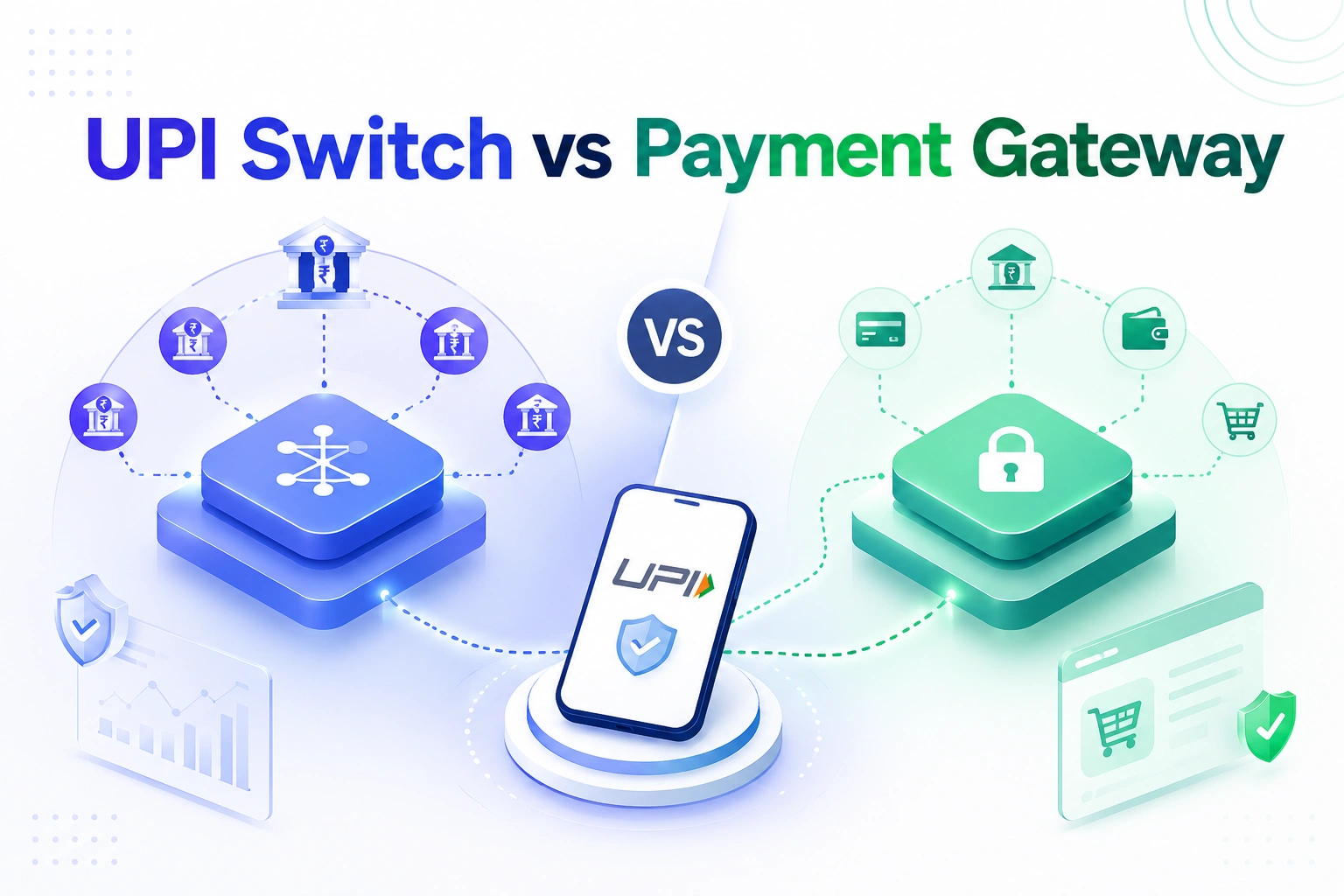
A payment gateway is the customer-facing layer that captures and passes on payment details, while a UPI switch is the backend routing system that moves the request between banks and NPCI. Most businesses interact only with the gateway, since the switch sits underneath it and is rarely something a merchant configures directly. The two are not competing options, and they work together in almost every UPI transaction a business processes.
A payment gateway is the layer a business actually integrates with. It sits on a checkout page or inside an app, collects payment details, and passes them along for processing.
A UPI switch operates one level deeper. It receives the validated request from the gateway’s backend and decides how to route it, whether that means the central NPCI switch or a bank-level PSP switch handling a specific provider’s traffic.
The confusion usually comes from assuming these are two alternatives a business picks between. In practice, a business rarely chooses a switch on its own. It chooses a gateway or aggregator, and the switch operates behind that choice.
This layering exists for a reason. Gateways are designed to be easy to integrate, with clean APIs and developer-friendly documentation. Switches handle a different job entirely, routing decisions, bank-side authentication, and settlement at a scale most businesses never manage directly, which is why businesses that eventually need this level of control often work with a dedicated UPI switch development partner instead of building it in-house.
Most of the confusion in this comparison stems from vendor marketing rather than the technology itself. Some providers use “switch” loosely to describe features that are really gateway-level routing between payment methods, not the bank-facing routing a genuine UPI switch performs. Reading past that language matters when evaluating what a provider is actually offering.
A single UPI payment actually passes through both layers in sequence, even though only one of them is visible to the person paying.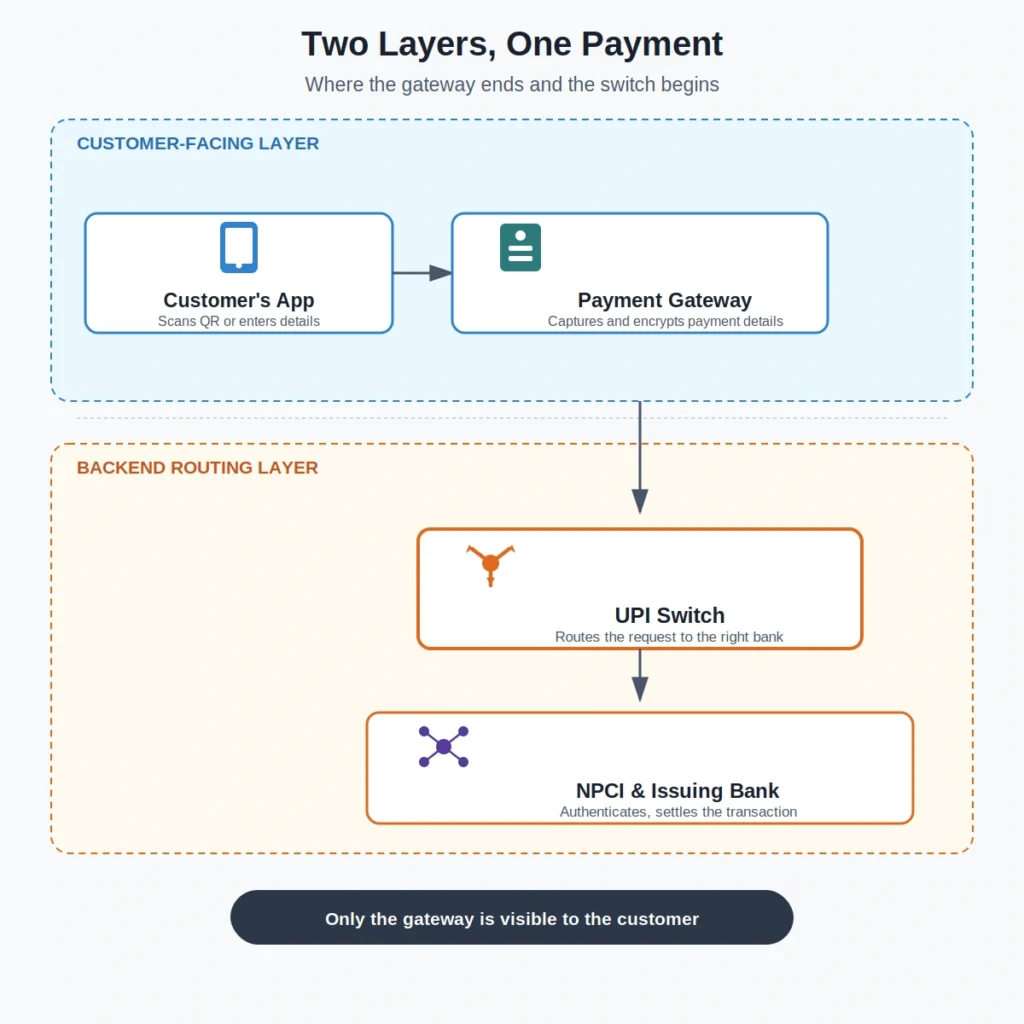
This is why a slow or unreliable switch can drag down a gateway’s success rates even when the gateway itself is working correctly. The problem often sits one layer below where a business is actually looking.
This is also why comparing gateways on interface and documentation alone can miss the more important variable. Two gateways can look identical on the surface while running on switches with meaningfully different routing logic, and that difference only shows up once transaction volume climbs high enough to expose it.
A useful question to ask a gateway provider directly is whether they operate their own switch or route through a shared one used by multiple clients, since RBI’s definition of a payment gateway as pure routing infrastructure without fund handling makes clear the two systems are meant to stay separate even when one vendor offers both. The answer often reveals more about expected reliability than anything listed in a feature comparison.
Each layer owns a distinct part of the transaction, and knowing where one ends and the other begins helps explain why failures get attributed to the wrong system.
A gateway can look completely healthy in its own dashboard while the switch underneath it is struggling with bank-side load, which is exactly why success-rate issues need to be diagnosed at both layers rather than assumed to be a gateway problem by default. RBI’s turnaround time rules for failed transactions place the reversal responsibility squarely at the settlement layer, reinforcing that a stuck payment is rarely something the gateway itself can resolve alone.
This split in responsibility also explains why switching gateway providers does not always fix a reliability problem. If the new provider routes through a similarly constrained switch, the same failure patterns tend to resurface, just under a different dashboard.
Understanding this division also changes how a support conversation should go when something breaks. Asking a gateway provider “why did this transaction fail” gets a more useful answer once a business already knows whether to expect a capture-side explanation or a routing-side one.
For most businesses, the answer is no. The switch layer is abstracted away by whichever payment aggregator or gateway provider they integrate with, and this is deliberate rather than a limitation.
| Layer | Who Typically Manages It | When a Business Interacts With It Directly |
| Payment gateway | The business, via API or SDK integration | Almost always, this is the standard integration point |
| PSP-level UPI switch | The gateway or aggregator provider | Rarely, unless the business becomes its own PSP |
| Central NPCI switch | NPCI and licensed banks/aggregators only | Never directly; only banks and RBI-licensed entities connect here |
A business only needs to think about the switch layer directly once it reaches a scale where routing reliability, settlement speed, or reconciliation accuracy starts affecting revenue in a way a standard gateway integration cannot fully explain, a question that comes up regularly in financial services work as transaction volume grows past what a standard integration was designed for. At that point, the conversation shifts from “which gateway should we use” to “does our provider’s switch architecture actually hold up under our transaction volume?”
Getting to that question early, rather than only after a spike in failed transactions, gives a business room to evaluate providers on switch quality before it becomes an urgent problem instead of a planned decision.
Some businesses reach this point earlier than expected, particularly if they process high transaction volumes during predictable spikes like sales events or subscription renewal cycles. In those cases, switch-level reliability becomes a revenue question well before overall transaction volume looks large by industry standards.
Most businesses never need to touch the switch layer directly, but the choice of gateway or aggregator still determines how well that underlying switch performs for them. Getting this right early avoids a much harder migration later, once transaction volume and customer expectations are already locked in.
Zethic works with fintech and platform businesses to evaluate this exact decision, matching gateway and integration choices to where a business actually is today rather than a generic recommendation. Zethic helps teams read past marketing claims from providers and assess routing reliability, settlement speed, and reconciliation quality directly, so the switch layer underneath the gateway is never a blind spot.
Ram brings deep expertise in product strategy and system architecture across fintech, SaaS, and AI platforms. He specializes in pre-execution planning to help teams build scalable technology foundations and avoid costly rebuilds.
