


Start Your Project Today
Tell us about your project — we’ll get back within 24 hours

Founder
User Interface Design
AML transaction monitoring systems generally fall under the broader AML software development cost range of $10,000 to $500,000 or more, depending on scope. India-based development often comes in well below US or UK benchmarks for the same work.
AML transaction monitoring is the system a regulated business uses to screen transactions for patterns tied to money laundering, terrorist financing, and sanctions evasion. Unusual activity gets routed to a compliance analyst for review. A typical system screens for transactions structured just under a reporting threshold, rapid movement of funds across multiple accounts, activity involving high-risk countries or sanctioned entities, and sudden shifts in a customer’s usual transaction size. Each pattern maps to a specific rule or model inside the system, which is part of why build cost varies so much between vendors. The price gap exists because “transaction monitoring system” means different things to different buyers. A basic rule engine for a small payments startup and a full case-management platform for a bank, the kind of range typical in fintech software development, are both sold under the same label, even though the underlying build work is entirely different.
The gap usually comes down to how much of the system is pre-built versus scoped from scratch. The same detection logic often powers fraud detection in fintech systems, since both rely on the same transaction data and behavioral signals.
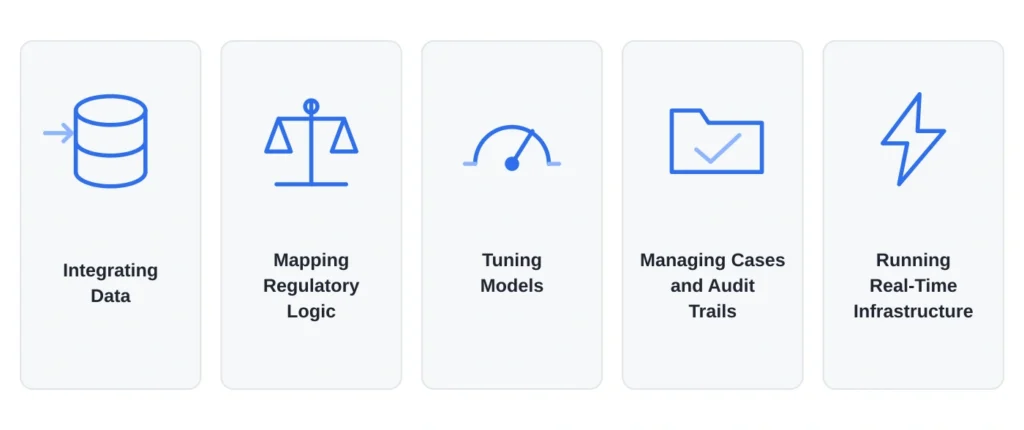
Most of the cost sits outside the visible rule engine. The expensive parts are the ones a demo never shows.
Skipping any one of these to save budget upfront usually means paying for it twice, once during the rebuild. Vendors rarely itemize these costs separately, which is part of why quotes look so different on paper.
Development cost depends on where the engineering team sits and how much of the system is built from scratch.
| Cost Component | Global (US/UK) Benchmark | India-Based Development |
|---|---|---|
| Initial build (rule-based, single market) | $10,000 to $50,000 (Appinventiv, 2025) | Roughly ₹3.9 lakh to ₹19.3 lakh, estimated from India’s 50 to 65 percent senior-engineering cost advantage over the US (Wisemonk India IT Services Analyst Report, 2026) |
| Full platform (real-time, ML-assisted, multi-entity) | $100,000 to $500,000+ (Appinventiv, 2025) | Roughly ₹33.8 lakh to ₹1.74 crore, using the same cost-advantage basis |
| Annual maintenance and model tuning | 20 to 30 percent of build cost annually (Finantrix Buyer Guide, 2026) | Same percentage range, applied against the lower India build cost |
| Enterprise-scale, multi-jurisdiction TCO | $2 million to $8 million annually (Finantrix Buyer Guide, 2026) | Typically scoped in phases rather than as one enterprise contract |
The India-side figures are lower mainly due to engineering labor cost, not lighter compliance work. Building regulatory technology solutions for India still means matching the same review depth RBI and FIU-IND expect elsewhere.
Anti-money laundering laws in India carry real criminal exposure on top of the compliance cost. Rupee figures use the ₹96.5/USD rate as of July 2026.
Cutting corners on transaction monitoring rarely stays a one-time saving. Regulators in multiple jurisdictions have shown they will penalize gaps in monitoring long after a system goes live.
Metro Bank’s financial crime failings led to a fine of roughly $21 million after the bank failed to properly monitor over 60 million transactions worth more than £51 billion between 2016 and 2020.
In the US, TD Bank’s money laundering settlement confirms the bank pleaded guilty to conspiracy to commit money laundering and agreed to pay approximately $3.09 billion in penalties to the DOJ, Federal Reserve, OCC, and FinCEN combined.
Beyond the fine itself, remediation often costs more than the original system, since it includes a historical transaction look-back alongside the rebuild. In India, the stakes go further, since money laundering offences under the PMLA carry three to seven years of imprisonment, extending up to ten years where linked to narcotics offences.
These figures vary by source and jurisdiction, so treat them as a directional warning rather than a fixed number. The fine itself is often smaller than what follows it, since a finding typically triggers a look-back review that can take months before any system changes begin.
The right call depends less on preference and more on three factors: transaction volume, budget certainty, and how often regulatory obligations change.
Cost should not be the only input, but it is usually the one that gets ignored until the invoice arrives. Banking compliance software cost follows the same math whichever way this decision goes.
The clearest way to avoid an unpredictable AML transaction monitoring quote is scoping the system to the transaction volume and regulatory footprint a business actually has, rather than accepting a generic vendor package. Zethic scopes transaction monitoring builds this way for banking and payments clients, as part of our dedicated banking software development services, pricing the real data integration and compliance mapping work directly instead of quoting a flat license fee.
This same scoping discipline extends to fintechs outside the banking-specific track as well. Zethic’s fintech software development in Bangalore practice prices AML and transaction monitoring work the same way, against actual data volume and regulatory footprint, rather than a flat license quote that hides the real integration cost until later.
Let Zethic help you build smarter Not just faster
Yes, Indian reporting entities must meet RBI and FIU-IND requirements under the PMLA, including specific reporting thresholds and Suspicious Transaction Report filings that differ from other jurisdictions.
Ram brings deep expertise in product strategy and system architecture across fintech, SaaS, and AI platforms. He specializes in pre-execution planning to help teams build scalable technology foundations and avoid costly rebuilds.

Adding {{itemName}} to cart
Added {{itemName}} to cart