


Start Your Project Today
Tell us about your project — we’ll get back within 24 hours

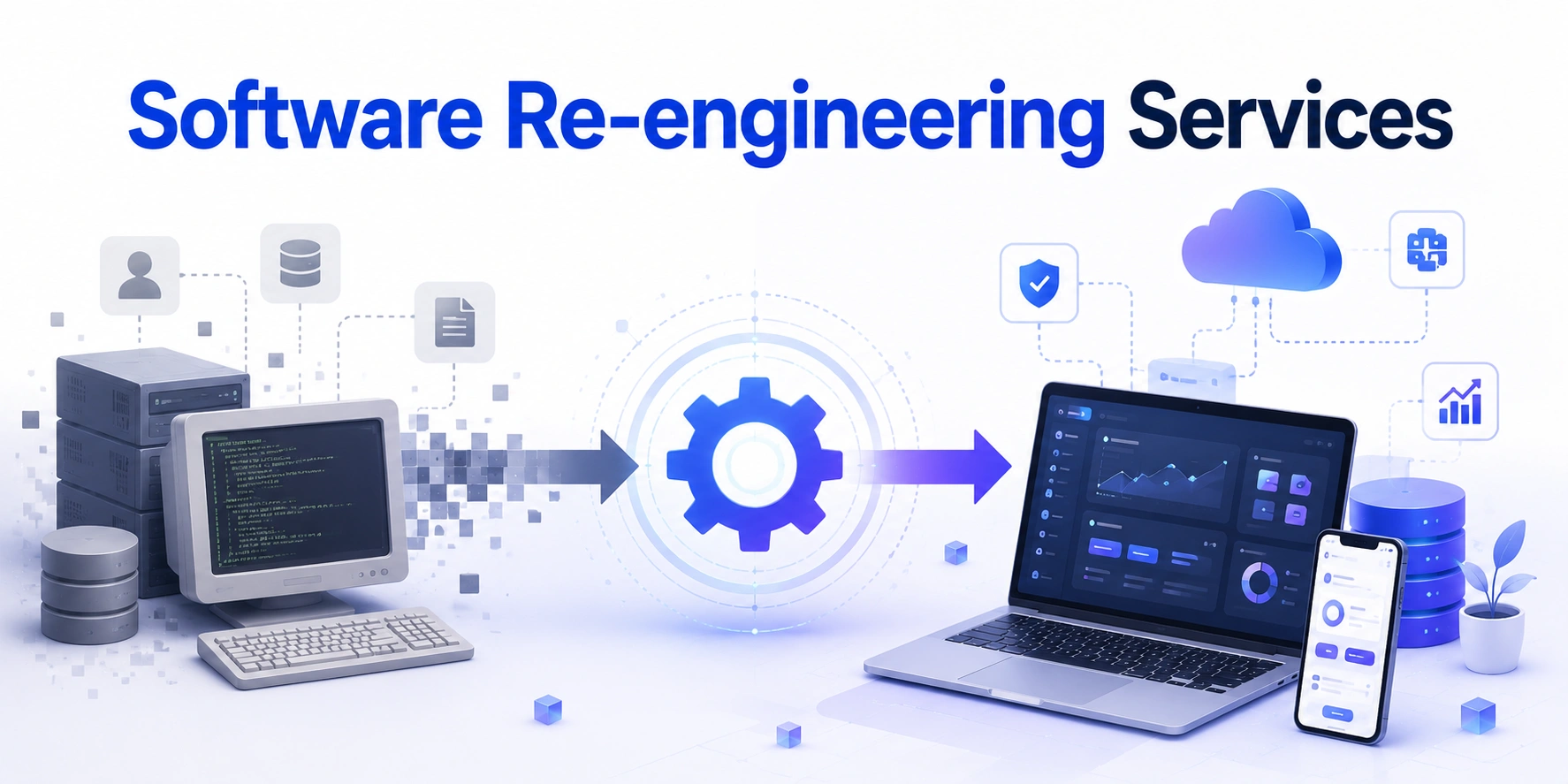
Software re-engineering services take an existing system, such as a compliance software solution, as the starting point rather than a blank page, analysing, restructuring, and rebuilding it while preserving the business logic that already works. That distinction, keeping what’s proven instead of rediscovering it, is what separates re-engineering from a full rewrite.
Software re-engineering is the structured process of examining an existing system, understanding how it actually works, and rebuilding its structure, architecture, or platform while keeping the business rules and data intact. The old system functions as the specification for the new one, rather than a written requirements document built from scratch.
This matters most for systems where the original documentation is gone, the developers who built it have moved on, and the only accurate record of what the business actually needs is the running code itself. A team that treats the existing system as disposable often ends up rebuilding logic nobody remembered was there in the first place, a risk that shows up just as often in a straightforward custom software vs off-the-shelf decision, since either path still depends on knowing exactly what the current system does before replacing any part of it.
These three terms describe very different levels of change, and picking the wrong one is an expensive mistake to correct halfway through a project.
| Approach | Scope of Change | Risk Level | What’s Preserved |
| Refactoring | Internal code structure only | Low | External behavior, architecture, and business logic all stay the same |
| Re-engineering | Architecture, platform, and structure | Moderate | Core business logic and data, rebuilt on a new foundation |
| Full rewrite | Entire system from scratch | High | Nothing automatically; logic must be rediscovered and reimplemented |
Refactoring is a routine maintenance activity a team runs continuously. Re-engineering is a deliberate, scoped project undertaken when refactoring alone can no longer fix what’s wrong, and the software development services a team chooses for that project should be scoped around exactly that boundary rather than a generic build.
A re-engineering project moves through a consistent sequence, even though the specific work inside each stage varies by system, and knowing that sequence in advance is part of what separates a scoped re-engineering plan from the kind of unresolved build vs buy software debate that stalls a project before it starts.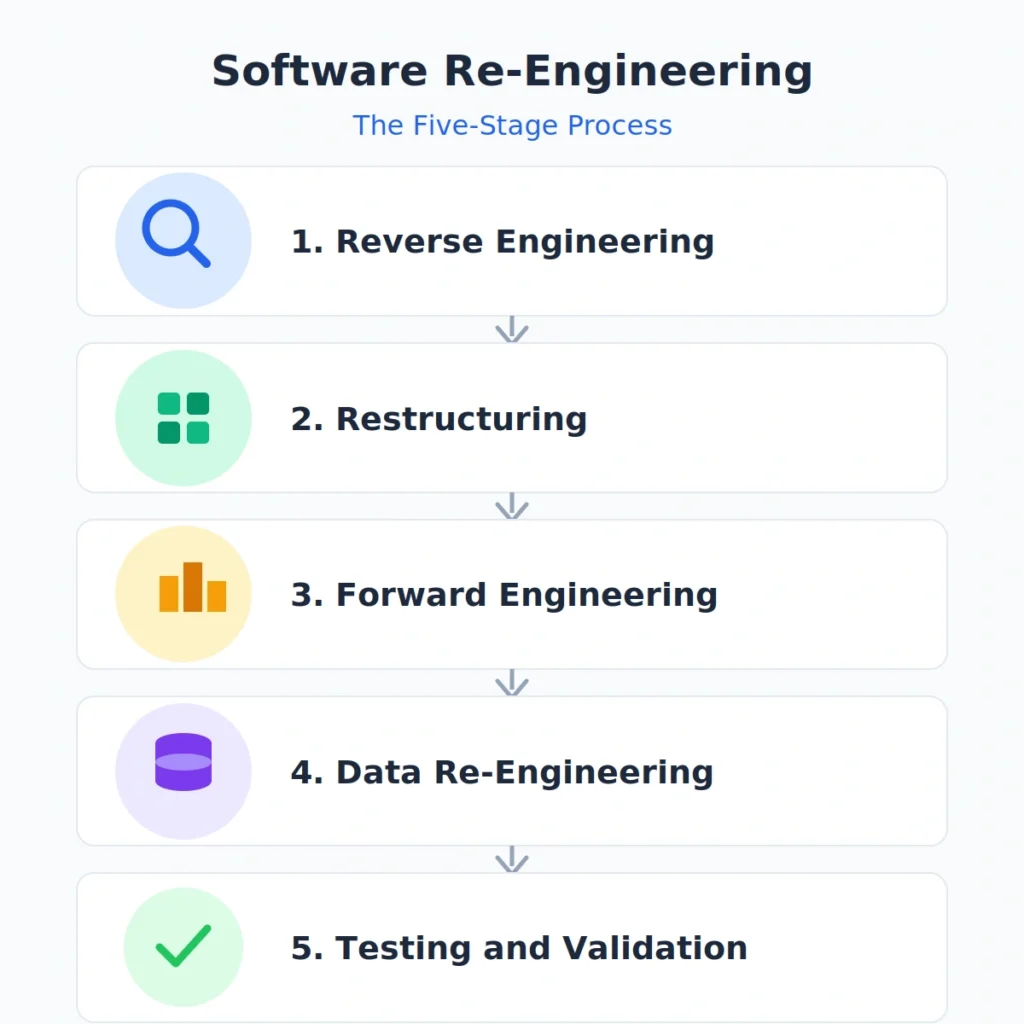
Most businesses don’t plan for re-engineering years in advance. It becomes necessary when a system that still earns its keep for the business has quietly become too costly or risky to keep patching.
The scale of this problem isn’t unique to any one company. The same budget pressure that pushes a growing business toward digital transformation without a big budget is often exactly what delays re-engineering past the point where it would have been the cheaper option.
Cost depends primarily on system size, the age of the underlying technology, and how much of the original logic needs to be reverse-engineered before anything can be rebuilt. The ranges below reflect production-grade work for mid-size systems.
| Project Scope | Typical Cost Range (INR) | Timeline |
| Single-module re-engineering | ₹8,00,000 – ₹20,00,000 | 6-10 weeks |
| Full application re-engineering, mid-size system | ₹20,00,000 – ₹50,00,000 | 12-20 weeks |
| Enterprise-scale, multi-system re-engineering | ₹50,00,000 – ₹1,20,00,000+ | 20-36 weeks |
Systems with little or no original documentation push costs toward the higher end of each range, since more of the reverse engineering stage has to happen manually before restructuring can even begin, a factor any experienced custom software development company in Bangalore accounts for during initial scoping rather than after work has started.
The main risk in re-engineering isn’t the new architecture; it’s losing business logic nobody documented because it lived only in the original code. A reverse engineering stage that skips edge cases will surface that gap only after the new system is live.
Running the old and new systems in parallel during a phased rollout catches these gaps before they reach customers, since discrepancies between the two systems’ outputs point directly to logic the reverse engineering stage missed. Even India’s own Digital India programme for modernizing public-sector systems runs on the same phased logic, since a rushed cutover on any system carrying real operational weight tends to surface the same gaps a re-engineering project is meant to catch early.
The projects that go well start with an honest reverse engineering phase before anyone commits to a timeline or an architecture. Skipping that step to save a few weeks upfront is the single most common reason re-engineering projects run over budget.
Zethic scopes re-engineering work by starting with that same reverse engineering discipline, mapping what a system actually does before proposing what its replacement should look like. Teams bring Zethic in specifically because that sequencing, understand first, rebuild second, is what keeps a re-engineering project from quietly becoming a rewrite with a smaller budget.
Ram brings deep expertise in product strategy and system architecture across fintech, SaaS, and AI platforms. He specializes in pre-execution planning to help teams build scalable technology foundations and avoid costly rebuilds.
