


Start Your Project Today
Tell us about your project — we’ll get back within 24 hours

Founder
User Interface Design
FinTech app development services
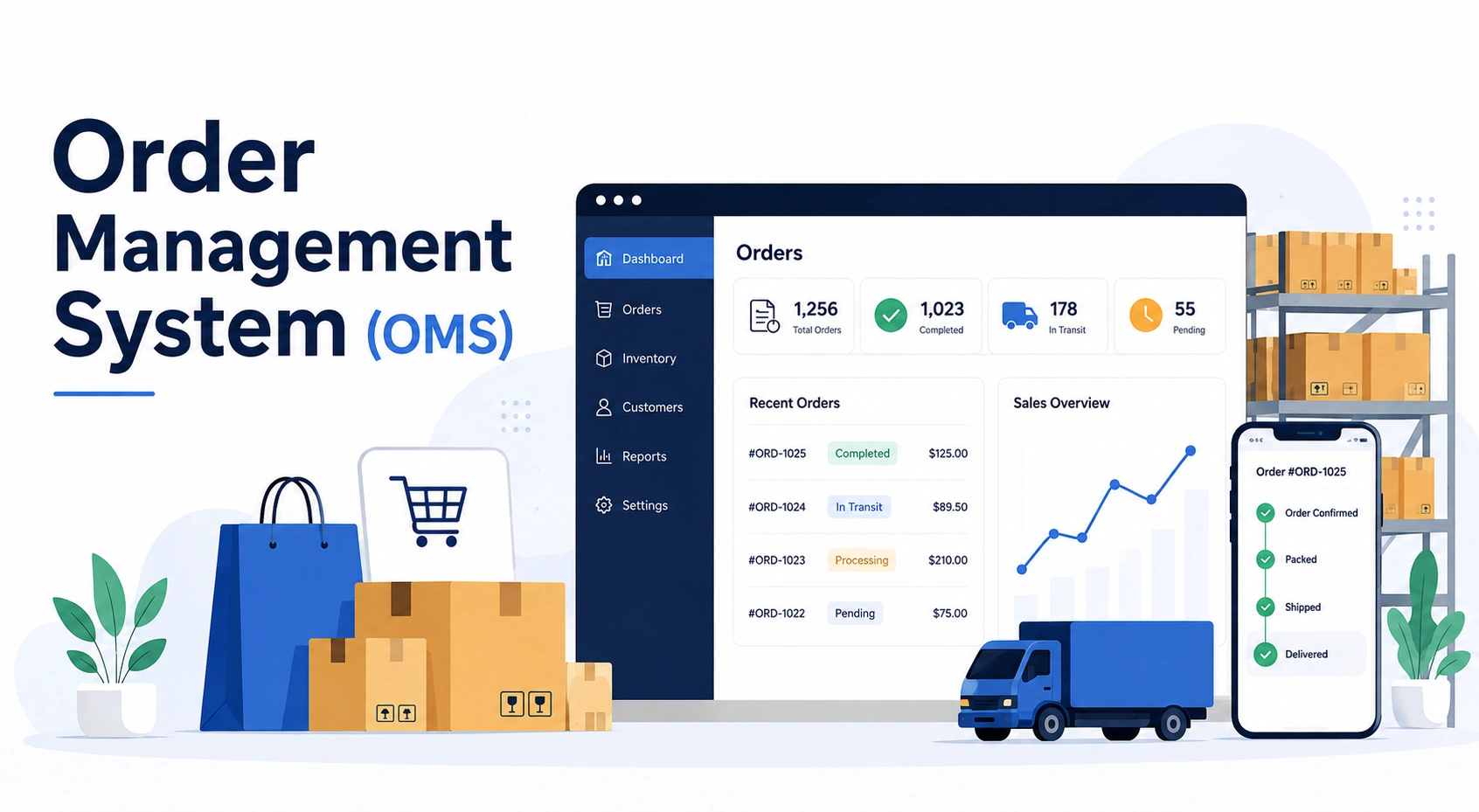
An order management system is software that tracks and coordinates a customer order from the moment it is placed to the moment it is delivered or returned. It gives a business a single place to view order status, inventory, and fulfillment activity across all sales channels.
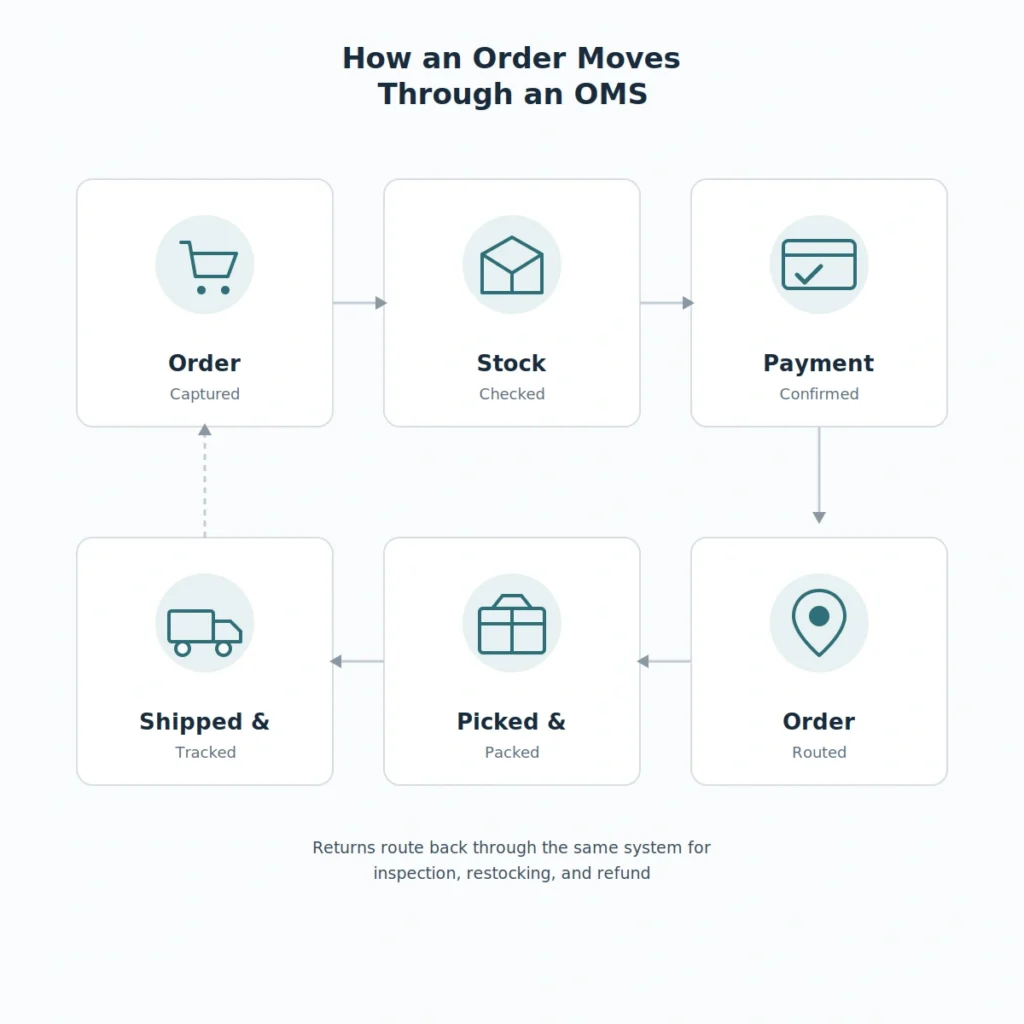
An order management system, or OMS, connects the systems a business already uses, such as its website, warehouse, and accounting software, so an order does not need to be re-entered by hand at each stage. When a customer places an order, the OMS checks stock, confirms payment, and routes it to the location best placed to fulfill it.
From there, the order moves through picking, packing, shipping, and any return, all tracked in one place. The business gets a single view of every order regardless of channel, and the customer gets one accurate status update instead of conflicting information from separate systems.
Businesses often confuse an OMS with an inventory management system, an ERP, or a warehouse management system, and it’s a fair mix-up, since all four touch orders and stock in some way and fall under the broader category of supply chain management software. But each one solves a distinct part of the problem, and most growing businesses end up running two or three of them side by side.
An OMS typically sits between the ERP and the warehouse management software, pulling inventory data from one side and sending fulfillment instructions to the other. When all four run in sync, businesses tend to see a real drop in the manual reconciliation work that comes from keeping order, stock, and financial records apart.
An OMS handles several connected jobs at once rather than a single task, which is exactly why it sits at the center of the order-to-delivery process for most product businesses. Each function leans on the one before it, keeping order data accurate all the way from the first click to the final delivery.
This is the decision most growing businesses eventually run into: off-the-shelf OMS platforms cover the common cases well, but they tend to strain once order volume, channel count, or fulfillment logic gets specific to one business. A custom application development approach costs more upfront, but it also removes the licensing fees, feature ceilings, and workaround problems that come bundled with a packaged product.
| Factor | Buying an OMS | Building a custom OMS |
|---|---|---|
| Time to launch | Weeks to a few months | Several months to a year |
| Upfront cost | Lower | Higher |
| Ongoing cost | Recurring license or subscription fees | Maintenance and hosting only |
| Fit for complex workflows | Limited to what the vendor supports | Built around the business’s exact process |
| Integration with existing systems | Depends on available connectors | Built to match existing ERP, WMS, and CRM exactly |
| Ownership | Vendor controls the roadmap | Business owns the system and its data |
A packaged OMS makes sense for a business with a fairly standard sales process and a tight timeline to hit. A custom build starts to make more sense once order volume climbs high enough, or the fulfillment rules get specific enough, that a generic platform creates more workarounds than it actually solves.
Custom OMS development in the United States commonly runs $100,000 for a minimum viable build, and $400,000 or more once the system gets genuinely complex. Indian development teams typically deliver that same scope at a real saving of 55 to 62 percent, once management time and specification rework are factored in, rather than the 70 percent headline figure that often gets quoted. Businesses weighing this up often compare it against ERP development cost in India, since the two systems tend to get built together.
| OMS complexity | Typical scope | US cost (USD) | India cost (USD) | India cost (INR) |
|---|---|---|---|---|
| Basic | Single-channel order capture, inventory sync | $100,000-$150,000 | $35,000-$57,000 | ₹33.4L-₹54.4L |
| Mid-range | Multi-channel orders, ERP/WMS integration, returns workflow | $150,000-$280,000 | $57,000-$106,000 | ₹54.4L-₹1.01Cr |
| Enterprise | Multi-warehouse routing, multi-entity finance, detailed reporting | $280,000-$400,000+ | $106,000-$152,000 | ₹1.01Cr-₹1.45Cr |
The India figures above reflect blended team rates for agency-employed developers rather than individual freelancers, and they assume the client comes in with clear requirements upfront. Annual maintenance typically adds another 15 to 20 percent of the initial build cost each year for patches, updates, and small feature changes.
Any business moving physical goods within India needs to generate an e-way bill for consignments valued over ₹50,000, as the e-way bill system operated by the National Informatics Centre requires. An OMS built with this requirement in mind can trigger e-way bill generation the moment an order is confirmed for dispatch, instead of leaving it as a separate manual step someone has to remember.
This matters because e-way bill validity, governed by Rule 138 of the CGST Rules, is tied to distance and time. A shipment that leaves without a valid bill, or carries incorrect transporter or vehicle details, risks penalties and a delayed delivery. An OMS that pulls invoice, transporter, and consignment value data straight from the order record cuts down the chance of a mismatch between what was billed and what actually shipped.
The right starting point is not the feature list of any single OMS vendor. It’s a clear picture of order volume, sales channels, and how closely order management system development needs to match a business’s own operations, rather than fitting into a generic template.
When a business’s order logic, channel mix, or compliance needs stretch beyond what an off-the-shelf platform handles well, Zethic works with founders and operations leaders through exactly this kind of evaluation, mapping out current order workflows before building a system around the business’s actual process instead of forcing the business to fit someone else’s software.
Let Zethic help you build smarter Not just faster
Ram brings deep expertise in product strategy and system architecture across fintech, SaaS, and AI platforms. He specializes in pre-execution planning to help teams build scalable technology foundations and avoid costly rebuilds.

Adding {{itemName}} to cart
Added {{itemName}} to cart