


Start Your Project Today
Tell us about your project — we’ll get back within 24 hours

Founder
User Interface Design
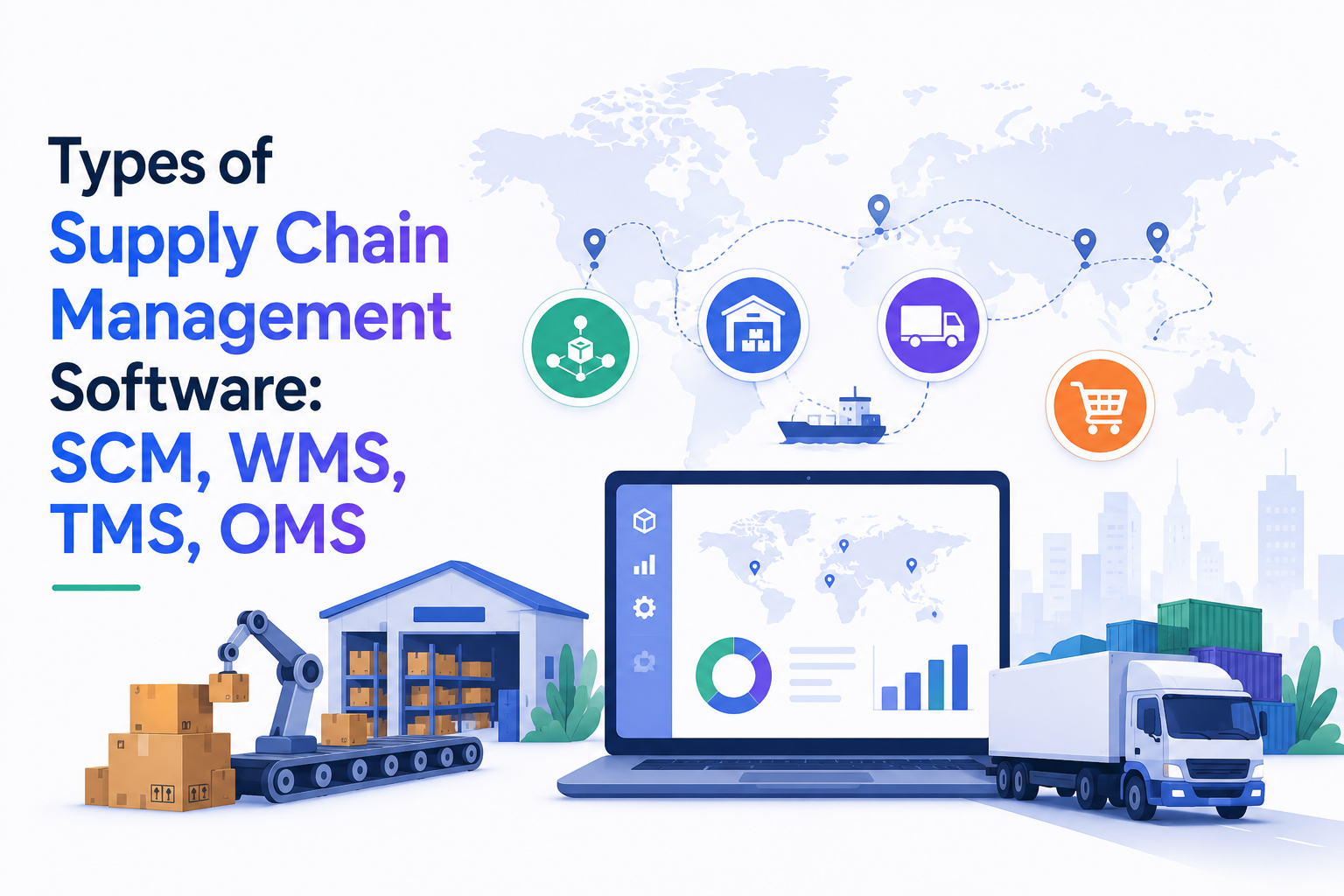
Supply chain management software covers any system that helps a business plan, coordinate, or execute the movement of goods and information across suppliers, warehouses, carriers, and customers. It is not one product but a category of tools, each built for a specific part of that movement.
Supply chain software development rarely means building one product from scratch. It means connecting a handful of systems, each responsible for a distinct stage, which businesses refer to collectively as their supply chain software stack.
The confusion around these categories usually comes from vendors marketing their product as “complete supply chain management software” when it really covers only one or two functions well. Knowing which specific function a system actually handles makes it much easier to evaluate whether it fits a real business need or duplicates something already in place.
Three systems make up the core of most supply chain software stacks, each answering a different question about an order.
An enterprise resource planning (ERP) system often sits above all of these, pulling data from each one into a single financial and operational view, though the specific supply chain management software features each system needs vary by function.
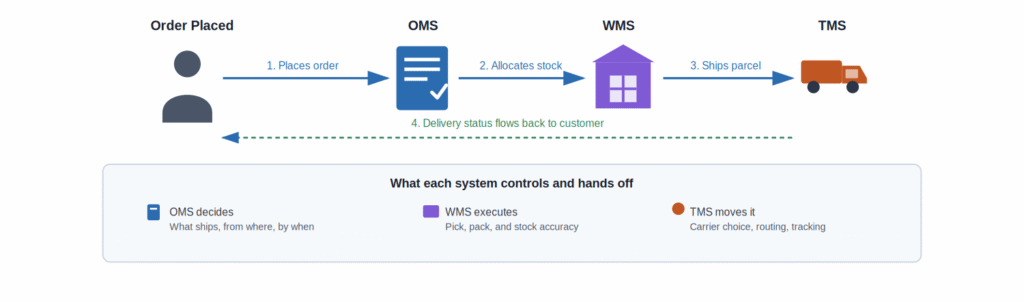
Each handoff depends on accurate, near-real-time data moving between systems. If the WMS confirms a pick but that status takes hours to reach the OMS, a customer-facing tracking page shows stale information even though the warehouse has already moved. The same lag between the TMS and OMS shows up as a shipment that is genuinely out for delivery but still marked processing.
Returns follow the same three systems in reverse, which is often where the weakest handoffs show up first. The OMS has to recognize a return request and reopen the order, the WMS has to receive and re-inspect the physical item before restocking it, and the TMS has to manage the reverse pickup, three coordination points that rarely get the same design attention as the forward shipping flow.
For businesses operating in India, supply chain software has to work inside a specific regulatory and logistics environment that generic global platforms do not always account for well. The e-way bill requirement under GST is the clearest example, since it directly shapes how a TMS or ERP integration needs to be built.
Choosing software that treats these as core requirements rather than add-ons saves a meaningful amount of custom integration work later.
Regional variation compounds this further. A business shipping nationally has to account for different intra-state e-way bill thresholds set by individual states, alongside the uniform inter-state rule, which means a system built only around the national threshold can still generate compliance gaps for certain state-to-state routes.
Businesses generally choose between a single unified suite covering OMS, WMS, and TMS, or integrating separate best-of-breed systems for each function. Each path trades integration effort against per-function fit differently.
| Approach | Integration effort | Flexibility per function | Best fit |
|---|---|---|---|
| Unified suite | Low: Modules share data natively | Limited: Features move at the vendor’s pace | Businesses prioritizing fast setup over deep customization |
| Best-of-breed | High: Each integration built and maintained separately | High: Pick the strongest tool for each function | Businesses with unusual requirements in one specific function |
| Hybrid core plus point solutions | Moderate: One core system plus a few targeted integrations | Moderate: Flexibility where it matters most | Growing businesses that outgrew a single suite in one area only |
India-specific note: Supply chain management software development cost depends heavily on warehouse count, order volume, and integration depth, which is why most vendors don’t publish standardized pricing. Based on comparable regulated logistics integration work in the Indian market, a unified suite implementation typically runs ₹10 lakh to ₹30 lakh in setup cost, a best-of-breed integration project runs ₹20 lakh to ₹50 lakh across systems, and a hybrid approach often falls between the two depending on how many point integrations are involved.
Most integration problems in a supply chain software stack surface during peak order volume, not during a calm testing period. The individual systems perform well in isolation, but the connections between them are where real orders expose gaps.
Data sync lag between the WMS and OMS is one of the most common issues, since a pick confirmation that takes even a few minutes to propagate can cause a customer support team to give a customer inaccurate information about their order. Duplicate or conflicting inventory counts are another frequent problem in retail software development for multi-channel sellers, since each channel’s system otherwise believes it has the full available stock.
Carrier handoff failures are a third common gap. When a TMS does not receive a clean, validated address and order weight from the OMS, shipping labels get generated with errors that surface only after a carrier has already picked up the parcel, turning a cheap fix into an expensive reshipment.
Most integration problems show up after launch, not during development. The framework itself is standardized, but participation across banks and account aggregators is not.
A single account aggregator is not connected to every bank. A customer’s savings account might sit with one while their insurer only connects through another, which breaks a single-consent experience into multiple approvals. Consent screens that bury purpose and duration in fine print also drive higher abandonment than any technical failure does.
Data arriving structured but unparsed catches many teams off guard as well. The account aggregator delivers a machine-readable file, not a categorized summary, so a lending team still needs a parsing and categorization layer before that data becomes usable in an underwriting model. Skipping this step is a common reason integrations look complete in a sandbox but stall once real transaction data starts arriving in production, a gap that usually traces back to how the surrounding fintech software development was scoped in the first place.
Most integration problems in a supply chain stack come from treating each system as a standalone purchase rather than designing the handoffs between them from the start. Zethic builds the OMS-to-WMS-to-TMS data flow as a single connected pipeline before any individual system is finalized, so status updates propagate in near real time instead of arriving in batches. For businesses evaluating a unified suite against best-of-breed systems, Zethic maps the actual handoff requirements first, based on order volume and carrier mix, before recommending either path.
Let Zethic help you build smarter Not just faster
Ram brings deep expertise in product strategy and system architecture across fintech, SaaS, and AI platforms. He specializes in pre-execution planning to help teams build scalable technology foundations and avoid costly rebuilds.

Adding {{itemName}} to cart
Added {{itemName}} to cart