


Start Your Project Today
Tell us about your project — we’ll get back within 24 hours

Founder
User Interface Design
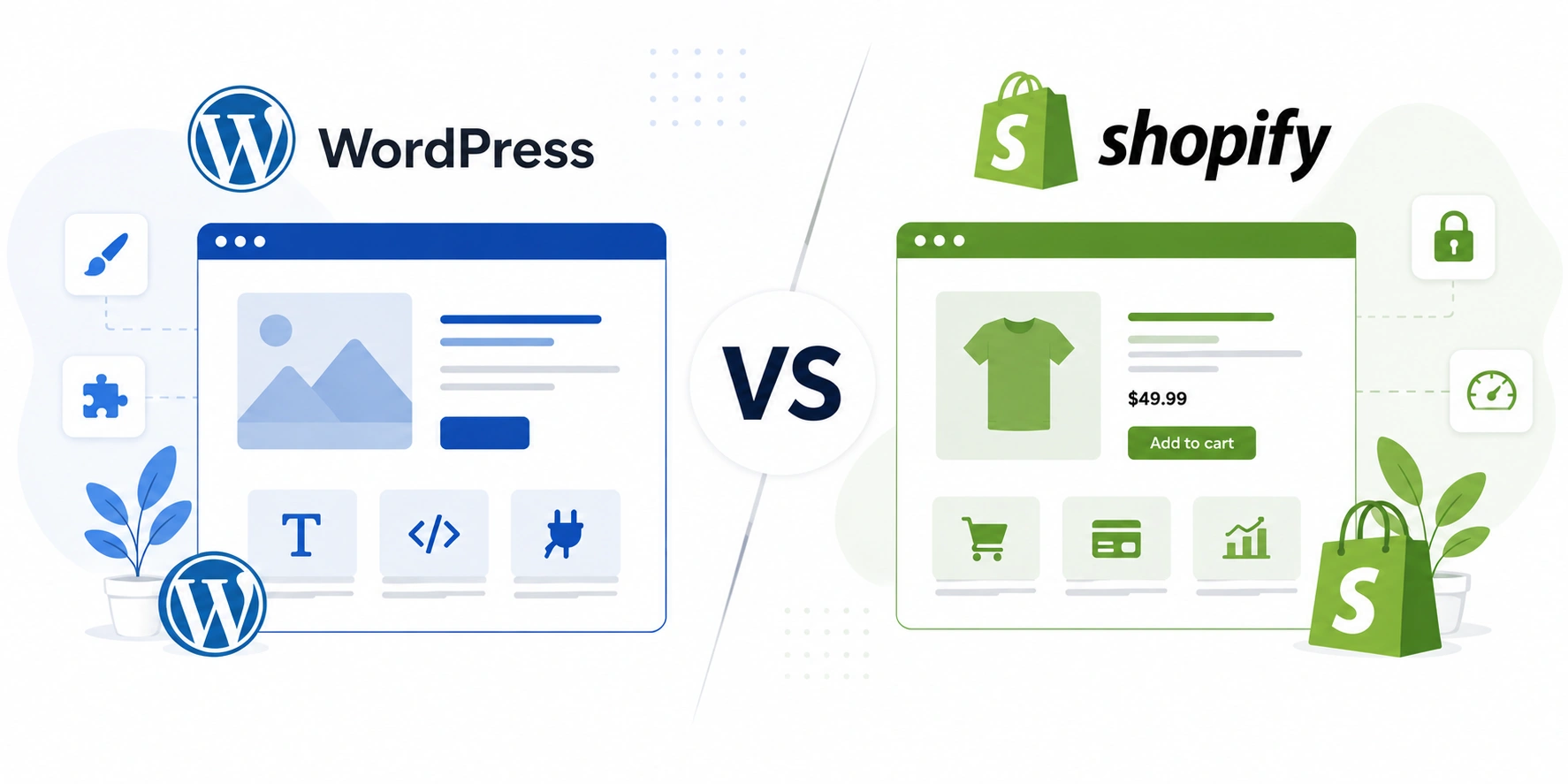
WordPress vs Shopify isn’t really a fair fight because the two solve different problems. WordPress is a content and flexibility platform that powers over 40% of all websites and can sell products through an add-on. Shopify is a selling platform that can also publish content.
Most of the confusion in this decision comes from comparing them as if they were interchangeable, when the right answer usually depends on whether the business is built around content, around products, or genuinely needs both.
This breaks down where each platform actually wins, what they cost in practice, and how to decide which one fits a specific business rather than which one wins on paper.
WordPress is an open-source content management system, with e-commerce added through the WooCommerce plugin. WordPress development service means owning the entire stack: the code, the hosting choice, and every plugin decision that shapes the final site.
Shopify is a fully hosted commerce platform built specifically to sell products online, with hosting, security, and payments bundled in from day one. There’s no server to choose and no core software to patch, since Shopify runs and maintains that layer for every store on the platform.
That structural difference explains almost every other tradeoff between them. WordPress hands over full control of the codebase and hosting, which means more flexibility and more responsibility. Shopify keeps that responsibility on its own infrastructure, which means less flexibility but far less to manage day-to-day.
Shopify’s cost is predictable because it’s bundled: hosting, security, and PCI compliance all come in one monthly plan. WordPress costs less to start but scales in complexity, since hosting, plugins, security, and WooCommerce extensions are all separate line items that add up as a store grows. Ecommerce website development cost always depends more on catalog size and feature scope than on platform choice alone, but the table below covers the baseline difference between the two.
| Cost Factor | WordPress + WooCommerce | Shopify |
|---|---|---|
| Starting cost (Global) | $20 to $100/month (hosting + plugins) | $39 to $399/month, all-inclusive |
| Starting cost (India) | ₹500 to ₹3,000/month (hosting + plugins) | ₹1,499 to ₹22,680/month, all-inclusive (annual billing) |
| Transaction fees (Global) | None with most payment gateways | Additional fee unless using Shopify Payments |
| Transaction fees (India) | Standard gateway fee only, around 2% (e.g., Razorpay) | Shopify’s own fee (2% to 0.5% by plan) plus a separate gateway fee, since Shopify Payments isn’t available in India |
| Scaling cost | Rises with traffic, plugins, and hosting tier | Predictable, tied to the plan tier |
| Best value at | Content-heavy sites with modest sales | High-volume stores want one bundled cost |
Neither platform is categorically cheaper, which is why the WordPress vs Shopify cost comparison really only makes sense at a given scale rather than in the abstract. WordPress usually wins at small scale, and Shopify usually wins at high volume once its bundled infrastructure costs less than piecing together equivalent WordPress hosting, security, and support separately. For Indian merchants specifically, the transaction fee gap is worth watching closely, since Shopify Payments isn’t available in India, so every Shopify store pays both Shopify’s own fee and a separate payment gateway fee on each sale.
WordPress is generally the stronger platform for content-heavy SEO strategies. Plugins like Rank Math and Yoast give granular control over the same fundamentals covered in Google’s own SEO documentation, like metadata, schema, and internal linking, which matter most for businesses that rely on blogs, tutorials, or long-form content to drive organic traffic.
Shopify has meaningfully closed the gap in 2026 with better built-in SEO tools, covering the basics most stores need without a plugin at all. It remains better suited to product-focused SEO than the kind of resource-hub content strategy WordPress handles natively, since its content editor and URL structure are both built around product pages first.
A business selling twenty products with no content plan won’t feel this gap at all. A business publishing weekly articles alongside its store will notice it within the first few months, which is usually the deciding factor in the WordPress vs Shopify SEO comparison more than any single feature.
Shopify wins clearly on maintenance. Updates, security patches, PCI compliance, and uptime are all handled on Shopify’s side, which is why many small teams choose Shopify website development services specifically to avoid managing a codebase at all.
WordPress demands more hands-on maintenance: plugin updates, security monitoring, and hosting management typically need either an in-house resource or an ongoing development relationship. In exchange, WordPress scales without the platform-level constraints Shopify eventually introduces at very high traffic or catalog size, since there’s no vendor-imposed ceiling on what a self-hosted site can be customized to do.
Shopify’s AI tools ship built into the platform and read directly from store data, covering things like product recommendation engines and built-in analytics assistants, often replacing $100 to $200 a month in separate third-party tools.
WordPress covers similar ground through plugins, but stays fragmented: each function usually needs its own plugin, subscription, and data sync setup rather than one connected system. For merchants who want these tools working the moment a store goes live, that difference is a real practical gap, not just a feature checklist item.
The gap narrows considerably for businesses building custom AI functionality rather than relying on off-the-shelf tools. AI chatbot development cost runs roughly the same whether the underlying site is WordPress or Shopify, since a custom-built assistant sits on top of either platform rather than depending on which one is running underneath.
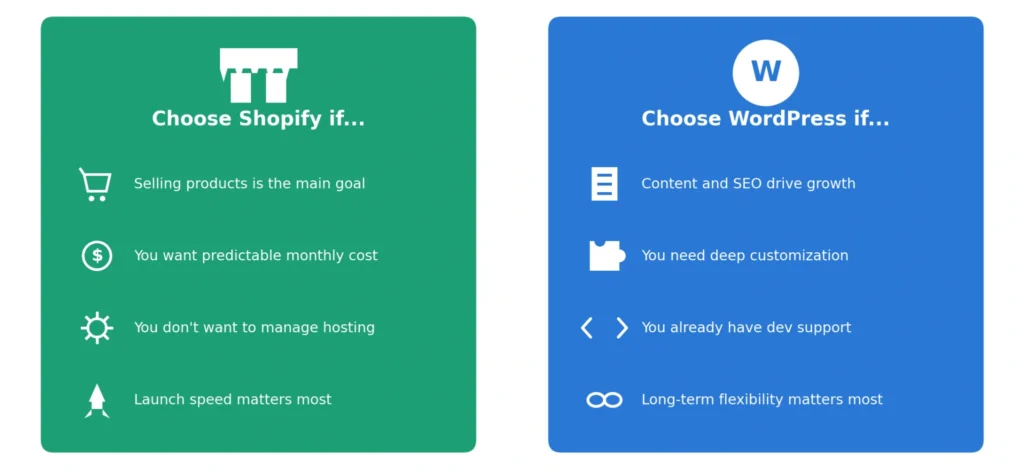
Some businesses genuinely need both: WordPress for a content hub and Shopify for the storefront, connected through an integration rather than forced onto a single platform. That split is more common than it sounds, particularly for brands that built an audience through content before adding a store, or added a blog to an existing store after realizing organic traffic was worth chasing.
The decisions that shape this choice are architecture decisions first: how a store is meant to look and feel over the next three years is different from how it needs to move goods next quarter. Zethic works with founders on both sides of this decision, offering ecommerce development services for building Shopify stores that need custom checkout logic and WordPress sites that need commerce bolted onto existing content operations.
Let Zethic help you build smarter Not just faster
Ram brings deep expertise in product strategy and system architecture across fintech, SaaS, and AI platforms. He specializes in pre-execution planning to help teams build scalable technology foundations and avoid costly rebuilds.

Adding {{itemName}} to cart
Added {{itemName}} to cart