- AI
Artificial Intelligence
Emerging Tech
- Products
AI, Marketing & Sales
Financial Services
Banking
Logistics & Mobility
- Services
Strategy & Innovation
Intelligent Engineering
Partner to Scale
Have a project in mind?
- Industries
FinTech & Banking
Logistics & Supply Chain
Practice spotlight
- ROI Calculator
- Company

- 8 MIN READ
- Views: 18
PWA vs Native App: Which Should You Build First?
By Ram Nethaji
Founder
FinTech app development cost
User Interface Design
Custom software development
FinTech app development services
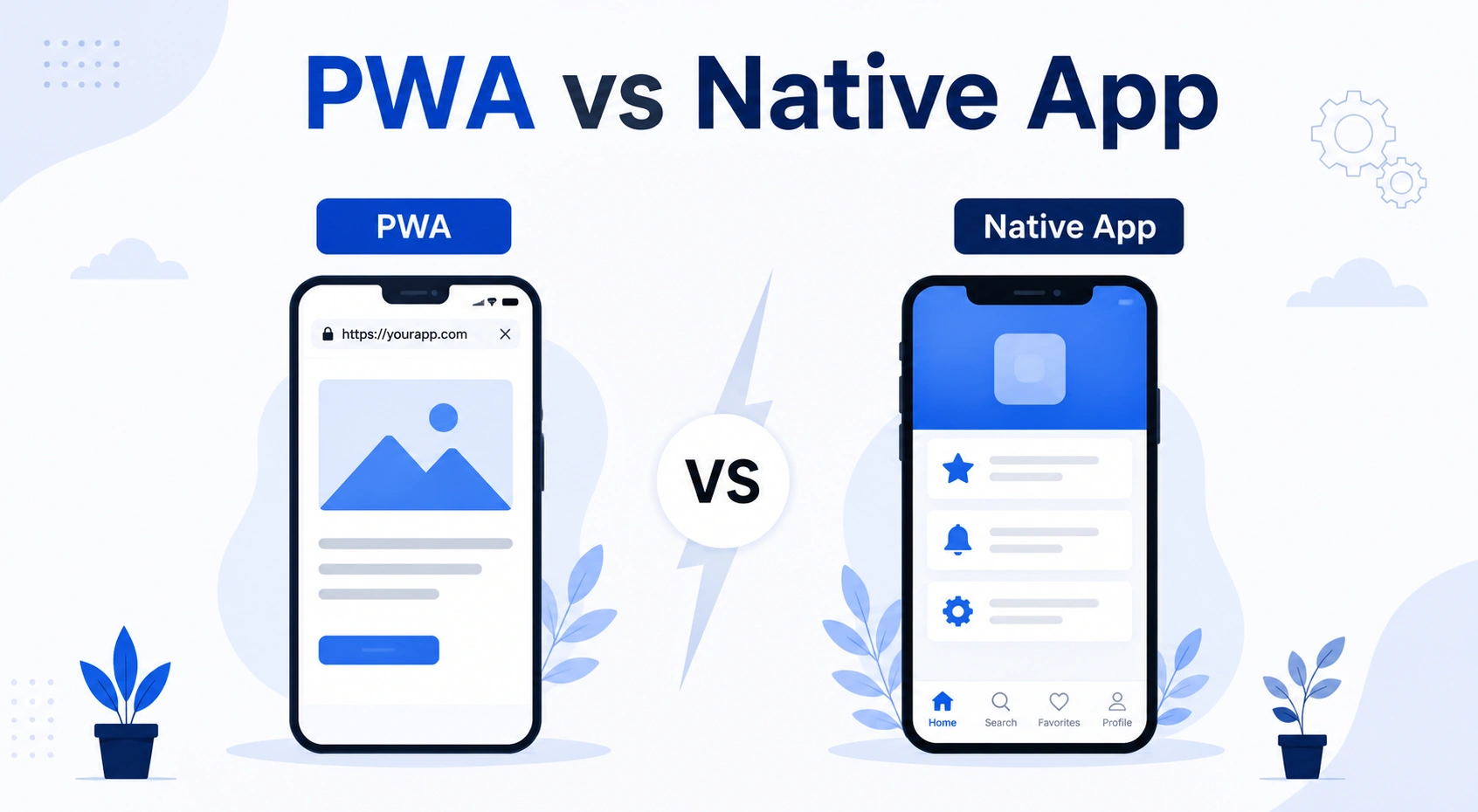
A PWA is usually the faster and cheaper starting point, since it runs from one codebase across every device with a browser. A native app becomes the better choice once you need deep hardware access, app store presence, or performance a browser cannot match. The right first move in the PWA vs native app decision depends on your budget, timeline, and how central mobile experience is to your product. Many businesses end up building both at different stages.
What Is a PWA vs a Native App?
A progressive web app is a specific kind of web application development built with standard web technology that adds app-like behavior through service workers, offline caching, and a home screen icon. It runs inside a browser engine, so one build works across Android, iOS, and desktop without separate codebases. Users can open it directly from a shared link, with no install step required before first use.
A native app is built in the specific language of its platform, such as Kotlin for Android or Swift for iOS, and is distributed through the app store for that platform. This gives it full access to device hardware and the performance ceiling of the operating system itself, at the cost of maintaining a separate build for each platform. Every update also passes through app store review before it reaches users.
The PWA vs native app choice is rarely permanent. Many products start on one path and add the other once specific needs, such as hardware access or app store visibility, become clear enough to justify the investment.
What Are the Real Trade-Offs Between the Two?
Neither approach is universally better in the PWA versus native app debate. The right choice depends on your product’s goals, technical requirements, target audience, and long-term roadmap. As those factors evolve, the best option may change as well.
- Development cost: PWAs typically use a single shared codebase across platforms, while native apps usually require separate development efforts for Android and iOS.
- Distribution: PWAs are accessed through a web URL, whereas native apps are distributed through app stores, which are subject to regulations such as the EU’s gatekeeper obligations for designated platforms.
- Device access: PWAs can access many browser-supported device features, while native apps generally provide broader access to platform-specific hardware and operating system capabilities.
- Performance: PWAs deliver excellent performance for most business applications, while native apps generally remain the preferred choice for graphics-intensive, real-time, or highly performance-sensitive workloads.
- Search visibility: PWAs can be indexed by search engines, whereas native apps primarily rely on app store discovery and optimization.
- Update speed: PWA updates are deployed directly from the server and become available immediately, while native app updates typically require app store review and approval, a factor that can significantly influence mobile app development timelines.
Rather than treating one option as universally superior, businesses should evaluate these trade-offs against their product strategy, user expectations, and future growth plans to determine the most appropriate approach.
What Can't a PWA Do on iOS Today?
Apple has expanded Progressive Web App (PWA) support in Safari over recent years, but some platform-specific limitations remain that are important when evaluating a PWA strategy. These constraints primarily affect iOS and iPadOS, while browser support on Android is generally more comprehensive. If your application depends on advanced hardware access or background processing, these limitations should be considered during planning.
- No Background Sync API: iOS Safari does not support the Background Sync API, so background synchronization after the app is closed is limited.
- Storage management: Web app data may be cleared by the operating system after extended periods of inactivity, depending on available device storage and system policies.
- Limited hardware access: Certain hardware capabilities, including Bluetooth and NFC, have more limited support in iOS PWAs than in native applications.
- Push notifications: Web Push notifications are supported only on newer versions of iOS and iPadOS for PWAs added to the Home Screen, with implementation differences compared to Android.
These limitations do not automatically rule out a PWA. They become most relevant for applications that depend on continuous background synchronization, advanced hardware integration, or platform-specific capabilities on Apple devices.
What Does the Cost and Timeline Actually Look Like?
Development budgets and timelines vary considerably depending on whether you build a single Progressive Web App (PWA) or separate native applications for iOS and Android. For many early-stage products, this difference is one of the primary factors in choosing between the two approaches. Working with an experienced custom software development services partner can help translate these indicative ranges into an estimate tailored to your product requirements.
Table: Illustrative cost and timeline comparison (India)
| Factor | PWA | Native (Single Platform) | Native (iOS + Android) |
|---|---|---|---|
| Typical build cost | ₹4L to ₹12L | ₹15L to ₹40L | ₹25L to ₹70L |
| Typical timeline | 4 to 8 weeks | 3 to 5 months | 5 to 8 months |
| Annual maintenance | Around 15% of build cost | Around 20% of build cost | Around 20% to 25% of build cost |
India’s internet ecosystem is predominantly mobile, with wireless connections accounting for the vast majority of internet subscriptions. Because a PWA runs through the browser on a single codebase, it can reach users across platforms without the additional development and maintenance effort associated with separate native applications for iOS and Android.
When Does a Native App Make More Sense?
Some products genuinely require capabilities that are available only through native mobile development, regardless of the cost advantages of a Progressive Web App (PWA). In these situations, functional requirements should take precedence over development budget, as even a single requirement may justify choosing a native approach.
- Advanced hardware integration: The application depends on features such as Bluetooth devices, advanced camera controls, NFC, or continuous background location tracking.
- App store presence: Your target users expect to discover, download, and trust the product through the Apple App Store or Google Play Store.
- Background processing: Offline functionality requires reliable background synchronization even when the application is not actively running.
- High-performance graphics: The product involves gaming, augmented reality (AR), 3D rendering, video processing, or other graphics-intensive workloads where native performance is important.
For businesses that require broader device capabilities without maintaining two completely separate native codebases, React Native app development is often considered a practical middle ground, offering near-native experiences while sharing much of the application code across platforms.
If none of these requirements are central to your product, a PWA is often the more practical starting point, offering faster development, lower maintenance costs, and broad cross-platform accessibility.
Can You Start With a PWA and Add Native Later?
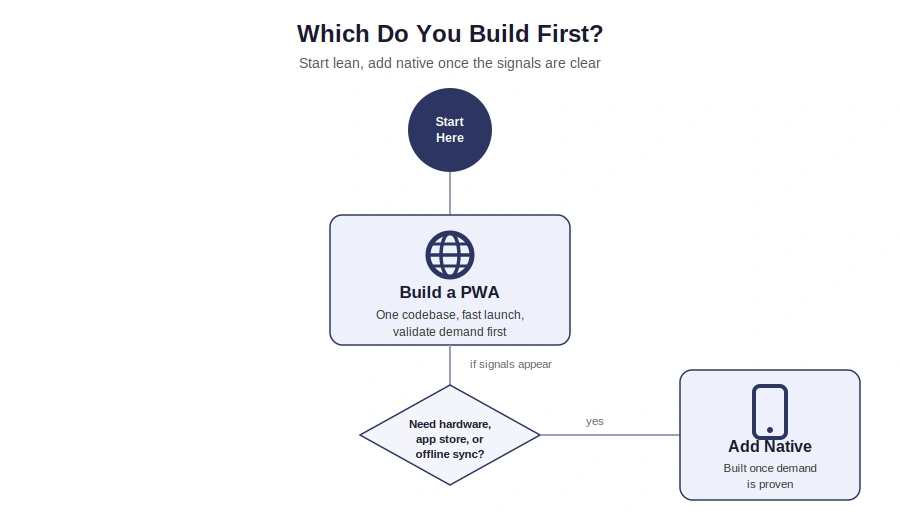
Yes, and it is often the more sensible path rather than a compromise in the PWA vs native app decision. A PWA lets you validate demand, reach users instantly through a link, and gather real usage data before committing to the higher cost of native development.
Once the product proves it needs hardware access, deeper offline support, or app store presence to grow further, native development becomes a justified next investment rather than a guess made before launch. This staged approach reduces the risk of overbuilding for a product that has not yet found its audience, and it also means the native build can be scoped around real usage patterns instead of assumptions made at day one. Planning this path with a custom software development company in Bangalore early on makes the eventual transition to native smoother, since the PWA’s architecture can be built with that future migration in mind from the start.
How Do You Decide Which One Fits Your Business?
Before choosing between a Progressive Web App (PWA) and a native application, evaluate your product against four practical factors. For many early-stage products, the first three factors alone often point toward a PWA as the most cost-effective starting point.
- Development budget: Consider how much you can realistically invest in the initial build and ongoing maintenance.
- Time to market: Determine how quickly the product needs to launch and whether faster iteration is a priority.
- Device capabilities: Assess whether your application depends on advanced hardware features such as Bluetooth, NFC, background location, or intensive camera access.
- App store presence: Evaluate whether your target audience expects to discover and install the product through an app store or whether browser-based access is sufficient.
Every product has different technical and business priorities, so the right choice depends on balancing these factors against your long-term goals. At Zethic, we help founders evaluate both approaches by reviewing product workflows, hardware requirements, scalability, and business objectives before recommending the most appropriate development path.
Let Zethic help you build smarter Not just faster
Frequently Asked Questions
Can a PWA send push notifications on iOS?
Yes, but only on newer iOS versions, and the reach and reliability are narrower than push notifications on Android.
Does building a PWA hurt or help SEO?
It helps. PWAs are standard web pages that search engines can crawl and index, unlike native apps, which depend entirely on app store search.
Do PWAs feel less trustworthy without an app store listing?
Some users still associate app store presence with legitimacy, though this gap is narrowing as more established brands use PWAs alongside or instead of native apps.
How much cheaper is a PWA than a native app in India?
A PWA typically runs ₹4L to ₹12L versus ₹15L to ₹40L for a single native platform, as shown in the cost breakdown above, largely because it uses one codebase instead of separate development for each platform.
Can a PWA access the camera and GPS?
Yes, browsers support camera and location access, though deeper hardware features like Bluetooth and NFC remain native-only.
Is it harder to maintain two native apps than one PWA?
Generally yes, since two native codebases mean two sets of updates, bug fixes, and platform-specific testing, while a PWA maintains one codebase for all devices.