


Start Your Project Today
Tell us about your project — we’ll get back within 24 hours

Founder
User Interface Design
Last-mile delivery now makes up more than half of total shipping costs, and that share keeps climbing as customer expectations for speed rise. The software chosen to manage that final leg, whether bought off the shelf or built from scratch, decides how much of that cost stays under control. Getting this decision wrong tends to show up months after launch, not on day one.
Delivery management software is a system that coordinates the movement of goods from a warehouse, store, or hub to a customer’s door. It typically connects order data, driver assignments, and route planning into a single dashboard so dispatchers can see and adjust operations in real time.
Most platforms also give drivers a mobile app for navigation, proof of delivery, and status updates, while customers get tracking links and notifications. This kind of coordination overlaps closely with logistics app development, since the software usually needs to talk to inventory systems, payment processors, and existing business tools rather than operate on its own. On the payments side specifically, businesses handling cash-on-delivery, refunds, or driver payouts at scale often bring in dedicated payment gateway software development services to make sure that layer is reliable rather than a thin bolt-on integration.
The exact feature set depends on the business, but a few capabilities show up in almost every serious platform.
Businesses building a platform from scratch often start with a narrower set of these features, then expand as operations grow; the same progression most logistics app types, features, and development steps tend to follow.
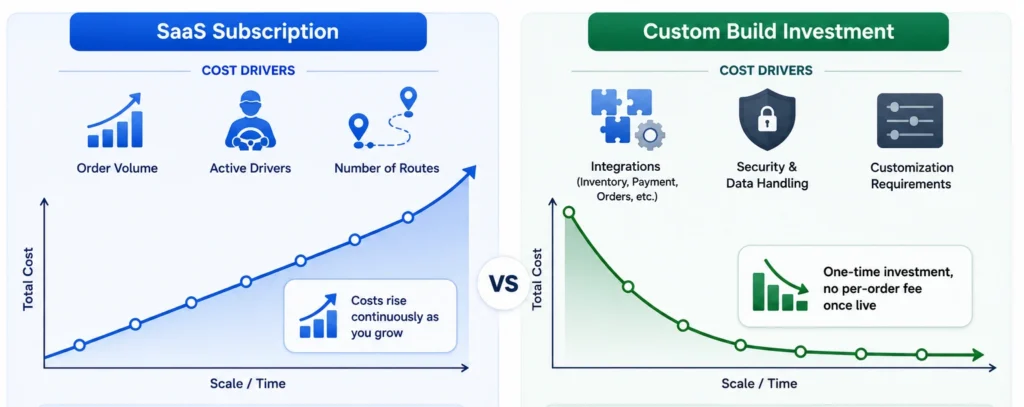
What actually drives the cost on each side comes down to a few recurring factors:
The gap between these two paths widens with scale. A growing courier or retail operation that outgrows a SaaS plan’s limits often ends up paying more in upgrade fees than it would have spent on logistics app development costs for a right-sized system from the start.
The decision usually comes down to three factors: how specific the business’s delivery workflow is, how fast it needs to launch, and how much ongoing engineering support it can commit to internally.
| Factor | Build | Buy | White-Label |
|---|---|---|---|
| Upfront cost | Highest | Lowest | Moderate |
| Timeline | 3 to 6 months | Days to weeks | 4 to 8 weeks |
| Control | Full | Limited to vendor settings | Partial customization |
| Ongoing cost | Internal maintenance | Recurring subscription | License plus customization fees |
| Best fit | Businesses with unique workflows | Small operations with standard needs | Businesses wanting a branded app fast |
White-label tends to get skipped over in this comparison, but it solves a specific problem the other two don’t. A retailer that needs to launch in 8 weeks but still wants a branded checkout and tracking experience, rather than a subscription with someone else’s logo on it, is the clearest case for going white-label. The underlying platform is already built, so what’s left to configure is branding, a narrower set of workflows, and a handful of integrations rather than the full feature set.
Many businesses land somewhere in the middle, buying a base platform, then commissioning custom work once specific gaps show up, the same tradeoff that shows up when comparing logistics app development against in-house teams.
Timelines vary sharply between the three paths described above.
Testing tends to be the phase businesses underestimate most, particularly around route optimization accuracy and driver app reliability under real conditions. Skipping this step to launch faster usually means fixing the same problems later, once real deliveries are already failing, rather than following a blueprint for building an intuitive logistics app from the start.
India’s logistics costs have fallen to 7.97% of GDP, the headline number from a joint assessment of logistics costs commissioned by the country’s industry ministry. This marks a sharp drop from the 13 to 14% figures long assumed to represent the country’s logistics overhead.
For businesses building delivery software with development teams based in India, this shift matters beyond the logistics sector itself. Lower logistics overhead nationally tends to accompany stronger digital infrastructure and more mature software talent, both of which lower the real cost of custom delivery platform development compared to markets where hourly rates run several times higher.
The throughline across cost, features, and timeline comes down to fit: a delivery management platform only pays for itself when it matches how the business actually operates, not a generic workflow borrowed from a SaaS template. That fit matters more than whether the software gets bought, built, or licensed as white-label.
This is the kind of scoping Zethic works through directly with businesses building or upgrading delivery operations, as part of our broader logistics software development practice, from a first MVP through full custom platforms tied to existing warehouse and order systems. Whether the right starting point is a lean build or a hybrid setup layered on a purchased platform depends on the same cost, timeline, and workflow questions this article has walked through.
Let Zethic help you build smarter Not just faster
An MVP with core routing logic typically takes a few months. Full production systems with multiple integrations and real-time re-routing take longer.
Custom builds vary widely by scope, but they generally cost more upfront than a SaaS subscription while avoiding the recurring per-order fees that scale with volume.
Most modern platforms are built to connect with order management, inventory, and payment systems, though the integration effort depends on how outdated the existing systems are.
Outgrowing a SaaS plan’s limits or under-scoping a custom build both lead to expensive rework later, usually after the business has already scaled around the wrong system.
White-label platforms typically allow branding and workflow adjustments but not the deep customization a fully custom build provides.
Ram brings deep expertise in product strategy and system architecture across fintech, SaaS, and AI platforms. He specializes in pre-execution planning to help teams build scalable technology foundations and avoid costly rebuilds.

Adding {{itemName}} to cart
Added {{itemName}} to cart