


Start Your Project Today
Tell us about your project — we’ll get back within 24 hours

Founder
User Interface Design
Payment orchestration is a layer that sits between a business and its payment service providers, routing each transaction to the best available processor based on cost, success rate, or region. Instead of integrating with every PSP directly, a business connects once to the payment orchestration layer and lets it manage the rest.
This matters most for businesses running multiple PSPs or operating across regions, where a single processor underperforming can directly cost revenue. Without payment orchestration, adding each new processor or local payment method becomes its own standalone integration project, one that has to be maintained indefinitely rather than configured once.
This kind of routing decision overlaps with the broader question of build vs. integrate decisions in custom fintech app development, since the same tradeoff shows up across most fintech software development work, not just payments.
Orchestration gets talked about as one product, but it is really several distinct layers doing different jobs.
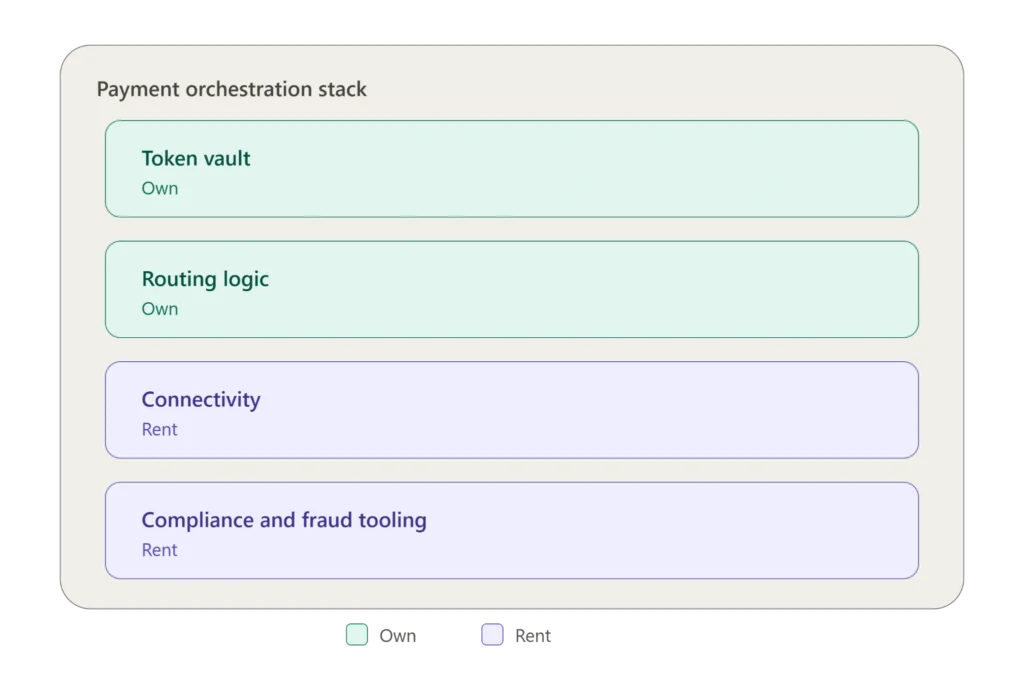
Connectivity and compliance tooling sit on the other side of the split. These are the layers that change constantly and rarely set one business apart from another.
| Layer | Own or rent | Why |
|---|---|---|
| Token vault | Own | Holds switching cost and lock-in risk |
| Routing logic | Own | Reflects the business’s own cost and approval-rate data |
| PSP connectivity | Rent | Changes constantly, no lasting advantage from building it |
| Compliance and fraud tooling | Rent | Regulatory requirements shift faster than most teams can track |
Connectivity in particular tends to multiply in scope the moment a business expands into a new market or adds a payment method, a pattern that shows up clearly in the compliance work behind building a payment gateway in India. A team that owns connectivity in-house ends up maintaining a growing list of provider-specific quirks, from settlement file formats to authentication flows, time that a rented connectivity layer frees up for work that actually shapes the customer experience.
Fraud tooling follows the same logic. Detection models improve constantly as new fraud patterns emerge, and specialist providers update those models across their entire customer base rather than one business alone. Payment orchestration built around rented fraud tooling gets the benefit of that shared learning without carrying the cost of building it independently.
PCI DSS compliance applies no matter how the payment orchestration stack gets split, since it governs how cardholder data gets stored, processed, and transmitted. The standard itself, maintained by the PCI Security Standards Council, applies to any entity that stores, processes, or transmits cardholder data, not just the vendor handling the connection.
This is exactly the kind of layer worth renting rather than building. Certification, audits, and the constant tracking of new requirements are better handled by a specialist than absorbed as a permanent internal function, even when the routing logic sitting on top of it stays fully owned.
The scope of PCI DSS also depends on how much of the transaction flow a business touches directly. A business that never handles raw card data, because a rented connectivity layer takes on that responsibility, faces a much lighter compliance burden than one storing and transmitting cardholder data itself.
The layer-by-layer split matters more than the build-versus-buy label attached to it. A business can own its routing logic and token vault while renting connectivity and compliance, without that being a compromise between two extremes. That combination is itself a form of payment orchestration, just one built around ownership rather than a single vendor’s package.
This is the kind of split Zethic works through directly with businesses building payment gateway software development infrastructure, identifying which layers are worth owning outright and which are better left to specialists who track compliance and connectivity full time, as part of our broader fintech software development in Bangalore practice. Getting that split right at the start avoids the more expensive version of this decision made later, after a provider or a regulation has already forced the question.
Let Zethic help you build smarter Not just faster
Only businesses running multiple payment providers or operating across regions typically need to make this decision at all, since a single-PSP setup rarely needs a dedicated orchestration layer. Checkout design and the customer-facing side of payments remain a separate decision, usually handled by a fintech design agencyrather than the orchestration layer itself.
Ram brings deep expertise in product strategy and system architecture across fintech, SaaS, and AI platforms. He specializes in pre-execution planning to help teams build scalable technology foundations and avoid costly rebuilds.

Adding {{itemName}} to cart
Added {{itemName}} to cart