


Start Your Project Today
Tell us about your project — we’ll get back within 24 hours

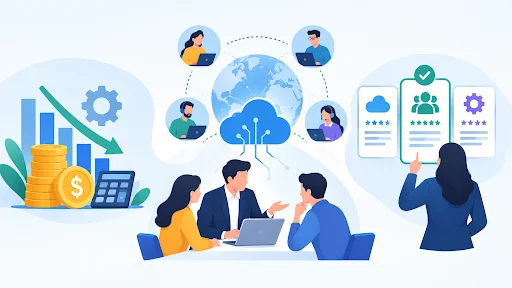
A business pays a well-known firm for a polished strategy deck, then discovers the contract never included building anything, and has to hire a second team to execute what the first one recommended. Digital transformation consulting only delivers value when the business knows exactly what it is paying for before signing, not after the first invoice arrives. Cost, the outsourcing decision, and the choice of partner are three parts of the same question, not three separate ones.
Digital transformation consulting is external support for planning and, in some cases, executing the technology and process changes a business needs to make. The critical distinction is between advisory-only work, which produces a strategy or roadmap, and execution-inclusive work, which also builds the systems and manages the rollout. This same distinction separates a one-time assessment from digital transformation services that continue into execution as an ongoing part of the work.
Confusing these two is the single most common cause of budget disputes. A business that buys advisory-only work and expects a working system at the end of it will typically be disappointed, regardless of how good the strategy document turns out to be. The reverse mismatch happens too: a business that only needed a second opinion on direction ends up paying execution-level rates for work it did not actually need done.
Cost depends far more on which of the two work types above is being purchased than on the size of the business buying it. Two quotes that look wildly different in price are often pricing entirely different scopes, not different levels of quality for the same work.
| Consulting Scope | Cost (USD) | Cost (India, ₹) |
| Advisory only (strategy, roadmap, assessment) | 15,000-80,000 | ₹12 lakh-₹65 lakh |
| Execution-inclusive, single workstream | 80,000-400,000 | ₹65 lakh-₹3.2 crore |
| Execution-inclusive, multi-year program | 400,000-2,000,000+ | ₹3.2 crore-₹16 crore+ |
Day rates for individual consultants within these figures commonly range from roughly $150 to $400 depending on seniority, based on published government procurement rate cards for comparable public-sector work. The India-side figures run lower mainly because of the difference in consulting labor cost between the two markets, not because the scope of work is smaller. Smaller organizations facing tighter budgets encounter this same trade-off, and digital transformation for SMEs commonly narrows scope rather than compressing price to fit a smaller budget.
Strategy and business-model decisions are usually better made by people who will live with the consequences, which argues for keeping them in-house. Execution and specialist skills, the kind needed for a short period rather than permanently, are where outsourcing tends to work best. Specialist needs like AI consulting and audit illustrate the kind of short-term skill this applies to.
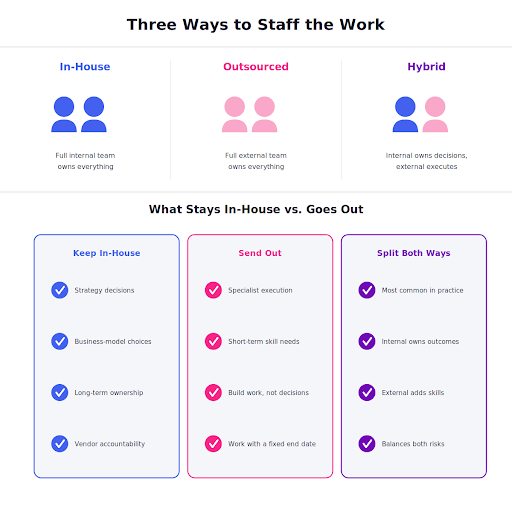
A hybrid model, internal ownership of decisions paired with external teams for execution, tends to combine the strengths of both rather than forcing a single all-or-nothing choice. Paying for outside skills is rarely the most expensive part of an outsourcing decision; choosing the wrong partner, or the wrong split of ownership, causes more cost than the skills themselves. Most businesses that later regret an outsourcing decision regret the split of responsibility, not the fact that they outsourced at all.
The choice matters more than the price, since a mismatched partner results in comparable financial loss regardless of which cost tier the business paid for. The criteria below matter more at the execution-inclusive tier, where a poor match costs far more to unwind.
A firm that resists including any of these terms in the contract signals a risk worth addressing before any payment is made. Contractor evaluation criteria in government procurement formally require evaluating past performance and technical fit alongside price, not price alone.
A global survey on digital transformations found that only 16 percent of respondents reported that their digital transformation both improved performance and sustained that improvement over time. Outsourcing the work does not change this figure on its own, since the same planning gaps that affect in-house programs affect outsourced ones.
Because the same 16 percent figure applies broadly, a poorly chosen partner does not introduce a new risk; it simply fails to reduce the risk that already exists. The criteria in the previous section exist specifically to close that gap rather than leave it to chance.
The right approach starts with deciding whether the business needs advisory-only work or execution-inclusive work, before requesting a single quote. Comparing prices across mismatched scopes is the most common reason businesses feel they overpaid afterward. Getting this one decision right before any vendor conversation begins tends to matter more than any other choice in the process.
Zethic works with business and technology leaders to define that scope clearly upfront, then delivers execution-inclusive work with named accountability rather than a strategy document that still needs a second vendor to build.
Ram brings deep expertise in product strategy and system architecture across fintech, SaaS, and AI platforms. He specializes in pre-execution planning to help teams build scalable technology foundations and avoid costly rebuilds.
