


Start Your Project Today
Tell us about your project — we’ll get back within 24 hours

Founder
User Interface Design
FinTech app development services
GDPR reaches beyond the EU’s borders through Article 3, which sets two tests for whether a non-EU company falls under the regulation. The first is establishment: if an Indian fintech has any real presence in the EU, even a single employee acting with reasonable stability, GDPR applies to processing connected to that presence.
The second test is targeting, and this is the one that actually catches most Indian-built fintech apps. GDPR applies if the app offers goods or services to people in the EU, whether or not payment is involved, or if it monitors their behavior through tools like analytics or tracking cookies. Signals that indicate targeting include pricing in euros, marketing aimed at EU users, or support content in EU languages.
A fintech app built entirely for the Indian market, with no EU marketing, pricing, or user base, generally sits outside GDPR’s scope. One that lets EU residents sign up, prices in euros, or actively markets to European users falls squarely within it.
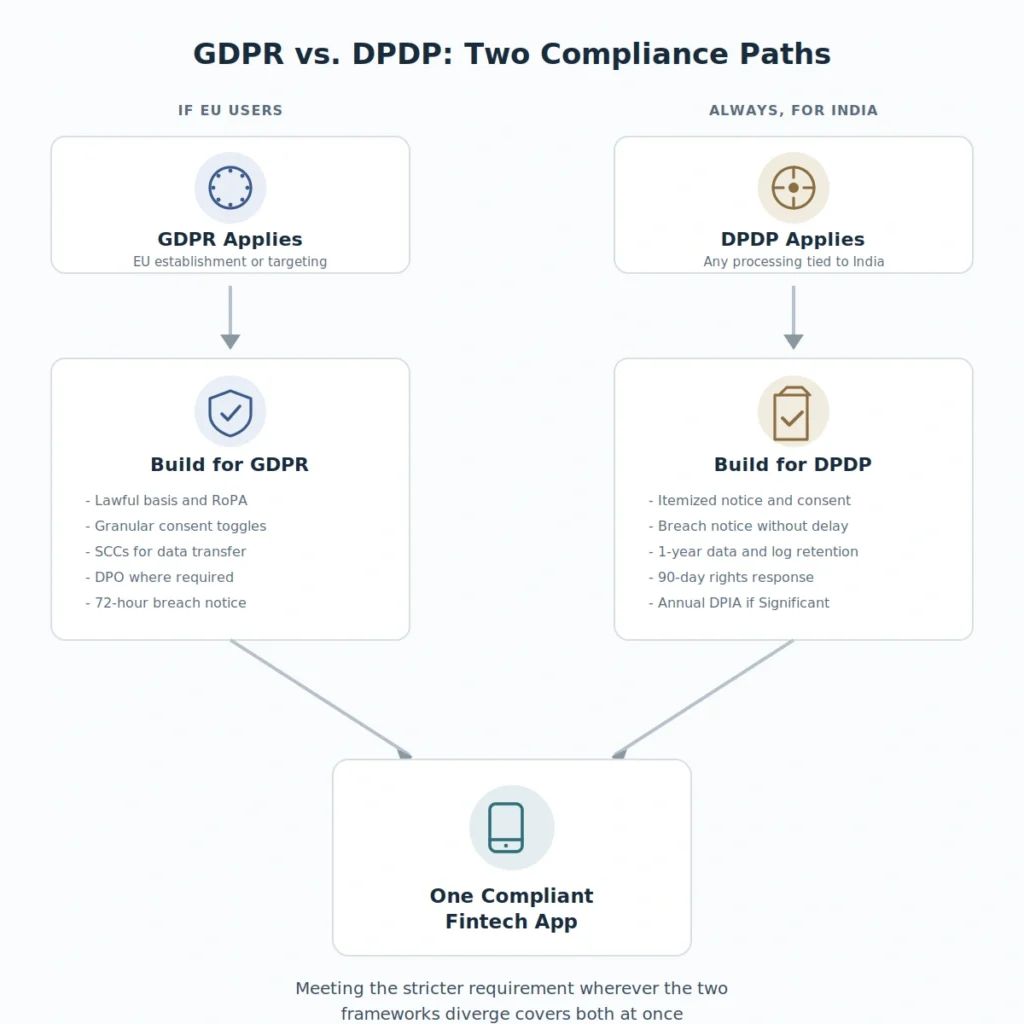
India’s Digital Personal Data Protection Act, 2023, with its DPDP Rules notified in November 2025, is the law that applies to a fintech app built in India regardless of whether GDPR ever comes into play. It covers any processing of digital personal data within India, and it extends to foreign entities offering goods or services to people located in India as well.
The DPDP framework rests on principles that will look familiar from other privacy laws: consent and transparency, purpose limitation, data minimization, accuracy, storage limitation, security safeguards, and accountability. A fintech operating only in India still needs to meet these requirements in full, since GDPR exposure and DPDP exposure are separate questions with separate answers.
| Factor | GDPR | India’s DPDP Act |
|---|---|---|
| Applies to an India-built app | Only if EU-established, EU-targeting, or EU-monitoring | Yes, for any processing connected to India |
| Breach notification to the regulator | Within 72 hours of becoming aware | Without delay, per DPDP Rules |
| Maximum penalty | Up to €20 million or 4% of global turnover | Up to ₹250 crore per violation |
| Data Protection Officer | Mandatory in specific cases | Required for Significant Data Fiduciaries |
| Cross-border data transfer | Requires an adequacy decision or safeguards like SCCs | Generally permitted, subject to government-specified restrictions |
| Compliance timeline | Already in force since 2018 | Phased through May 2027 |
Once GDPR genuinely applies, a fintech needs a lawful basis for every category of personal data it processes, documented in a Record of Processing Activities. Consent has to be freely given, specific, and easy to withdraw, which usually means separate, granular toggles rather than a single accept-all checkbox.
Cross-border transfers out of the EU need a legal mechanism behind them, typically Standard Contractual Clauses, since India does not currently have a GDPR adequacy decision. A fintech handling large-scale or sensitive data processing, such as payment gateway security infrastructure, may also need to appoint a Data Protection Officer and conduct a Data Protection Impact Assessment before launching a new feature that carries real privacy risk.
Every Data Fiduciary under the DPDP Rules has to give a clear, itemized notice before collecting personal data, describing exactly what is collected and why. This applies just as much to a KYC and AML module as to any other part of a fintech app, since consent has to be specific and informed, and a user has to be able to withdraw it as easily as they gave it.
Most of these Rules take full effect by May 2027, but a fintech that waits until the deadline to start building consent flows and breach pipelines will be retrofitting under time pressure rather than designing it in from the start.
GDPR penalties run in two tiers under Article 83: up to €10 million or 2 percent of global turnover for procedural failures, and up to €20 million or 4 percent for violations touching core processing principles or data subject rights, whichever figure is higher in either case. Regulators weigh factors like the severity and duration of the violation and how cooperative the company was once it was discovered.
India’s DPDP Act sets its own penalty ceiling at ₹250 crore for the single most serious violation, a failure to maintain reasonable security safeguards. Failing to notify the Data Protection Board or affected users of a breach, or violating obligations related to children’s data, can each draw penalties up to ₹200 crore, with other violations capped at ₹50 crore, which is why technical compliance and governance need to be built into a fintech app rather than added after the fact.
The right starting point isn’t a generic privacy checklist pulled from a GDPR overview. It’s an honest map of exactly which users a fintech app actually serves, a question that sits at the center of fintech and banking software development generally, since that single fact determines whether GDPR applies at all and shapes how DPDP compliance needs to be built alongside it.
Getting there usually means data protection and privacy engineering work upfront, mapping real data flows before a single consent screen or breach notification pipeline gets built.
When a fintech’s user base spans India and the EU, or its data flows are complex enough that a generic compliance template doesn’t fit, Zethic works with product and compliance teams through exactly this evaluation, building consent, breach notification, and retention systems suited to where the app’s users actually are.
Let Zethic help you build smarter Not just faster
No, though the two share similar principles. DPDP applies to any fintech app processing personal data connected to India, while GDPR applies only when a specific EU connection exists. A fintech may need to comply with both, one, or neither, depending on its user base.
Ram brings deep expertise in product strategy and system architecture across fintech, SaaS, and AI platforms. He specializes in pre-execution planning to help teams build scalable technology foundations and avoid costly rebuilds.

Adding {{itemName}} to cart
Added {{itemName}} to cart