


Start Your Project Today
Tell us about your project — we’ll get back within 24 hours

Budgeting for a custom AI agent is hard because vendors quote wildly different prices for what sounds like an identical request, sometimes ten times apart. The reason is that the word “agent” gets used for everything from a scripted chatbot to a system that reasons, plans, and takes action on its own. Once a project is mapped to its actual complexity, AI agent development cost in India settles into three fairly predictable tiers: ₹2 lakh for a single-task agent, up to ₹1 crore or more for a multi-agent enterprise system.
AI agent development cost in India breaks down into three broad tiers based on complexity, not on vague labels like “basic” or “full-featured” that mean different things to different vendors.
| Tier | Cost Range (INR) | What It Typically Includes |
| Single-task agent | ₹2 lakh – ₹8 lakh | One clear function, one or two integrations, limited memory |
| Mid-complexity agent | ₹10 lakh – ₹40 lakh | Multiple integrations, workflow logic, ongoing memory |
| Enterprise multi-agent system | ₹50 lakh – ₹1 crore+ | Multiple coordinated agents, governance, audit trails |
These ranges reflect the full delivery cycle: scoping, development, integration, testing, and initial deployment support. A business automating a single well-scoped task lands at the low end, while a business coordinating several departments through one system, such as agentic AI in fintech development, lands at the high end.
The range within each tier reflects concrete scope variables: Number of source and destination systems, volume of test scenarios required for the agent’s decision logic, and whether the agent needs a persistent memory store or can operate statelessly per session.
Two businesses can describe what sounds like an identical request and receive quotes that differ by 10 times or more. The gap usually comes down to what is actually being built behind the word “agent.”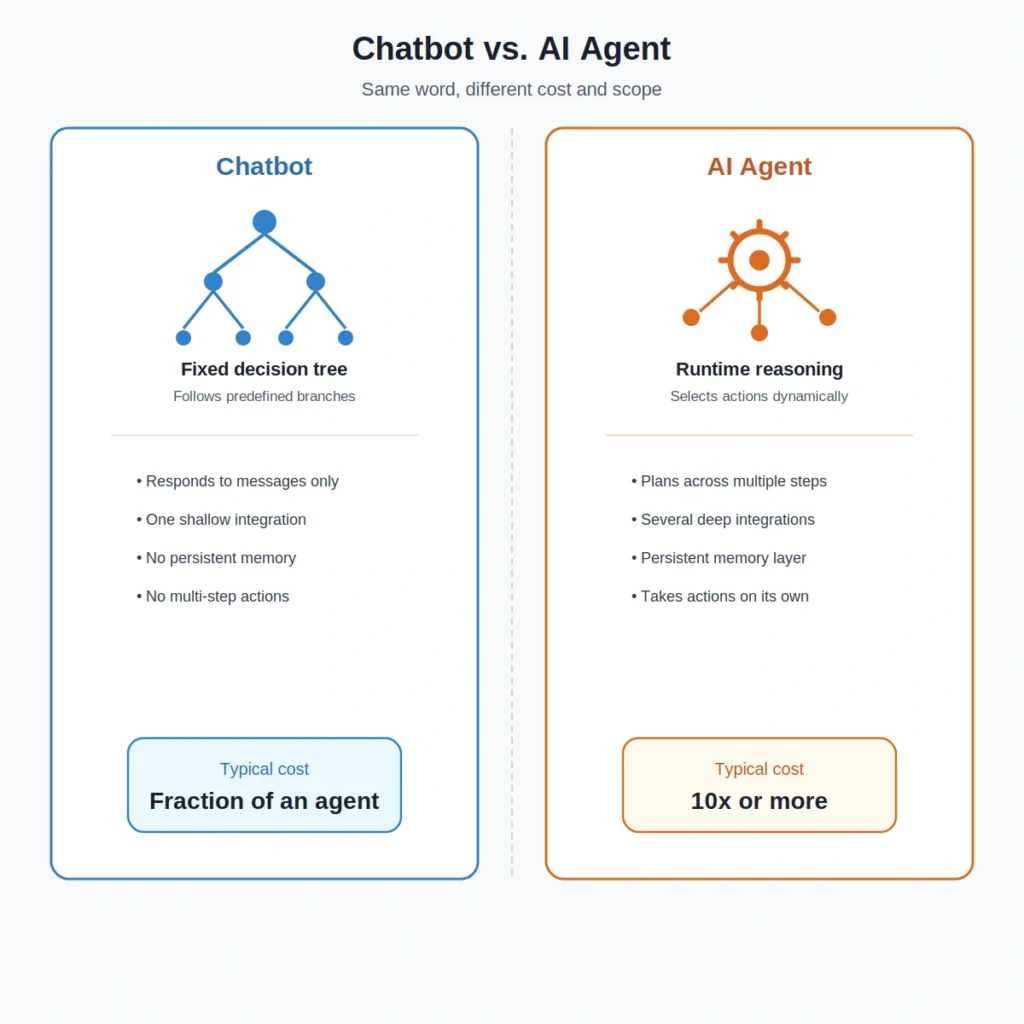
Before comparing quotes, it helps to ask exactly what each vendor means by “agent,” since the word alone carries almost no pricing information on its own.
A concrete way to separate the two is to check whether the system uses a fixed decision tree with predefined branches, or a language model that reasons over context and selects actions dynamically at runtime. The second pattern is what agentic AI development delivers: orchestration logic, tool-calling infrastructure, and a state or memory layer, which is what the higher end of the quote range pays for.
AI agent development cost in India is shaped by a distinct set of factors beyond complexity alone: the engineering talent pool, the regulatory environment, and the infrastructure choices that go into building on Indian AI infrastructure.
Accounting for these factors upfront keeps compliance work inside the original budget and timeline, rather than as a separate cost added mid-project.
Building compliance requirements into the initial architecture, such as data residency in the storage layer and audit logging at the orchestration layer, typically costs less than adding these as separate modules later, since both usually require access to the same underlying data pipelines and decision logs.
The initial development cost covers the build phase only. An AI agent in production carries a separate set of recurring operational costs tied to usage, infrastructure, and maintenance.
A reasonable rule of thumb is to budget 15 to 25 percent of the initial development cost per year for these ongoing needs, though usage-heavy agents can run higher.
Budgeting for these costs from the outset keeps the agent’s decision quality aligned with the data and workflows it was built against, since model behavior, API pricing, and integration endpoints all shift over the system’s operating life and are easier to account for as a planned line item than an unplanned one.
Rather than guessing which tier applies, a business can check its own project against a short set of scope markers that map fairly reliably to the three cost tiers above.
A project matching “one task, no actions, no memory, no regulated data” is a single-task agent by definition, independent of how a specific vendor names or tiers their offering. That scope sits at the level AI development work typically starts at, and checking a project against these markers before requesting quotes makes it far easier to map a specific request to the right cost tier.
A fair quote should be traceable back to a specific scope, not handed over as a single number with no explanation of what drives it. Businesses that understand this framework going in are far better positioned to evaluate whether a quote actually matches what they asked for.
Zethic builds custom AI agents for businesses across fintech, logistics, and general software use cases, scoping each project against the same complexity factors covered above rather than a flat rate card. Zethic works through the actual integrations, autonomy level, and compliance needs a project requires before quoting, so the number a business receives reflects the real scope of the work.
The wide quotes that make this budgeting exercise feel unpredictable stop being confusing once a project is mapped to its actual complexity. AI agent development cost in India settles into three distinct price points once a build is scoped this way, not one vague category with an unpredictable price tag attached.
Ram brings deep expertise in product strategy and system architecture across fintech, SaaS, and AI platforms. He specializes in pre-execution planning to help teams build scalable technology foundations and avoid costly rebuilds.
