


Start Your Project Today
Tell us about your project — we’ll get back within 24 hours

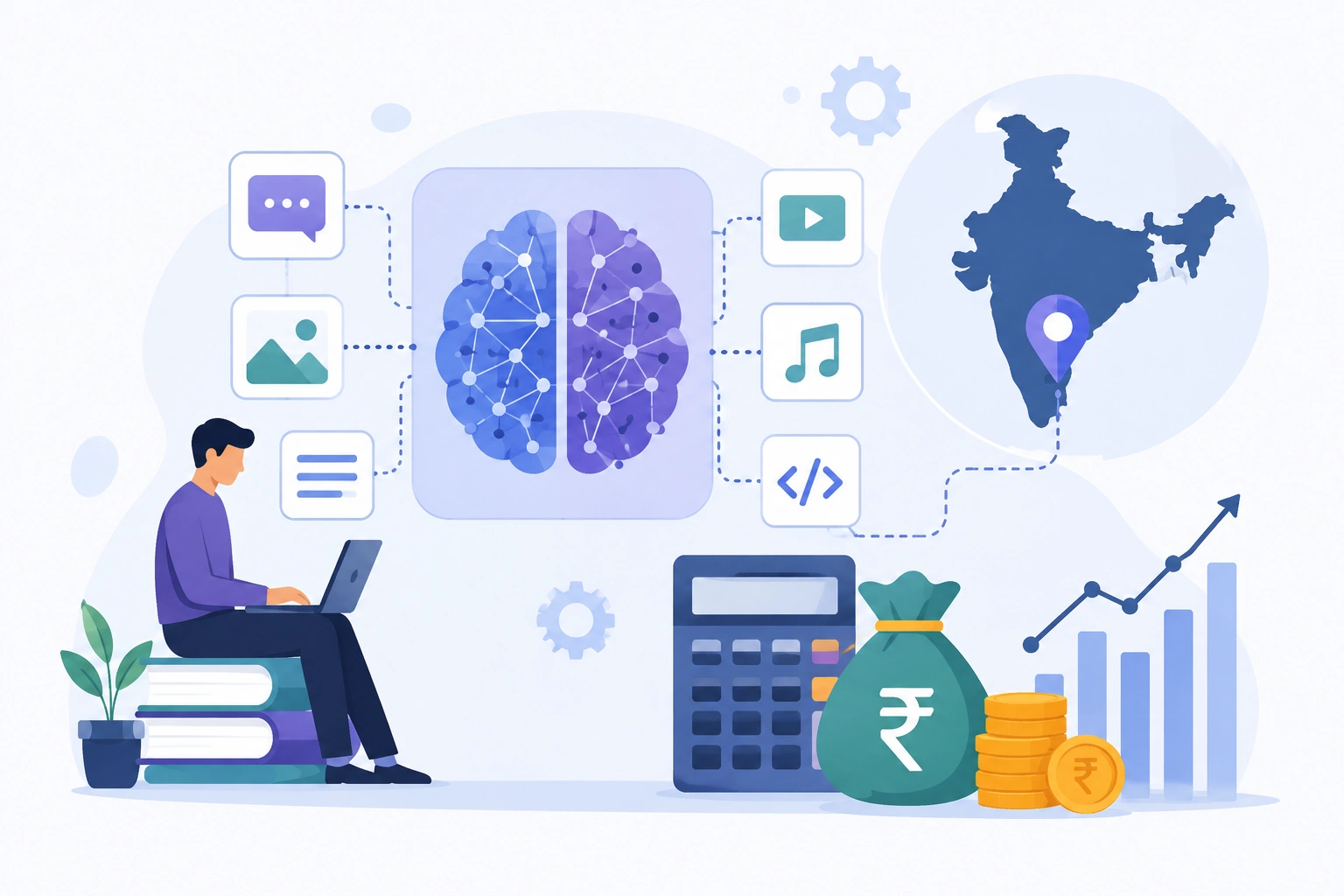
Budgeting for a generative AI project takes a different approach than a typical software estimate, since quotes for what sounds like the same request can vary by 10 times or more. The reason is that the phrase “generative AI” covers wildly different scopes, from a simple prompting layer over an existing model to a fully custom, fine-tuned system trained on a business’s own data. Once a project is scoped against these differences, generative AI development cost in India settles into a fairly predictable range: ₹4 lakh for a simple content assistant, up to ₹80 lakh or more for a fine-tuned enterprise system.
Generative AI development cost in India breaks down into three broad tiers based on what the system actually needs to do, not on vague labels like “basic” or “full-featured” that mean different things to different vendors.
| Tier | Cost Range (INR) | What It Typically Includes |
| Content assistant | ₹4 lakh – ₹12 lakh | Single use case, prompting only, one or two integrations |
| RAG-powered tool | ₹15 lakh – ₹45 lakh | Retrieval over internal documents or databases, multiple integrations |
| Fine-tuned enterprise system | ₹50 lakh – ₹80 lakh+ | Custom model tuning, in-house data training, governance layers |
These ranges reflect the full delivery cycle: scoping, development, data pipeline work, integration, testing, and initial deployment support. A business generating marketing copy or summarizing documents lands at the low end, while a business training a model on its own internal data for a regulated fintech use case, where GDPR and data privacy compliance becomes part of the build itself, lands at the high end.
The range within each tier reflects concrete scope variables: how much data needs cleaning and structuring before it is usable, how many source systems the tool needs to read from, and whether the project stops at prompting and retrieval or moves into actual model fine-tuning.
These tiers also do not map cleanly onto team size or industry. A ten-person startup with clean internal documentation can land in the RAG tier just as easily as a large enterprise, while a company with years of unstructured, scattered data can face fine-tuning-tier costs even for a fairly simple use case, since so much of the budget goes into preparing the data before any model work begins.
No, and the distinction changes both the cost and the build itself. Generative AI is about producing content, text, summaries, images, or code, based on a prompt and whatever context it retrieves.
An AI agent goes further: it reasons across multiple steps and takes actions on external systems, such as updating a CRM or interacting with marketing automation software, rather than only generating output for a person to read. A generative AI build can sit inside an agent as one component, but pricing an agent and pricing a content-generation tool are two different exercises with different cost drivers.
This article consists of generative AI development specifically: content creation, retrieval, and fine-tuning costs. Businesses evaluating a self-directing, action-taking system should scope that separately, since integration depth and autonomy level, not content generation, are what drive an agent’s price.
The two do overlap in practice. Many agentic AI development projects call a generative model internally to draft a message or summarize a result as one step in a larger workflow, but that generative component is usually the smallest line item in an agent’s overall cost, not the driver of it.
This is the single decision that moves a generative AI project between cost tiers more than any other factor. Retrieval-Augmented Generation, or RAG, connects an existing model to a business’s own documents and data at query time, without changing the model itself.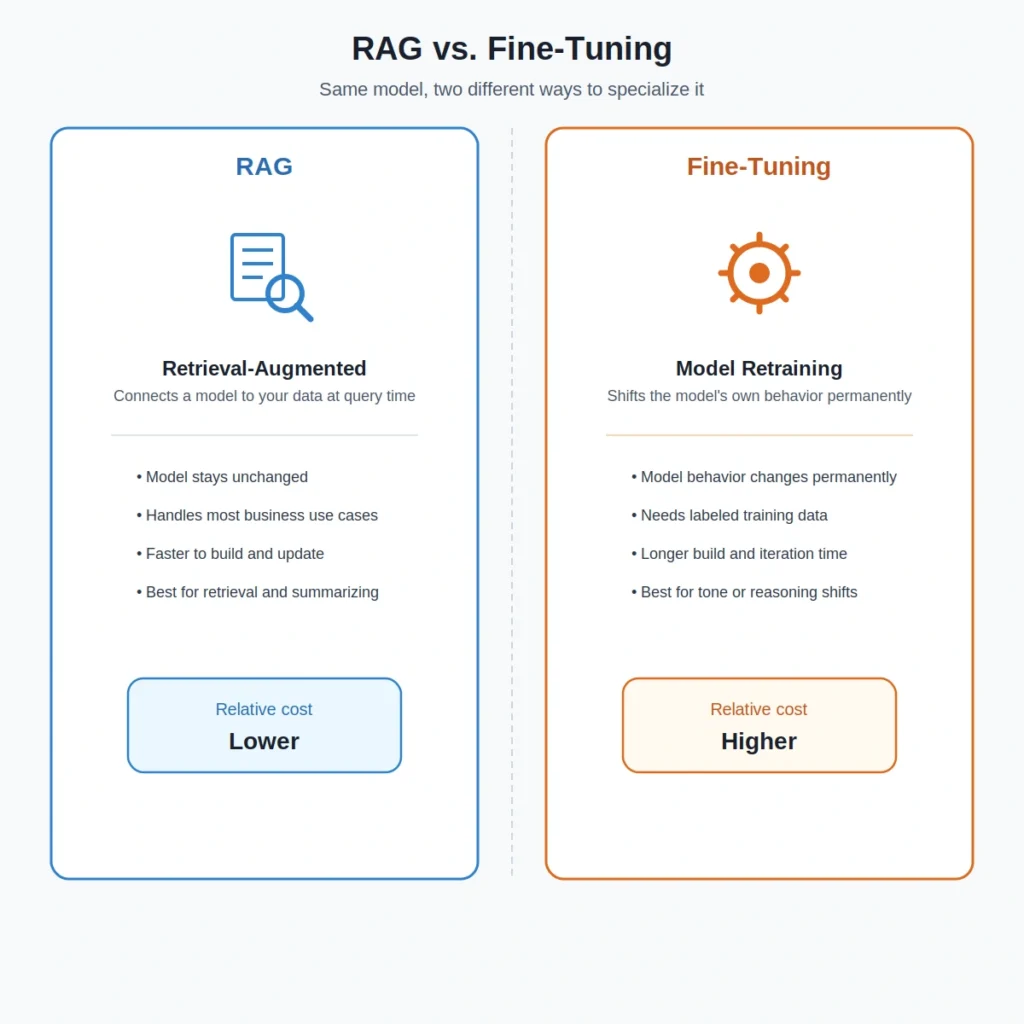
Fine-tuning takes a different approach entirely: it retrains part of the model on a business’s own data so the model’s behavior shifts permanently, a process that benefits directly from subsidized GPU compute at roughly ₹65 per hour through India’s national compute infrastructure. RAG handles the large majority of business use cases at a fraction of the cost, since it avoids the compute and data-labeling work that fine-tuning requires.
Most businesses that assume they need fine-tuning actually need RAG, since accurate retrieval over well-structured data addresses the real need, delivering correct, well-grounded answers more directly than retraining the model itself.
A useful way to test this before committing budget is to identify what a general-purpose model’s output is still missing. If the gap is context about the business, RAG closes it directly. If the gap is tone, format, or domain-specific reasoning that persists even with the right context supplied, fine-tuning becomes the more defensible choice.
Generative AI development cost in India is shaped by factors distinct from a typical software build: data pipeline readiness, model and infrastructure choices, and the same talent cost advantage that applies across Indian AI development generally.
These factors interact rather than stack independently. A project with clean, well-organized data can move through the RAG tier quickly, while messy or unstructured data pushes both timeline and cost upward regardless of which model or vendor is chosen.
This is also where the India cost advantage shows up most clearly. Data pipeline work, cleaning, chunking, and indexing documents, is labor-intensive rather than compute-intensive, which means the labor cost gap between India and Western markets applies to exactly the line item that tends to dominate a generative AI budget. Fine-tuning on business data that includes personal information also brings the project under India’s DPDP Rules, which set out consent and data-handling obligations that shape how that data pipeline work gets structured from the start.
The initial build cost stops at deployment. Generative AI development cost in India does not stop there, since a tool in production carries its own distinct recurring costs tied to usage volume rather than a flat maintenance fee.
A reasonable starting point is to budget 15 to 20 percent of the initial development cost per year for these ongoing needs, with usage-heavy tools running higher once query volume scales past initial estimates. This ongoing cost profile is one of the clearest differences between generative AI development and a typical software maintenance contract, since usage-based fees replace a flatter, more predictable support fee.
A fair quote should be traceable back to a specific scope, with a clear explanation of what drives the number. It should show which tier the project falls into, whether RAG or fine-tuning fits the actual problem, and how ready the underlying data is before any development work starts.
Zethic scopes generative AI development cost in India against these same three factors rather than a flat rate card. The team walks through data readiness, the RAG-versus-fine-tuning decision, and integration depth with a business before quoting, so the number a business receives is tied to what the build genuinely requires rather than a generic estimate.
Ram brings deep expertise in product strategy and system architecture across fintech, SaaS, and AI platforms. He specializes in pre-execution planning to help teams build scalable technology foundations and avoid costly rebuilds.
