


Start Your Project Today
Tell us about your project — we’ll get back within 24 hours


A business picks the model with the best accuracy score on a benchmark, ships it, then can’t explain a single rejected loan application to a regulator or an unhappy customer. How to choose a machine learning model isn’t really a technical decision made once and forgotten. It’s a business decision that has to account for what the model needs to justify, not just what it needs to predict.
Getting this wrong is expensive in a way that doesn’t show up until much later. A team that skips straight to the most accurate option often has to rebuild the entire system once a regulator, a customer, or an internal audit asks a question the model can’t answer.
Two questions settle most of this decision before any accuracy comparison happens. What type of problem is this: predicting a category, a number, or finding structure with no known answer? And how much of the reasoning behind each prediction does the business need to show someone?
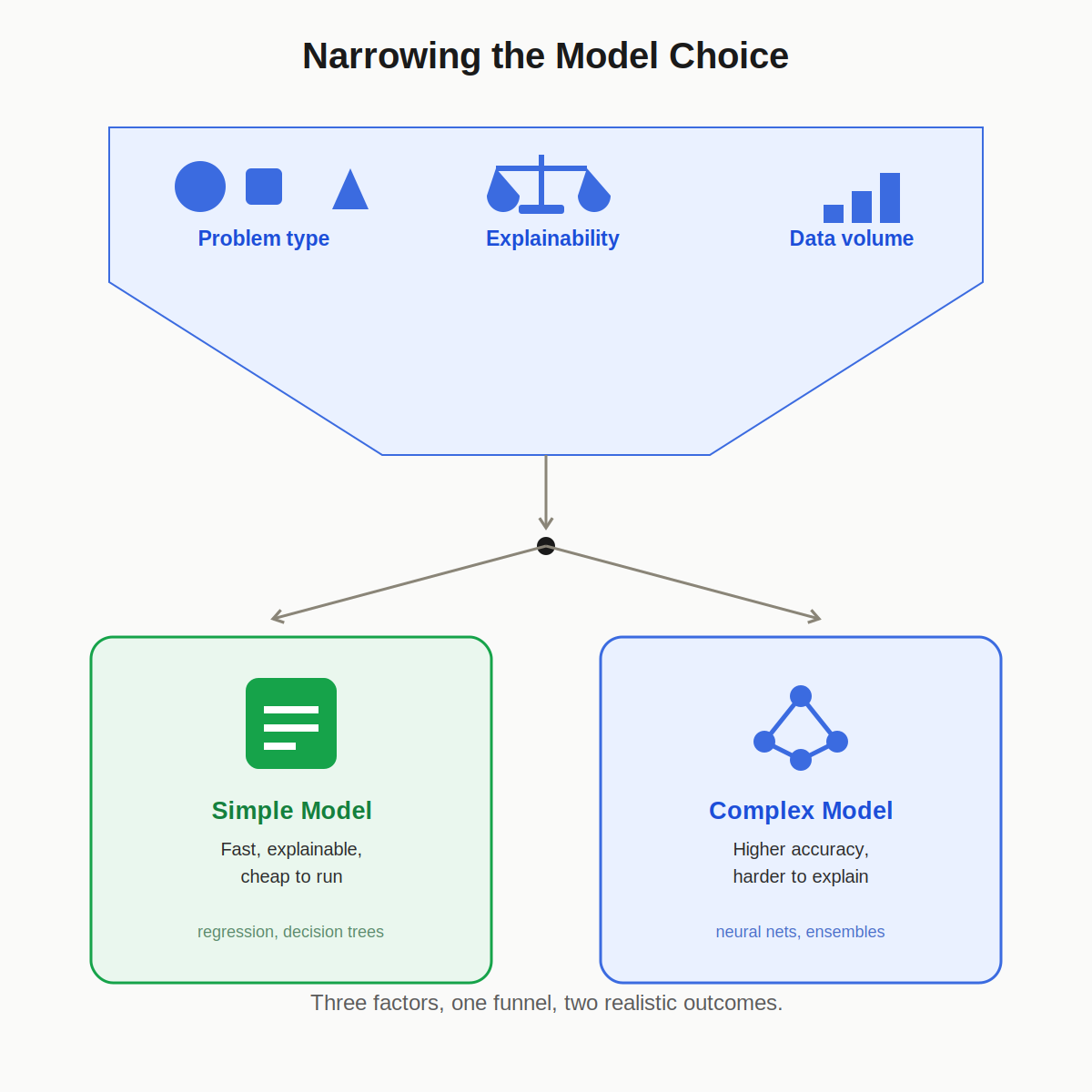
The data itself narrows things further. Structured, tabular data like spreadsheets and databases favors a different family of models than images, text, or sequences do. Getting this part wrong wastes more time than any later tuning decision will ever recover.
Getting this right starts with these two questions, since they eliminate entire categories of models before a single line of code gets written, rather than after a team has already invested weeks building the wrong one. Most artificial intelligence services providers walk through these same two questions with a client before writing a line of code.
Accuracy vs interpretability isn’t a philosophical debate for a business making credit or medical decisions. It’s a legal requirement. Lenders in the US have to give applicants specific reasons for a denied loan under Regulation B’s specific-reasons requirement, and a model nobody can explain cannot satisfy that requirement no matter how accurate it is.
Healthcare carries a similar weight. A diagnostic model that flags a condition without a traceable reason puts a physician in the position of trusting a black box with a patient’s care, which most clinical workflows are not built to accept.
In both cases, the business doesn’t get to pick the most accurate model and explain it later. Explainability has to be a requirement from the start, not a feature added after the fact.
Complexity has a price beyond computing power. Interpretable models like linear regression or decision trees are faster to build, faster to validate, and cheaper to explain to a regulator or a client. Complex models like ensembles and neural networks often score higher on accuracy but carry real ongoing costs in tuning, monitoring, and justifying their behavior.
| Model Type | Cost (USD) | Cost (India, ₹) |
|---|---|---|
| Simple, interpretable (linear regression, decision trees) | $15,000-$50,000 | ₹2 lakh-₹8 lakh |
| Mid-complexity (random forest, gradient boosting) | $40,000-$150,000 | ₹8 lakh-₹30 lakh |
| Complex, high-accuracy (deep neural networks, large ensembles) | $150,000-$1,000,000+ | ₹30 lakh-₹5 crore+ |
These bands track the same pattern as most machine learning development cost breakdowns: complexity buys accuracy, but it also buys a harder, more expensive system to keep explainable and current.
Getting this stage right prevents a common budgeting mistake: approving a complex model’s build cost while forgetting that its maintenance bill scales the same way.
Classification vs regression model selection starts with a simple question: is the output a category or a number? Everything else follows from there, which is why this split is usually the fastest part of picking a model.
None of these categories require guessing. A business that can state its output in one sentence, whether that’s a category, a number, or a discovered group, has already answered most of the model choice for that specific problem. This is the same starting point every team faces when it sets out to build an AI fintech app from the ground up.
A neural network trained on a few hundred records usually performs worse than a simple model trained on the same data, since complex models need volume to find real patterns instead of noise. The model selection criteria that matter most at low data volume are simplicity and resistance to overfitting, not raw capacity.
Complex models start earning their cost once a business has tens of thousands of clean, labeled examples or more, depending on how many variables the problem involves. Below that line, a simpler model isn’t a compromise. It’s usually the better-performing option too.
This is the step most often skipped when choosing a machine learning model, since data volume rarely comes up until a complex model is already underperforming in testing. Assessing whether a dataset has reached that threshold is one of the first things Machine Learning Development Services checks before recommending model complexity either way.
The most common mistake isn’t picking a bad algorithm. It’s picking one that fits the benchmark better than it fits the business. A model chosen purely for accuracy can still fail if nobody can explain its output to a regulator, or if it needs far more data than the business has.
Overfitting is the technical version of the same problem: a model that memorizes training data instead of learning general patterns looks excellent in testing and falls apart on real, unseen cases. Both failures trace back to the same root cause: treating model selection as a purely technical exercise instead of a business one.
Fixing either mistake after launch costs far more than catching it during selection would have, in the same way that non-compliance actually costs a bank is always more than building the compliance system upfront. A regulator or a customer rarely accepts “the model is more accurate” as an answer to “why can’t you explain this decision?”
Machine learning model selection rarely comes down to whichever model tops a leaderboard. It comes down to matching model complexity to what the business needs to explain, what data exists, and what regulatory requirements apply before a single line of code gets written.
Zethic works with founders and CTOs to make that call correctly from the start, scoping which problem type the business has, checking what explainability the industry requires, and sizing model complexity against real data volume, and Zethic builds the resulting system around a model the business can defend, not just one that scores well in testing.
Ram brings deep expertise in product strategy and system architecture across fintech, SaaS, and AI platforms. He specializes in pre-execution planning to help teams build scalable technology foundations and avoid costly rebuilds.
