


Start Your Project Today
Tell us about your project — we’ll get back within 24 hours

Founder
User Interface Design
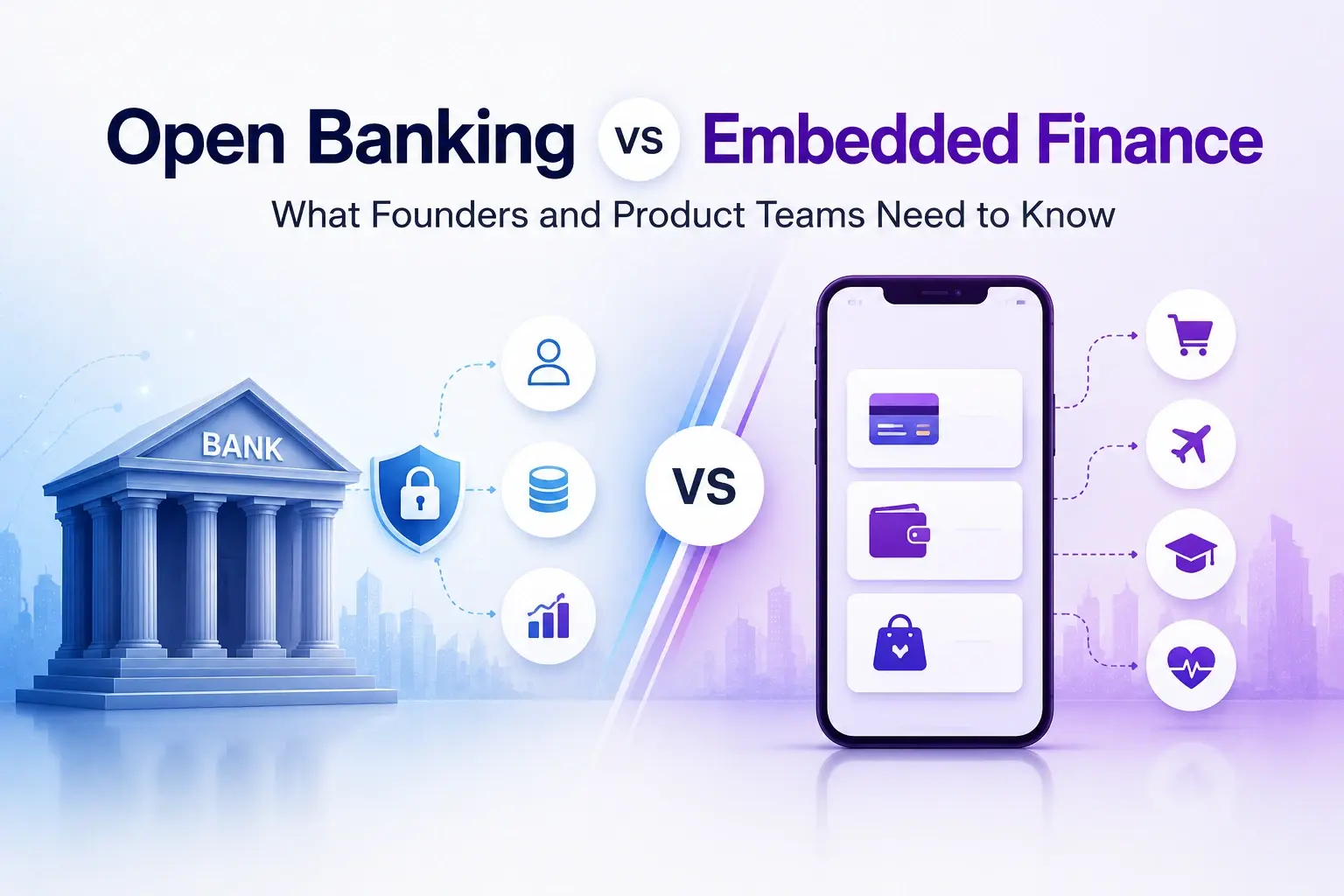
Embedded finance transaction value in the US alone is projected to reach $7 trillion in 2026, accounting for 10% of all US financial transactions. The B2B embedded finance opportunity sits at $185 billion globally. UPI, India’s open API payment infrastructure, processed 228.3 billion transactions worth Rs 300 lakh crore in 2025, surpassing Visa in daily transaction volume. These are not future numbers. The infrastructure is already built. What separates the products that use it well from those that do not is understanding which model actually fits what you are building.
Open banking and embedded finance are often treated as synonyms. They are not. One is about data access. The other is about financial product delivery. The distinction matters at the architecture stage, not just the definition stage.
| Aspect | Open Banking | Embedded Finance |
|---|---|---|
| Core function | Regulated, consent-based sharing of financial data via APIs | Integration of financial products (payments, lending, cards, insurance) into non-financial platforms |
| What gets built | Budgeting tools, account aggregation, credit scoring, bank-to-bank payments | BNPL at checkout, in-app wallets, gig worker payouts, branded debit cards |
| Who controls data | Customer consents to share data with a third party | The platform owns the financial experience; the bank or BaaS provider sits in the background |
| Regulatory model | Highly regulated: PSD2 (EU), UK Open Banking Standard, CFPB Section 1033 (US), Account Aggregator framework (India) | Varies by product type; platforms partner with licensed institutions for compliance |
The two models are not competing. Open banking is often the data and connectivity layer that embedded finance products sit on top of.
Understanding why open banking and embedded finance interact rather than compete requires seeing the full stack. In practice, three layers operate together.
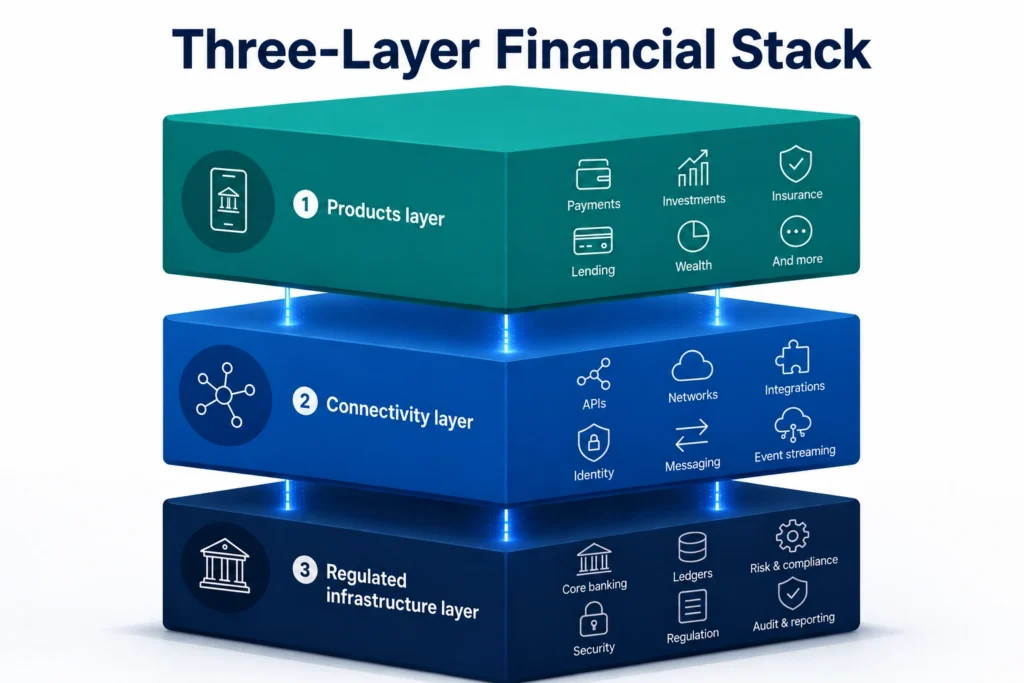
The regulated infrastructure layer is also where payment gateway software development services come into the picture. Acquirer routing, settlement logic, and payment rail selection all sit at this layer and cannot be changed cheaply once the product is live.
An embedded finance product picks the infrastructure it needs: open banking for account verification, UPI or ACH for payouts, and a sponsor bank for card issuing.
Banking-as-a-Service (BaaS) is the middle layer that makes embedded finance possible for non-banks. It is frequently confused with both open banking and embedded finance, but it is neither.
BaaS is a model where a licensed bank exposes its regulated functions (accounts, payments, cards, lending, and KYC) as APIs that non-bank businesses can integrate into their own products. The KYC in fintech layer is one of the most complex components to get right, since it sits at the intersection of identity verification and regulatory compliance across every product that uses BaaS.
How it connects to the other two models:
In India, BaaS operates through licensed partner banks (such as RBL Bank, SBM Bank India, and Yes Bank) that expose their regulated functions through APIs under the RBI’s framework. The Account Aggregator network functions as India’s open banking connectivity layer within this stack.
The right model depends on what your product does with money: whether it reads financial data, moves it, holds it, or lends it. Each use case maps to a different layer of the stack.
| Product Type | What You Need | Model |
|---|---|---|
| Personal finance / budgeting app | Read account data, categorise transactions | Open banking (connectivity layer) |
| Lending platform | Verify income, assess creditworthiness in real time | Open banking data + BaaS credit infrastructure |
| E-commerce platform | Accept payments, offer BNPL at checkout | Embedded finance (payments + lending via BaaS) |
| Neobank | Accounts, cards, transfers, savings | BaaS + embedded finance product layer |
| SaaS platform | Embedded invoicing, payouts to vendors or contractors | Embedded finance (BaaS-issued accounts + ACH/UPI rails) |
| Gig economy platform | Real-time worker payouts, earnings wallets | Embedded finance (BaaS payouts + open banking for account verification) |
Products that only need to read and analyze financial data sit in open banking. Products that need to hold, move, issue, or lend money sit in embedded finance, built on BaaS infrastructure. The product layer, what users see and interact with, is where the financial experience is won or lost. A fintech design agency that understands the compliance and data constraints of each layer is what separates financial products that feel native from those that feel bolted on. The neobank row in the table above is the clearest example of all three layers working together: neobank app development requires BaaS infrastructure for accounts and cards, open banking connectivity for data, and an embedded finance product layer that users actually interact with.
India has its own version of each layer, and both are more advanced than most markets globally.
Yes. The most defensible fintech products in 2025 and 2026 use open banking data to improve the embedded finance product sitting on top of it.
Three real-world patterns:
The products that use both technologies effectively understand where each layer begins and ends. That architectural clarity increasingly separates well-designed fintech applications from products that outgrow their infrastructure at the first major scaling event.
For most product teams, the architecture decision between open banking, embedded finance, and BaaS does not happen once: it evolves as the product adds features. A lending product that starts with open banking data for credit scoring eventually needs lending software development services to disburse loans, and the cost of adding each layer is one of the hidden costs in fintech app development that most initial product budgets do not account for.
That sequencing decision is where the real engineering and product work happens in fintech software development. Zethic builds fintech products and payment-integrated platforms where those decisions are made at the architecture stage, before the first integration is written. Zethic builds fintech products and payment-integrated platforms where those decisions are made at the architecture stage, before the first integration is written.
Mapping a product onto this stack correctly, deciding what sits on BaaS, what pulls from the Account Aggregator network, and what the product layer needs to own, is exactly the kind of architecture work that has to happen before the first sprint, not after a scaling problem shows up. Zethic’s fintech software development in Bangalore works through these layering decisions directly with founders at the planning stage, for products built on India’s open banking and BaaS infrastructure specifically.
Let Zethic help you build smarter Not just faster
BaaS (Banking-as-a-Service) is the regulated infrastructure layer that lets non-banks offer financial products. Open banking provides the data connectivity above it. Embedded finance is the product experience on top. BaaS is the middle layer that makes embedded finance possible without a banking licence.
Yes. India’s Account Aggregator (AA) framework is the regulated equivalent of open banking. It lets users consent to share financial data across institutions via licensed AA entities. UPI functions as India’s embedded payment infrastructure: open, interoperable, and available to any licensed builder.
It depends on what the product does with money. If the product reads and analyses financial data (budgeting, credit scoring, account aggregation), start with open banking. If the product holds, moves, or lends money (payments, BNPL, neobank), start with embedded finance via a BaaS partner.
Yes, through a licensed BaaS partner bank or NBFC. Non-banks can embed payments via UPI, offer credit via credit-on-UPI with an NBFC partner, and manage accounts through a sponsor bank, all without holding a full banking licence. RBI’s regulatory framework governs each product type separately.
Ram brings deep expertise in product strategy and system architecture across fintech, SaaS, and AI platforms. He specializes in pre-execution planning to help teams build scalable technology foundations and avoid costly rebuilds.

Adding {{itemName}} to cart
Added {{itemName}} to cart