


Start Your Project Today
Tell us about your project — we’ll get back within 24 hours

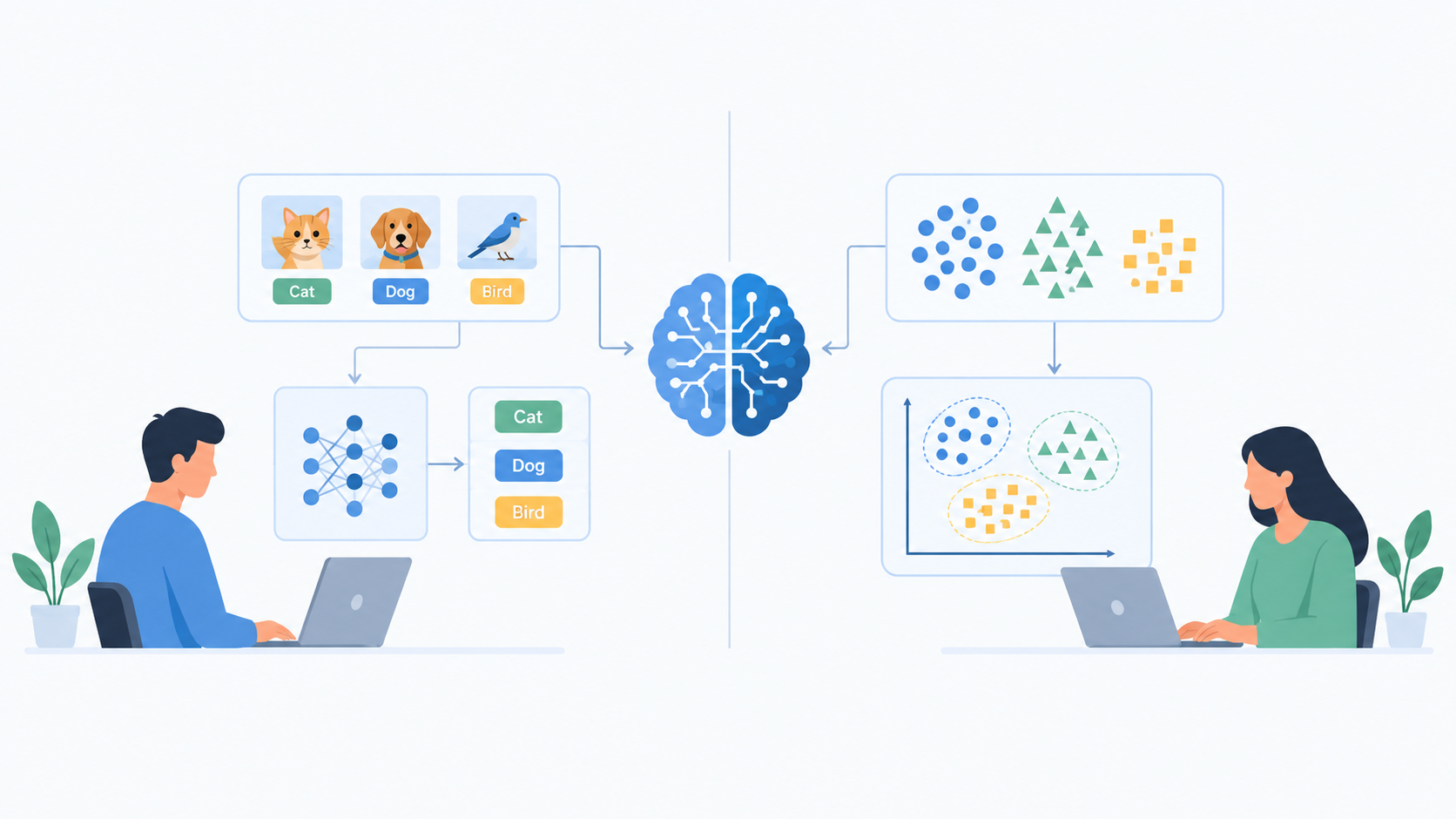
Two vendors can look at the same business problem and propose completely different approaches: one wants to label thousands of examples first, the other wants to start clustering data immediately. Neither is wrong. Supervised vs unsupervised learning isn’t a question of which technique is better; it’s a question of whether labeled examples exist, and what it would cost to create them if they don’t.
Supervised learning trains a model on labeled vs unlabeled data of the labeled kind: every input comes paired with a known, correct answer, and the model learns to map one to the other. Show it enough transactions tagged “fraud” or “not fraud,” and it learns to make that call on new transactions it has never seen.
Unsupervised learning skips the labels entirely. The model gets raw data and has to find whatever structure exists on its own, grouping similar customers or flagging a transaction that doesn’t resemble anything else in the dataset. Nobody tells it what “similar” or “unusual” means in advance; it works that out from the data itself.
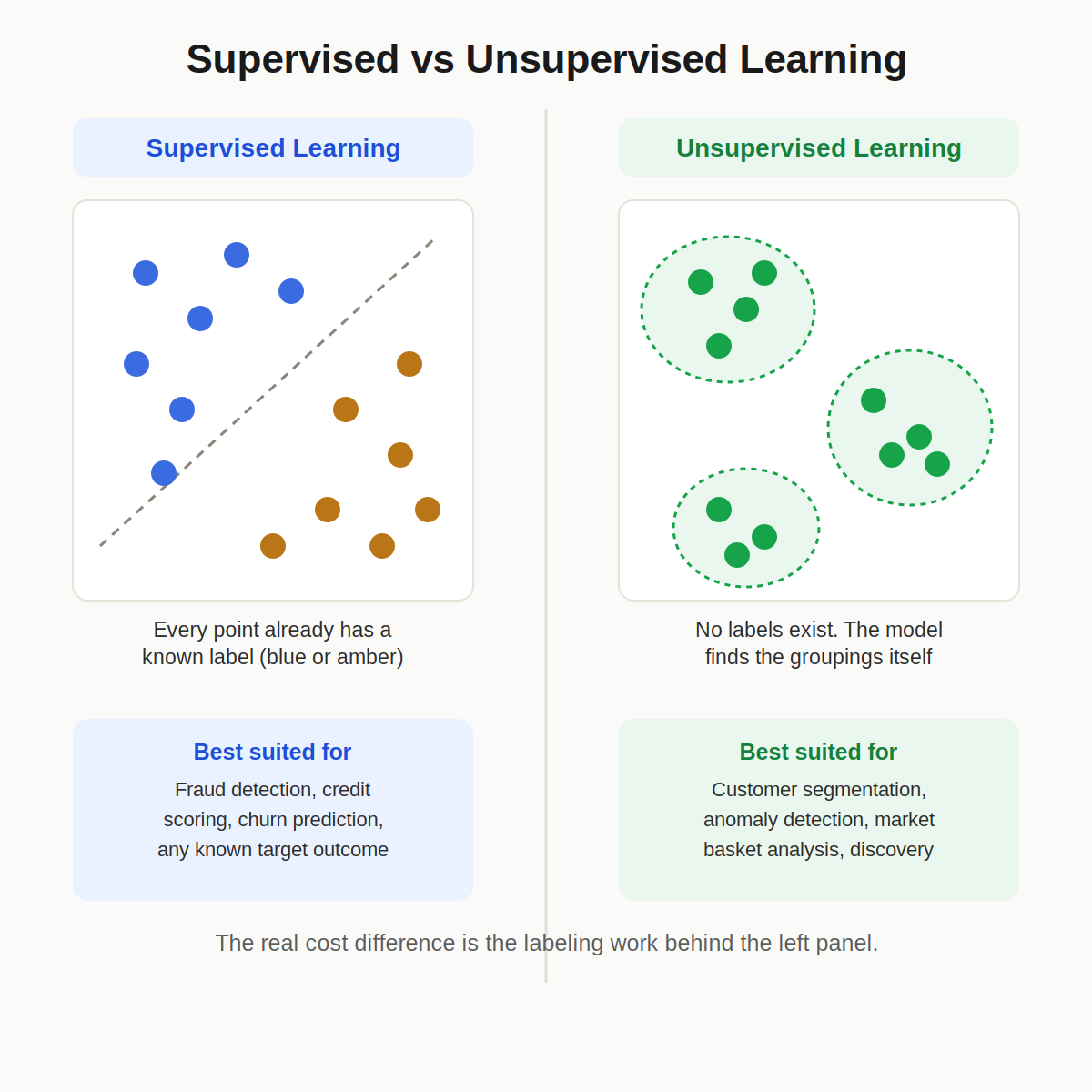
The supervised vs unsupervised learning split shows up in the math too, though a business rarely needs to touch it directly. Supervised models adjust their internal weights to close the gap between prediction and known answer. Unsupervised models adjust against a structural measure instead, like how tightly a cluster holds together, since there’s no known answer to check against.
That’s the first fork in the road, and it shapes every stage of the machine learning development process that follows, from data preparation through evaluation.
The technique itself rarely drives cost. Labeling does. Every input in a supervised dataset needs a human, or a human-reviewed process, to attach the correct answer, and that work adds up fast across a large dataset.
| Approach | What Drives Cost | Cost (USD) | Cost (India, ₹) |
|---|---|---|---|
| Data labeling (supervised) | Human annotators tagging each example with a correct answer | $15-$30 per hour for generalist work, $50-$100+ for expert domains like medical imaging | ₹100-₹300 per hour for generalist work, higher for specialist domains |
| Model training (either approach) | Compute and engineering time, largely similar for both once data is ready | Varies by project scope | Varies by project scope |
| Unsupervised setup | No labeling step, but more analyst time to interpret and validate output | Lower upfront, shifted toward interpretation | Lower upfront, shifted toward interpretation |
Data labeling alone commonly consumes 60-80% of an AI project’s total budget. That single fact is why unsupervised learning looks cheaper on paper. The cost doesn’t disappear; it moves downstream into the analyst time needed to make sense of patterns nobody defined in advance.
This labeling gap is one of the biggest swing factors in machine learning development cost overall, often outweighing differences in algorithm choice or compute.
That tradeoff rarely gets discussed as clearly as the labeling cost itself, but it’s real: a clustering project with no labeling bill can still run up significant hours in a data scientist reviewing what each cluster represents before anyone trusts the output enough to act on it.
Supervised learning wins whenever a business already knows the outcome it’s trying to predict and has, or can reasonably get, historical examples of it. Deciding when to use supervised learning starts with a simple check: can you point to past cases where you already know what happened?
Each of these shares a trait worth naming: the business already has, or can build, a historical record of the exact outcome it wants to predict. That record is what makes supervised vs unsupervised learning an easy call in these cases rather than a genuine toss-up. This is the shift behind how AI is changing credit decisioning, where models trained on labeled repayment history increasingly do work that used to rely on manual underwriting rules.
Unsupervised learning earns its keep when nobody has defined the “right answer” yet, or when getting one would be too expensive or too slow to be useful.
The clustering vs classification distinction maps directly onto this split: classification needs labeled categories to sort into, clustering discovers the categories itself.
Knowing when to use unsupervised learning often comes down to timing as much as technique. A business exploring a brand-new dataset for the first time rarely knows yet what the useful categories even are, which is the situation clustering is built for. Once those categories exist and get validated, the same data often becomes a supervised problem the second time around.
Most real systems do this rather than picking one side. Semi-supervised learning trains on a small labeled set alongside a much larger unlabeled one, which matters because full labeling is often the most expensive part of the entire project. It’s a middle path that most discussions of supervised vs unsupervised learning skip past, even though it’s closer to how production systems get built in practice.
A common pattern starts with unsupervised clustering to explore a new dataset, then uses what that reveals to define labels worth collecting for a supervised model afterward. The unsupervised pass essentially pays for part of the labeling work by narrowing down what’s worth labeling in the first place.
Fraud detection teams use this constantly. Unsupervised anomaly detection flags transactions that look unusual, a human reviews a sample of those flags, and the resulting labels train a supervised model that catches similar fraud faster next time. This layered pattern is close to how fraud detection is implemented in fintech systems today, where unsupervised anomaly detection and supervised classification routinely work side by side.
Three questions settle most of the supervised vs unsupervised learning decision before any modeling starts. Does labeled data already exist, or would it need to be created from scratch? Is the goal a specific, known prediction, or discovery with no fixed destination?
How large is the dataset relative to the labeling budget available? A “yes” to existing labels and a specific target usually points toward supervised learning. A “no” to both, paired with a dataset too large to label affordably, usually points toward unsupervised learning or a semi-supervised middle path.
Most artificial intelligence services providers run through these same three questions with a client before writing a line of code.
The honest answer to supervised vs unsupervised learning is rarely one or the other in isolation. It’s whichever approach matches what labeled data already exists, what a business can afford to label, and how well-defined the target outcome is.
Zethic works with founders and CTOs to make that assessment before a project starts, checking what labeled data already exists, scoping what new labeling would realistically cost, and identifying where a semi-supervised approach could cut that cost significantly, and Zethic builds the resulting model around data the business has rather than data it wishes it had.
Ram brings deep expertise in product strategy and system architecture across fintech, SaaS, and AI platforms. He specializes in pre-execution planning to help teams build scalable technology foundations and avoid costly rebuilds.
