


Start Your Project Today
Tell us about your project — we’ll get back within 24 hours

Founder
User Interface Design
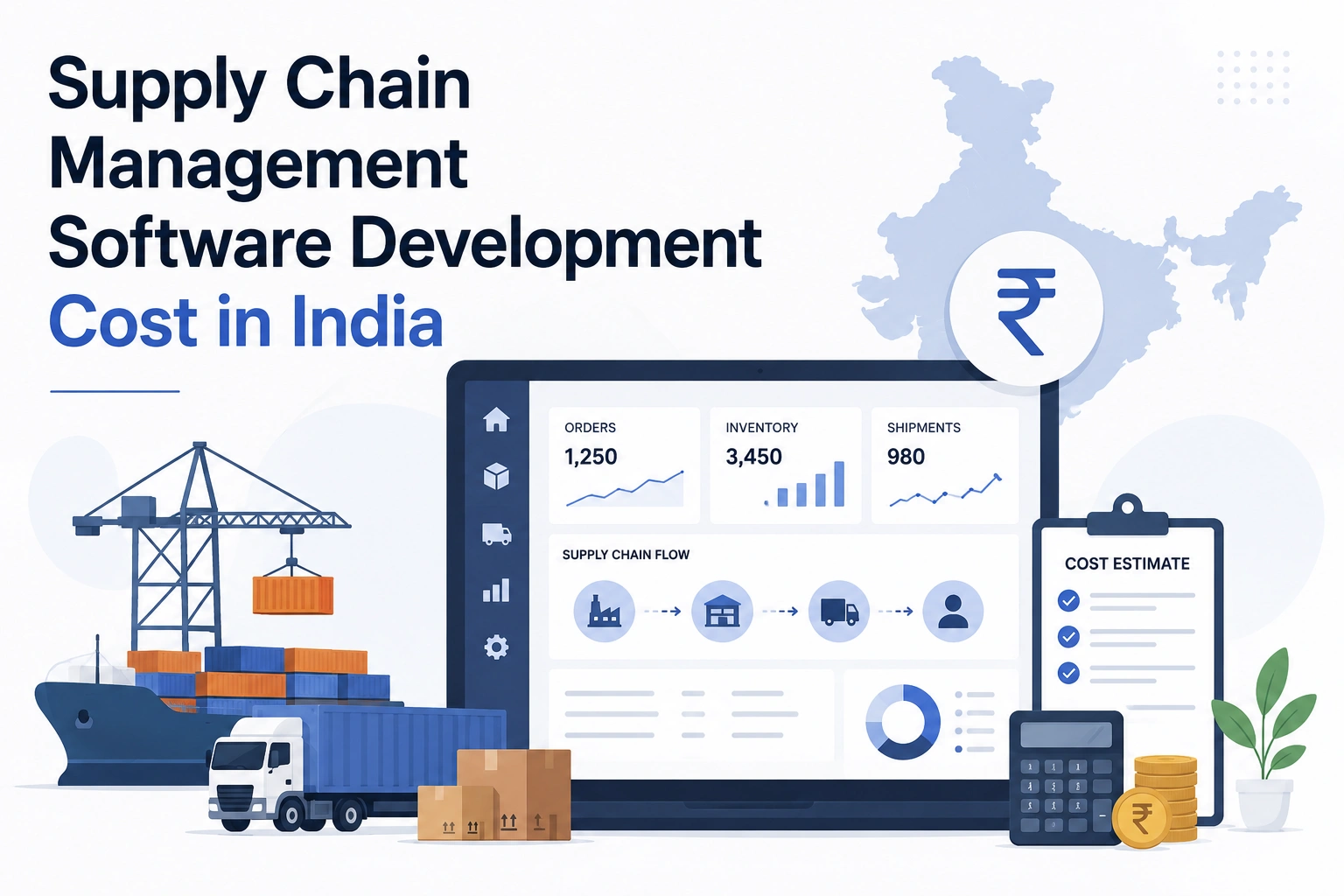
Four factors drive the bulk of the variation between a ₹40 lakh project and a ₹4 crore one. Module count matters most, since inventory tracking alone costs far less than a suite spanning procurement, warehousing, and transportation together, the kind of multi-module build common across logistics operations. A business that starts with one module and adds others over time spreads its costs differently than one that commits to the full suite upfront.
Integration complexity comes next. Connecting to existing ERPs, marketplaces, and logistics partners adds engineering time that a standalone system never needs. Each additional system a new SCM platform must integrate with, whether Tally, SAP, or a logistics partner’s API, requires its own mapping, testing, and validation effort.
Customization and workflow complexity also influence cost. Businesses with unique approval flows, inventory rules, pricing logic, or compliance requirements typically require more custom development than organizations that can adopt standard workflows.
Team structure and location round out the picture, since an in-house Indian team, an agency, and a hybrid offshore-onshore model all carry different overheads for the same supply chain management development output. An in-house team costs more per month but retains institutional knowledge, while an agency often costs less upfront but may require additional knowledge transfer if the vendor relationship changes.
Pricing rarely comes as one number, since a business buying inventory tracking alone pays a fraction of what a business buying five connected modules pays.
| Module | Typical Cost in India (₹) |
|---|---|
| Inventory management | ₹8 lakh to ₹25 lakh |
| Procurement and supplier management | ₹10 lakh to ₹30 lakh |
| Warehouse management (WMS) | ₹15 lakh to ₹45 lakh |
| Transportation and logistics tracking | ₹18 lakh to ₹50 lakh |
| Demand forecasting (AI-assisted) | ₹20 lakh to ₹60 lakh |
Most mid-sized businesses combine two or three of these rather than building the full suite at once, which keeps first-year spend closer to the lower half of the module ranges above. Demand forecasting sits at the top of the range because it depends on data engineering and model tuning, not just transactional logic like the other four modules.
A business that starts with inventory management and procurement, then adds warehouse management once volume justifies it, spends less in year one than a business that commissions all five modules together. The must-have SCM features map directly onto these modules, so the tradeoff is that modules built later need to integrate cleanly with what already exists.
Procurement specifically ties into dedicated procurement and demand forecast software, which is why that module often gets added early alongside inventory management rather than later.
These two India-specific requirements rarely appear as their own line item in cost breakdowns, even though both add real, separate engineering work beyond the core modules.
GST e-invoicing integration typically adds ₹1 lakh to ₹3 lakh in one-time development cost to connect the ERP or SCM system to a GST Suvidha Provider’s API, plus a small per-invoice fee once live. This covers generating the Invoice Reference Number and QR code that GSTN requires for every valid B2B invoice the system produces.
That step usually plugs directly into procurement and demand forecast software since that is where purchase orders originate, and it applies to any business above the GST registration turnover threshold.
ONDC integration, which lets a supply chain system participate in India’s open commerce network as a seller or buyer app, typically adds ₹2 lakh to ₹5 lakh depending on how many protocol endpoints it needs to support. A business only selling through its own channels does not need this, but one distributing through ONDC-linked marketplaces does.
Neither cost is high on its own, but skipping them at the design stage and retrofitting later usually costs more, since retrofitting means reworking data models never designed to carry the extra fields these integrations require.
The answer depends on how long a business plans to run the system and how much its workflow deviates from a standard template.
A business running standard workflows at moderate scale often does better with an off-the-shelf tool, since the subscription cost stays predictable and there is no engineering team to manage. One with non-standard processes, or plans to scale past a few years, typically recovers the custom build cost within that window, a pattern that shows up clearly in logistics app development cost estimates too, since subscription cost keeps climbing with usage while a custom build’s cost curve flattens after the initial spend.
Maintenance, hosting, and support together typically add 15 to 25 percent of the original build cost every year after launch. This covers bug fixes, security patches, and routine updates that keep GST, ERP, and logistics-partner integrations working as those third-party APIs change over time.
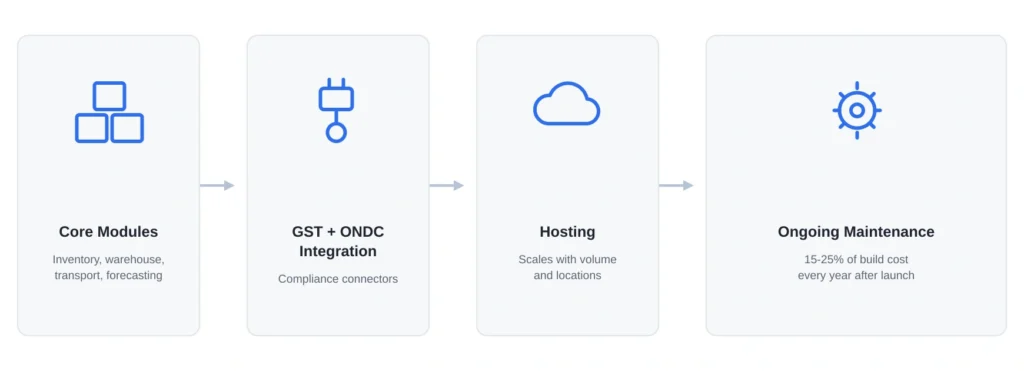
Hosting costs scale with transaction volume and warehouse or location count, a pattern that holds across the logistics industry generally. A business budgeting only for the initial build, without planning for this annual cost, is the most common source of underestimated total ownership cost in SCM projects, since the first invoice for year-two maintenance often arrives as a surprise rather than a planned line item.
The clearest way to control supply chain management software development cost in India is scoping modules to what the business actually runs today, not a full suite bought against plans that may never materialize. Zethic prices SCM builds module by module, as part of our broader logistics software development practice, so a business paying for warehouse management and forecasting isn’t also carrying the cost of procurement tools it doesn’t use yet.
For businesses selling through GST-registered channels or ONDC, that scoping includes the compliance integrations from the first build phase rather than as a retrofit once the core system is already live. Zethic treats these as part of the core estimate, not an add-on quoted later.
Let Zethic help you build smarter Not just faster
Ram brings deep expertise in product strategy and system architecture across fintech, SaaS, and AI platforms. He specializes in pre-execution planning to help teams build scalable technology foundations and avoid costly rebuilds.

Adding {{itemName}} to cart
Added {{itemName}} to cart