
Skip links

Must-Have Features in Supply Chain Management Software (2026)

Picture of By Ram Nethaji

By Ram Nethaji

Founder

FinTech app development cost

User Interface Design

Custom software development
FinTech app development services
supply chain management software features

The global supply chain management software market reached $36.39 billion in 2026, growing at a 9.01% CAGR. The defining shift of this cycle is not market size: it is what the software now does. Demand forecasting, anomaly detection, and dynamic safety-stock calculation have moved from premium add-ons to standard expectations. What separates well-built supply chain management software features from a basic tracking system in 2026 is where the intelligence sits and how much of the decision-making it takes on.

What Are the Core Supply Chain Management Software Features Every System Needs?

Core features are the foundation of any supply chain platform. A system missing any of these is not a true supply chain solution; it is simply a collection of spreadsheets with a user interface. These capabilities are essential whether you are evaluating an off-the-shelf platform or planning a custom build.

Six core supply chain management software features that form the foundation of any supply chain management software development project:

  • Real-time inventory tracking: Live stock levels across all warehouse locations, automatic low-stock alerts, and multi-location visibility from a single dashboard. Without real-time visibility, procurement decisions lag behind actual inventory levels, increasing both overstocking and stockout risks.
  • Order management: End-to-end order lifecycle management from placement through fulfilment confirmation. This includes multi-channel order consolidation (B2B, e-commerce, and direct sales), backorder management, and customer-facing shipment tracking. The order management layer is where the supply chain connects directly to the customer experience.
  • Procurement and purchase order management: Automated purchase order generation based on reorder rules, supplier quotation workflows, approval routing, and three-way matching between purchase orders, receipts, and invoices. Manual procurement remains one of the most common sources of margin leakage in mid-market supply chains.
  • Supplier management: Supplier onboarding, document storage, performance scorecards (including on-time delivery, defect rates, and responsiveness), and a self-service portal where vendors can update shipment statuses and submit invoices. The supplier portal typically reduces email and phone coordination by 40–60% in mature deployments. For businesses where supplier complexity is the primary operational challenge, vendor management software is often implemented as a standalone solution before broader inventory and order management modules.
  • Warehouse management: Inbound receiving, put-away, pick-and-pack, and outbound dispatch workflows. Barcode and RFID scanning, bin-level inventory tracking, and packing slip generation represent the minimum viable feature set for warehouses managing more than 200 SKUs. For warehouse staff, mobile app development for barcode scanning, pick confirmation, and real-time inventory counts is a companion scope that should be planned alongside the core warehouse management module.
  • Reporting and analytics: KPI dashboards covering fill rate, order cycle time, supplier on-time delivery, inventory turnover, and cost per order. Without these operational metrics, supply chain decisions are driven by assumptions rather than measurable performance.

What Additional Features Separate Good SCM Software from Basic Platforms?

Additional features are what separate a platform that simply tracks operations from one that actively improves them. These capabilities are the key differentiators to evaluate when comparing supply chain platforms or planning a custom solution beyond the MVP stage.

Five specialist supply chain management software features:

  • Demand forecasting: Machine learning models trained on historical sales, seasonal patterns, promotional activity, and external signals such as weather and macroeconomic indicators. While rule-based reorder points respond to past events, demand forecasting predicts future demand, reducing safety stock requirements by 20–35% in production environments.
  • Multi-warehouse and multi-location management: Centralised visibility and control across multiple warehouses, distribution centres, or production facilities. This includes inter-warehouse transfers, location-specific reorder rules, and consolidated reporting across the entire supply chain network. It is essential for businesses operating across more than one location.
  • Transportation management: Route planning, carrier API integrations for live shipment updates, freight cost optimisation, and proof-of-delivery capture. The transportation layer connects inventory decisions with logistics execution. Without it, even the most efficient warehouse operations lose time during carrier handoffs. For businesses where transportation and last-mile delivery are the core product rather than a module within a larger SCM platform, logistics app development provides dedicated carrier integrations, route optimisation, and proof-of-delivery functionality.
  • Supplier risk management: Continuous monitoring of supplier financial health, geographic concentration, and performance trends. The system identifies changes in supplier risk profiles and can trigger alternative sourcing workflows before disruptions impact inventory availability.
  • Integration layer: Pre-built connectors for ERP systems (SAP, Oracle, NetSuite, and Tally), e-commerce platforms (Shopify and WooCommerce), logistics providers, and IoT devices. The integration layer is often invisible when implemented well, but it quickly becomes the biggest operational bottleneck when missing or poorly designed.

What AI-Powered Features Are Now Standard in Supply Chain Management Software?

By 2030, 60% of enterprises using SCM software will have adopted agentic AI features, up from just 5% in 2025, according to the Gartner agentic AI SCM forecast published in April 2026. The AI layer in supply chain management software has moved from experimental to operational. These are no longer future-state capabilities; they are already present in production deployments and are increasingly expected by buyers evaluating modern SCM platforms.

Four AI features are now standard in leading SCM software:

  • AI-based demand sensing: Short-term demand signals are updated in near real time using point-of-sale data, website traffic, social sentiment, and weather feeds. While traditional demand forecasting updates weekly or monthly, demand sensing refreshes hourly. Early adopters have reduced forecast errors by 15–20% by layering demand sensing on top of conventional machine learning forecasting models. The effectiveness of demand sensing and disruption detection depends as much on the quality of the data pipeline as the AI model itself. Data engineering provides the foundation that determines whether AI-powered SCM features produce reliable insights or noisy, inaccurate outputs.
  • Disruption detection and alerting: Continuous monitoring of supplier performance, carrier feeds, port congestion, and geopolitical risk indicators allows the system to identify supply chain disruptions before they impact inventory. Procurement teams can activate backup suppliers or adjust safety stock levels before shortages occur.
  • Autonomous reorder and procurement agents: Agentic AI continuously monitors inventory levels, evaluates supplier pricing and lead times, and executes purchase orders within predefined business rules, eliminating the need for manual initiation. Supply chain planners define the policies, while the AI agent manages day-to-day execution. Gartner identifies this capability as the primary driver behind the projected growth of the agentic AI SCM market.
  • Spend analytics and procurement optimisation: AI models analyse historical purchase orders, supplier pricing patterns, and demand forecasts to identify savings opportunities, including optimal order quantities, alternative supplier recommendations, and improved purchasing schedules. Unlike traditional quarterly procurement reviews, these recommendations are generated continuously as new data becomes available.

What India-Specific Features Should Supply Chain Software Include?

For businesses operating in India, global SCM platforms consistently underperform in two areas: tax compliance and carrier integration. Both require India-specific capabilities that should be built into the platform from the outset rather than added as workarounds after deployment.

Five India-specific supply chain management software features:

  • GST-compliant invoicing and reporting: Purchase orders, sales invoices, debit notes, and credit notes generated in GST-compliant formats with accurate HSN codes, GSTIN validation, and input tax credit tracking. This is not an optional feature—it is a legal requirement for businesses registered under GST.
  • E-way bill generation: Automated e-way bill creation for interstate goods movement exceeding Rs 50,000, integrated directly into the outbound dispatch workflow. Manual e-way bill generation can add 15–30 minutes per shipment and increases the risk of data entry errors during GST audits.
  • Indian carrier API integrations: Live shipment tracking and proof-of-delivery capture through APIs for Shiprocket, Delhivery, Blue Dart, DTDC, and Ecom Express. While many global platforms support carriers such as FedEx and UPS, they often lack integrations with major Indian logistics providers, forcing teams to switch between systems.
  • Tally and SAP India ERP integration: Two-way synchronisation with TallyPrime and SAP Business One or SAP S/4HANA for Indian deployments. Inventory movements, purchase orders, and invoices created in the SCM platform should automatically sync with the accounting system without manual data entry.
  • ONDC seller network connectivity: Businesses selling through ONDC (Open Network for Digital Commerce) should be able to receive and process buyer network orders directly within the order management module, feeding them into the same inventory and fulfilment workflow as other sales channels. For businesses where ecommerce development and supply chain operations share a common inventory and fulfilment system, ONDC integration reduces the number of integration points required to serve multiple buyer networks from a single stock pool.

How Should You Prioritise Supply Chain Management Software Features?

The most common mistake when scoping supply chain management software features is treating all features as equally urgent. Teams that try to build or deploy every feature at once end up with systems that are too complex to adopt and too expensive to maintain.
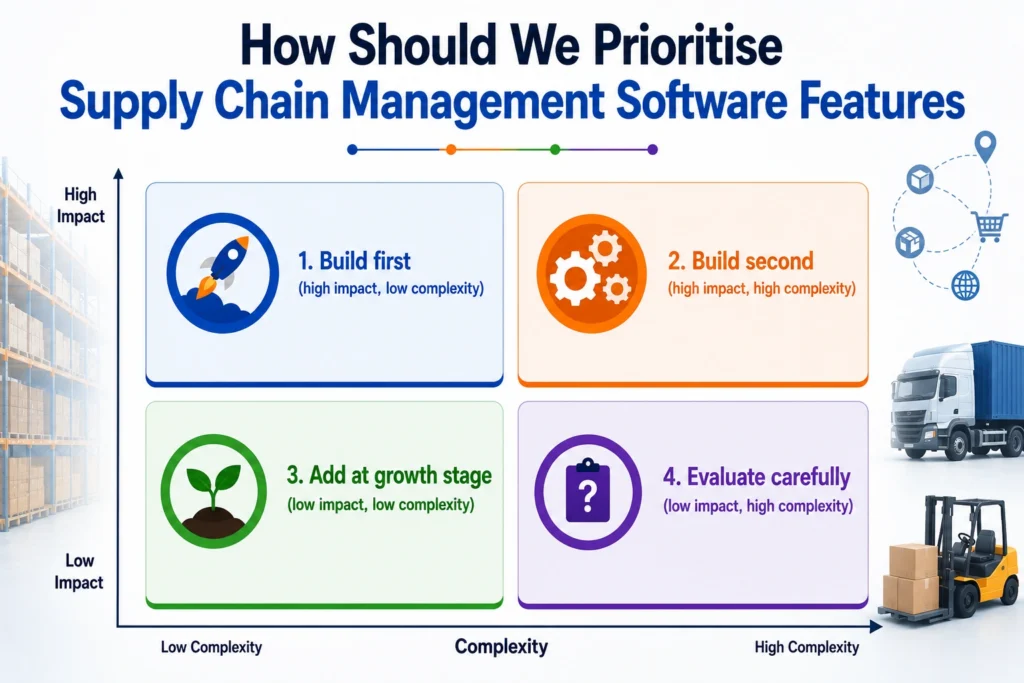
supply chain management software features

Feature priority matrix:

The matrix evaluates features across two dimensions: operational impact (the value a feature delivers to day-to-day operations) and implementation complexity (the time, effort, and cost required to build or configure it). This creates four priority categories:

  • Build first (high impact, low complexity): Inventory tracking, order management, and basic reporting.
  • Build second (high impact, high complexity): Demand forecasting, ERP integration, and transportation management.
  • Add at the growth stage (low impact, low complexity): Supplier portal and basic procurement automation.
  • Evaluate carefully (low impact, high complexity): Custom AI models, blockchain-based traceability, and specialised supplier risk scoring.

For businesses operating in India, GST compliance, e-way bill generation, and Indian carrier integrations should always be treated as “Build First” features, regardless of implementation complexity. The cost of non-compliance or operational workarounds is typically far greater than the cost of building these capabilities correctly from the start.

The same prioritisation framework applies when planning a custom SCM platform. Custom supply chain software projects that define feature tiers before development consistently reach production faster and stay closer to budget than projects that attempt to deliver every feature in the initial release.

What Should You Do Next?

The right set of supply chain management software features is not a fixed list. It is a function of your current operational pain points, the number of warehouses and suppliers you manage, and where the business is going in the next two to three years. An MVP with three well-built features creates more operational value than a full platform where half the features go unused.

Zethic builds custom supply chain and logistics software where feature selection is made at the architecture stage, not after the build has started. If you are scoping a custom SCM build or evaluating whether an existing platform covers your requirements, Zethic is a good place to start.

Let Zethic help you build smarter Not just faster

Frequently Asked Questions

Real-time inventory tracking, order management, procurement automation, and a basic reporting dashboard are the four features that deliver the most operational value at the mid-market stage. Demand forecasting and multi-location management are the logical next additions as the business grows.

GST-compliant invoicing, e-way bill generation, Indian carrier API integrations (Shiprocket, Delhivery, Bluedart), Tally or SAP India ERP integration, and ONDC seller network connectivity are the five features that global platforms consistently handle poorly for Indian operations.

Demand sensing, disruption detection, autonomous reorder agents, and spend analytics are the four AI features now present in production deployments. Of these, demand sensing and disruption detection deliver the fastest measurable ROI for most operations teams.

Off-the-shelf platforms cover most core and additional features out of the box but require configuration for India-specific requirements and rarely support deep integrations with legacy ERP or Indian carrier APIs. Custom SCM software is built around your specific workflows and integration requirements, at a higher upfront cost but with full ownership of the business logic.

Integration depth. Most platforms look complete in demos but lack reliable, well-maintained connections to the ERP, logistics, and payment systems a business already uses. Poor integrations create the data silos that make the rest of the feature set less useful, which is why 47% of supply chain leaders cite integration complexity as their primary barrier to getting full value from their SCM investment, per the PwC 2025 Digital Trends in Operations Survey.

Let’s build your app together

Table of Contents

zethic-whatsapp