


Start Your Project Today
Tell us about your project — we’ll get back within 24 hours


Many organizations begin a digital transformation process by selecting new software platforms before evaluating operational readiness. This approach commonly results in significant investment with limited adoption, since the underlying workflow and data gaps remain unaddressed. The pattern repeats across industries and organization sizes, which makes it a useful starting point for examining why some efforts sustain results while others do not.
The digital transformation process is the structured sequence an organization follows to change how it operates using technology. It includes assessing the current state, defining goals, determining where to act first, and implementing changes in a way that is sustained over time. The process addresses workforce and workflow changes as much as software, since a new tool implemented without corresponding changes in practice rarely produces measurable results.
This differs from a single software rollout. A CRM implementation is one project, while digital transformation services address the ongoing discipline of determining which projects should proceed, in what order, and how success will be measured. This is also why the process does not typically conclude on a fixed date, unlike a single system rollout, and why it requires sustained oversight rather than a single approval at the outset.
A global survey on digital transformations found that only 16 percent of respondents reported that their digital transformation both improved performance and sustained that improvement over time, with an additional 7 percent reporting improvement without sustained results. Several recurring factors account for this pattern.
Each of these factors reflects a gap in planning rather than a limitation of the technology, which is why the assessment stage described below carries particular weight. A missing CI/CD pipeline is frequently one of the specific gaps this surfaces. Organizations that address even two of these four factors before selecting technology typically report a meaningfully different outcome than those that begin with the tool.
An assessment evaluates the organization’s current standing across the areas that determine whether new technology is adopted, before any tool selection. Each area is scored on a consistent 1-to-5 scale, ranging from ad hoc, meaning no formal process exists, to fully managed, meaning the practice is consistently applied and maintained, so that gaps are identified clearly rather than described in general terms.
| Area | Ad Hoc (1) | Developing (2-3) | Managed (4-5) |
| Leadership sponsorship | No named owner, no assigned budget | Named lead, informal support | Executive owner, dedicated budget |
| Data readiness | Scattered spreadsheets, no shared source | Some systems connected, gaps remain | Consistent, accessible data across teams |
| Workforce skills | No training plan in place | Skilled staff in select teams | Role-based training built into rollout |
| Process documentation | Undocumented, informal knowledge only | Partially documented | Current workflows mapped and maintained |
An organization scoring mostly at level 1 has meaningful preparation to complete before developing a roadmap. Structured scoring of this kind is similar to GAO’s technology maturity model, used to evaluate federal agencies’ technology management readiness on a comparable scale.
An organization already scoring at levels 4 and 5 across these areas may require only targeted adjustments rather than a full program, a difference worth noting before setting aside a full year of budget. The accuracy of the assessment matters more than the score itself, since an overstated assessment results in a roadmap built for conditions the organization has not yet reached.
Once the assessment identifies the relevant gaps, the roadmap sequences the work so that early results support and inform the later stages. Ranking candidate projects at step three often determines whether a gap is closed through custom application development or an existing platform. Each step builds on the one before it, which is why proceeding to a later step before completing earlier ones typically extends the overall timeline.
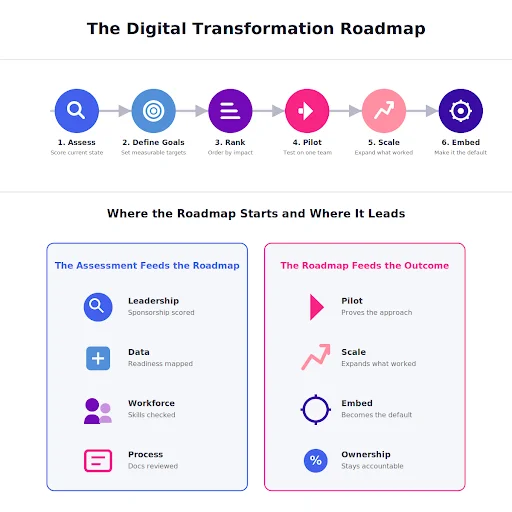
Skipping the pilot stage is a common way to speed up timelines, though it typically increases overall cost, since issues identified during a full rollout are more costly to correct than those identified during a contained pilot.
A single, contained effort, such as automating one workflow or replacing one system, commonly takes twelve to eighteen months from assessment to a working pilot at scale. A full enterprise-wide effort, spanning multiple business units and systems, typically takes three to five years, with initial measurable results expected within the first eighteen to twenty-four months.
Programs that attempt to complete an enterprise-wide effort within a single year often omit the assessment and pilot stages to meet the timeline, which matches the same pattern behind the outcomes described above. Organizations that maintain a longer, phased timeline typically require less time overall, since fewer rollouts require correction after implementation. Smaller organizations often shorten this further, since digital transformation for SMEs typically involves fewer systems to coordinate.
The digital transformation process is most effective when the assessment precedes the roadmap, and the roadmap is developed around documented gaps rather than a vendor’s product catalog. An organization that completes an accurate assessment, defines two or three measurable goals, and pilots before scaling addresses most of the factors associated with underperforming efforts.
Zethic works with business and technology leaders to conduct that assessment directly, scoring readiness across data, workforce, and process before recommending a roadmap, then develops the pilot that validates the approach before further scaling.
Ram brings deep expertise in product strategy and system architecture across fintech, SaaS, and AI platforms. He specializes in pre-execution planning to help teams build scalable technology foundations and avoid costly rebuilds.
