


Start Your Project Today
Tell us about your project — we’ll get back within 24 hours

Founder
User Interface Design
FinTech app development services
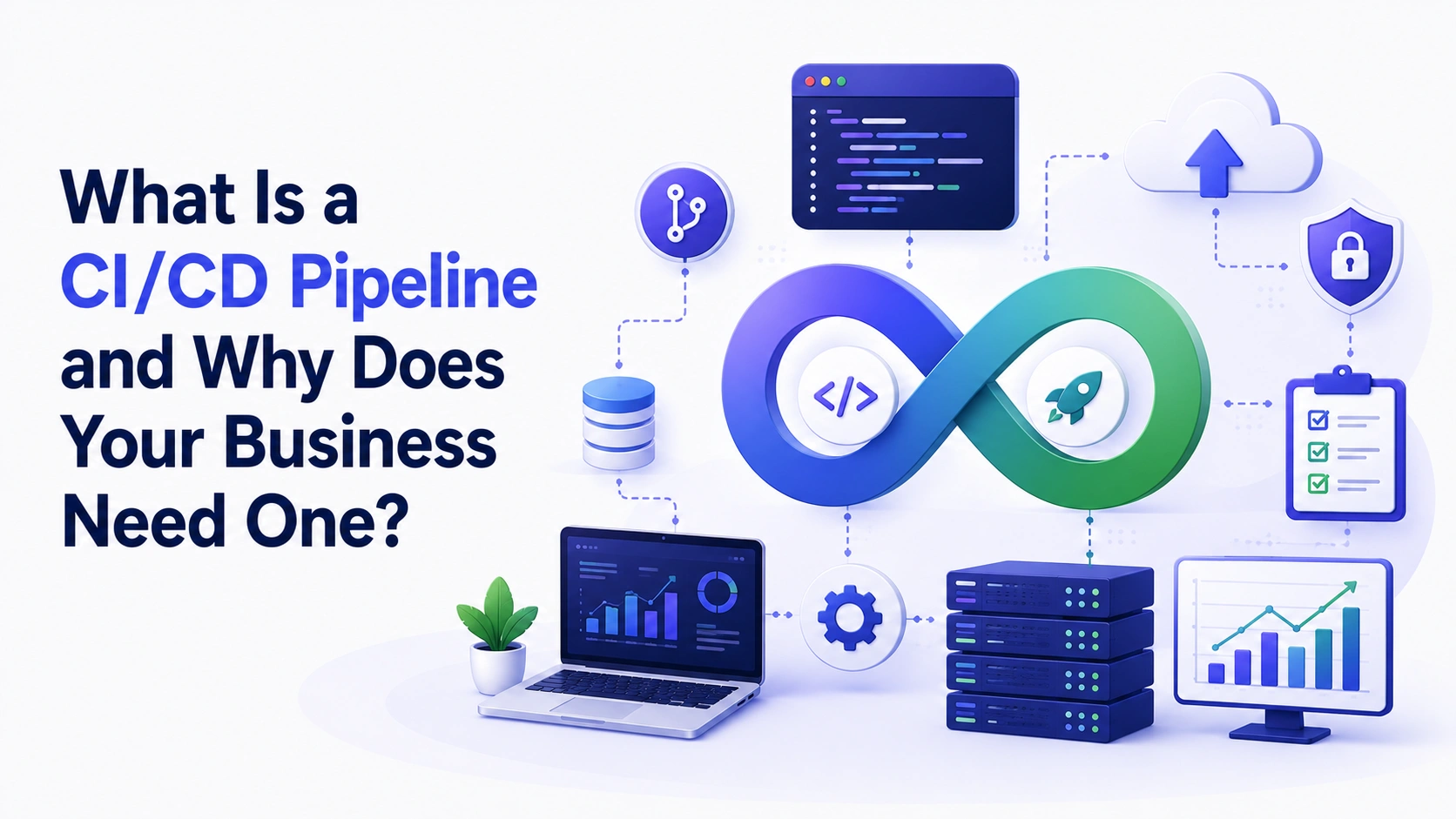
The difference between shipping a critical fix in hours or in weeks, that’s what a CI/CD pipeline gives a business. A CI/CD pipeline is the automated process behind that difference: it moves
code from a developer’s commit through building, testing, and deployment without a person manually running each step, catching bugs before customers ever see them.
Most software teams past a certain size run some version of this pipeline as part of a broader software development life cycle, but the specifics, what gets checked, how much runs without human approval, and where the pipeline itself lives, vary a lot depending on the business’s risk tolerance and technical maturity.
CI stands for continuous integration, the practice of merging code changes into a shared repository frequently, with automated tests running on every merge to catch problems early. This matters because small, frequent merges are far easier to debug than one giant merge at the end of a sprint, since a failing test points to a handful of recent changes rather than weeks of accumulated work.
CD usually stands for continuous delivery, where tested code is automatically prepared for release but still needs a human to approve the final push to production.
Some teams take this further with continuous deployment, where passing code releases to production automatically with no manual approval step at all. The right choice between delivery and deployment depends on how much risk a business is comfortable automating away, not on which one is objectively better.
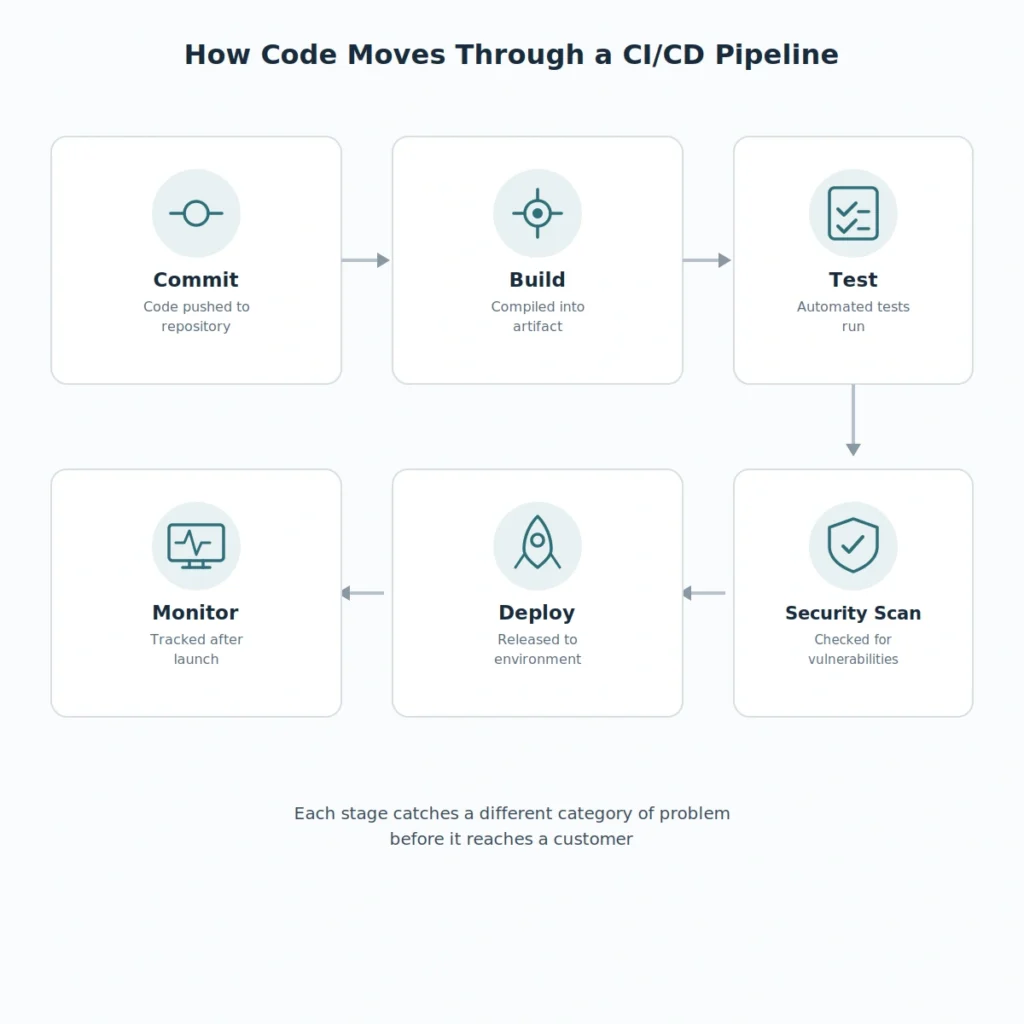
A pipeline strings together several distinct stages, and each one exists to catch a different category of problem before it reaches a customer. Skipping a stage to save time usually just moves the cost of finding that problem to production, where it’s far more expensive to fix.
Managed services like GitHub Actions or CircleCI charge per build minute but remove the burden of running the underlying infrastructure, similar to how managed cloud services shift operational overhead away from a business’s own team. Self-hosting a tool like Jenkins is free to license, but the servers, patching, and engineering time to keep it running rarely show up as a clean line item, which is exactly why it tends to surprise businesses later.
| Factor | Managed service | Self-hosted |
|---|---|---|
| Upfront cost | Low, often a free tier for small teams | Server and infrastructure costs from day one |
| Ongoing cost | Per-minute or per-user billing | Compute plus engineering maintenance time |
| Maintenance burden | Handled by the provider | Falls on the business’s own team |
| Control over environment | Limited to the provider’s options | Full control over hardware and configuration |
| Best fit | Teams without dedicated platform engineers | Teams with specialized hardware or compliance needs |
A small or growing team is almost always better off with a managed service, since the engineering time saved usually outweighs the per-minute cost. Self-hosting starts to make sense once a business has genuinely specialized needs, like GPU builds or cloud infrastructure and network hardening requirements a managed provider can’t meet.
The most common mistake is comparing only the sticker price of a CI/CD tool, since the real cost of running one includes far more than the platform bill, the same trap that shows up across most build vs buy software decisions. A 20-person team running Jenkins on its own servers typically spends several hundred to a couple thousand dollars a month once server costs and engineer maintenance time are counted, even though the software itself is free.
Managed platforms bill differently depending on the provider, with per-minute pricing, monthly build-minute allowances, and per-user tiers all common. Hidden costs on both sides tend to come from the same places: unused compute sitting idle, log storage that quietly grows, and data transfer fees that only show up once volume increases. A business comparing options should look at total cost over a full year of realistic usage, not the advertised starting price, since the cheapest-looking option on a pricing page rarely stays the cheapest once a team scales past its free tier.
A CI/CD pipeline holds a business’s source code, infrastructure definitions, and deployment credentials in one place, which makes it a genuinely attractive target rather than a minor internal tool. If an attacker compromises the pipeline itself, they can inject malicious code into every release that goes out afterward, affecting every customer downstream rather than a single system.
This isn’t a hypothetical risk. In May 2026, CISA issued an alert on real supply-chain intrusions that compromised the Nx Console extension and GitHub repositories through CI/CD pipeline weaknesses.
Building these protections in generally means treating pipeline security as its own discipline, often through dedicated AppSec and DevSecOps automation practices rather than an afterthought bolted onto an existing setup.
The right starting point isn’t the platform with the most features. It’s an honest read of the team’s size, the sensitivity of the systems being deployed, and whether a managed service or a self-hosted setup actually matches the business’s real constraints, a question a Fractional CTO often helps a growing team answer before committing budget either way.
When a business’s compliance requirements, scale, or security needs go beyond what a generic managed platform handles well, Zethic works with engineering and product teams through exactly this evaluation, mapping the actual deployment risk before building a pipeline suited to how the business really ships software.
Let Zethic help you build smarter Not just faster
Ram brings deep expertise in product strategy and system architecture across fintech, SaaS, and AI platforms. He specializes in pre-execution planning to help teams build scalable technology foundations and avoid costly rebuilds.

Adding {{itemName}} to cart
Added {{itemName}} to cart