


Start Your Project Today
Tell us about your project — we’ll get back within 24 hours

Founder
User Interface Design
VR app development cost spans a wide range, from a $15,000 product demo to a $500,000 multiplayer training simulation. The gap comes down to three things: how interactive the experience is, which platform it targets, and how much custom 3D content it needs.
This article breaks down VR app development cost, VR game development cost, and augmented reality game development cost separately, since each follows a different pricing pattern. It also covers what actually drives the price up, and where an India-based team changes the math.
Enterprise investment in the space keeps climbing too: the global AR and VR market is projected to grow from $75.18 billion in 2025 to $118.79 billion in 2026.
VR app development is the process of designing, building, testing, and launching a virtual reality application, covering 3D content, engineering, platform integration, and testing across headsets. VR app development cost, also called virtual reality development cost or virtual reality app development cost, is the total spend across the entire process.
For 2026, most VR apps fall into three tiers:
That range sits well above typical mobile app development costs, since VR requires 3D environments and spatial interaction design that a flat-screen app never needs. Labor makes up the majority of the difference, since VR development is engineering and art-hours intensive rather than license-driven.
Five factors move VR development costs more than anything else, whether you’re scoping a VR app or a VR game:
Hiring a team experienced specifically in virtual reality development, not just general mobile or web development, affects both quality and cost. Design and content work usually consumes more of the budget than the underlying code, which is why two apps with identical feature lists can still land at very different price points.
VR game development cost ranges from $10,000 for a simple title to $200,000 or more for a complex multiplayer game, following a similar tier structure to VR apps. Gameplay systems, physics, and player progression add cost that a passive VR experience doesn’t have:
Platform choice affects VR game cost as much as it does for apps. Meta Quest remains the most affordable starting point given its dominant share of the XR device market, while PC VR and PSVR2 both add cost through higher-fidelity graphics requirements and, in PSVR2’s case, console certification.
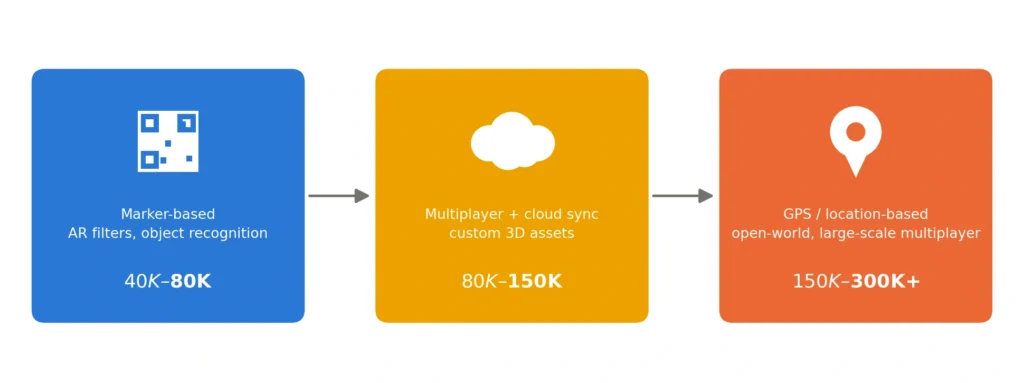
Augmented reality game development cost ranges from $40,000 for a basic marker-based title to $300,000 or more for a complex, location-based game. The price depends heavily on whether the game is marker-based, uses cloud features, or tracks a player’s real-world location:
A large-scale location-based AR game sits at the top of this range because it combines real-world mapping, live multiplayer, and constant server-side coordination, none of which a marker-based AR app needs to handle. The broader technical picture beyond gaming, covered in AR development fundamentals, applies here too, since AR games and AR apps share the same underlying tracking and rendering stack.
Here’s how the tiers covered above stack up side by side:
| Project Type | Tier | US Price Range | India Price Range |
|---|---|---|---|
| VR App | Basic | $15,000–$50,000 | ₹7L–₹21L |
| VR App | Mid-Level | $50,000–$150,000 | ₹21L–₹65L |
| VR App | Complex | $150,000–$500,000+ | ₹65L–₹2.1Cr+ |
| VR Game | Basic | $10,000–$50,000 | ₹4L–₹21L |
| VR Game | Mid-Level | $50,000–$120,000 | ₹21L–₹52L |
| VR Game | Complex | $120,000–$200,000+ | ₹52L–₹86L+ |
| AR Game | Basic | $40,000–$80,000 | ₹17L–₹34L |
| AR Game | Mid-Level | $80,000–$150,000 | ₹34L–₹65L |
| AR Game | Complex | $150,000–$300,000+ | ₹65L–₹1.3Cr+ |
These ranges assume a dedicated development team rather than a solo freelancer, and exclude ongoing maintenance, which typically runs 15% to 25% of the initial build cost per year.
Four choices control most of the budget before a single line of code is written:
Scoping properly during planning costs far less than re-architecting a build mid-project, which is why the studios with the tightest budgets tend to be the ones that scope hardest up front.
Building an in-house VR or AR team means higher fixed costs: salaries, recruitment, equipment, and management overhead, all before a single feature ships. Outsourcing to an established studio converts that into a fixed or milestone-based cost instead.
Team location changes the math significantly. Indian VR and AR studios typically bill at a fraction of North American or Western European rates for comparable engineering and 3D artwork, without giving up English-language communication or Unity and Unreal Engine expertise.
An outsourced partner with dedicated augmented reality and VR teams can often move faster than an in-house generalist team still climbing the learning curve. For most startups and mid-sized businesses, that makes an established outsourcing partner the more practical route to a working VR or AR product without the overhead of building a team from scratch.
Most businesses don’t need the most expensive tier. A focused 360-degree demo or a single-platform AR filter can validate a concept for well under $50,000, and scaling up only makes sense once that concept proves out with real users.
Zethic builds VR and AR applications, games, and enterprise experiences from its Bangalore studio, working across Unity, Unreal Engine, ARKit, and ARCore. Teams scoping VR app development cost, or a VR game or AR game budget, are welcome to talk to Zethic about what their specific feature list would actually cost.
Let Zethic help you build smarter Not just faster
Simple VR apps run $15,000 to $50,000, moderate apps with interactivity run $50,000 to $150,000, and complex multi-user simulations run $150,000 to $500,000 or more. Platform choice, 3D content volume, and feature complexity are the biggest swing factors.
Basic VR games start around $10,000 to $50,000, mid-level games with physics and AI run $50,000 to $120,000, and complex titles with branching progression or multiplayer reach $120,000 to $200,000 or more.
A simple VR or AR app takes 2 to 4 months, moderate builds take 4 to 6 months, and complex multi-user or multiplayer projects typically take 6 months or more, largely driven by how much custom 3D content the project needs.
Ram brings deep expertise in product strategy and system architecture across fintech, SaaS, and AI platforms. He specializes in pre-execution planning to help teams build scalable technology foundations and avoid costly rebuilds.

Adding {{itemName}} to cart
Added {{itemName}} to cart