


Start Your Project Today
Tell us about your project — we’ll get back within 24 hours

Founder
User Interface Design
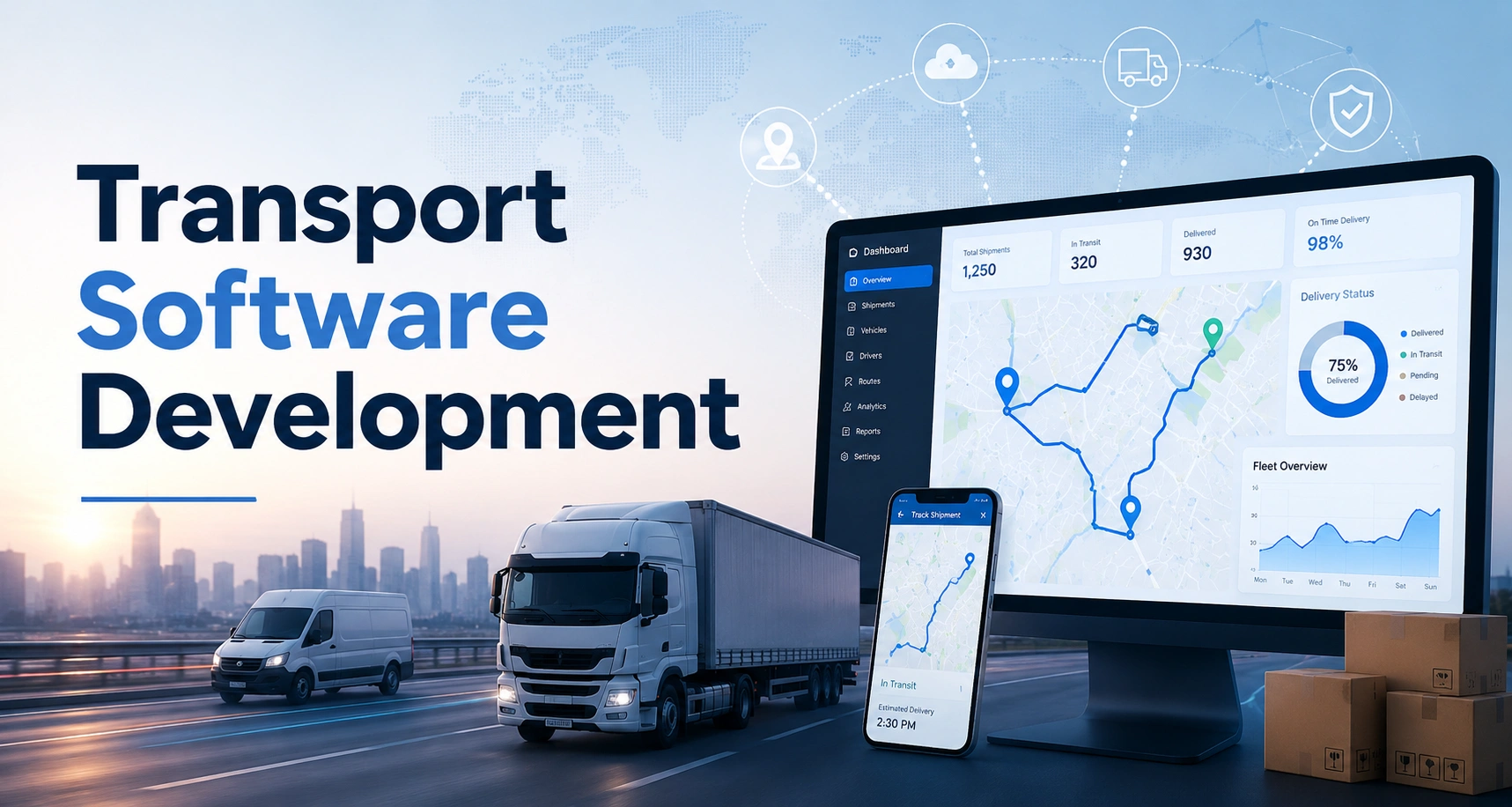
Ask five different logistics businesses what “transport software development” actually produces, and you’ll get five different answers: a system for tracking trucks, one for planning routes, one for managing carriers, or something else entirely. A transportation management system, for instance, is defined by Gartner as software built for planning and executing freight movement, a different job entirely from tracking a fleet a business already owns. That ambiguity is exactly why so many businesses end up buying the wrong category of software, then working around its limits for years.
Transport software development is the umbrella term for building digital systems that plan, execute, or track the movement of goods or people. In practice, that spans several distinct categories of software, each solving a different part of the operation rather than one unified product.
The confusion comes from how loosely the term gets used in the market. A transportation management system, a fleet asset management platform, and a delivery app are all technically transport software, but they solve different problems and often serve different people inside the same business.
Most conversations about transport software development are really about one of five categories: transportation management, fleet tracking, delivery management, dispatch and routing, or supply chain coordination. Each category has its own data model and its own users, which is why figuring out the right starting point often begins as a conversation with a logistics app development team about which specific problem needs solving first.
Each category below handles a distinct part of moving goods or people, and most businesses only need one or two of them, not all.
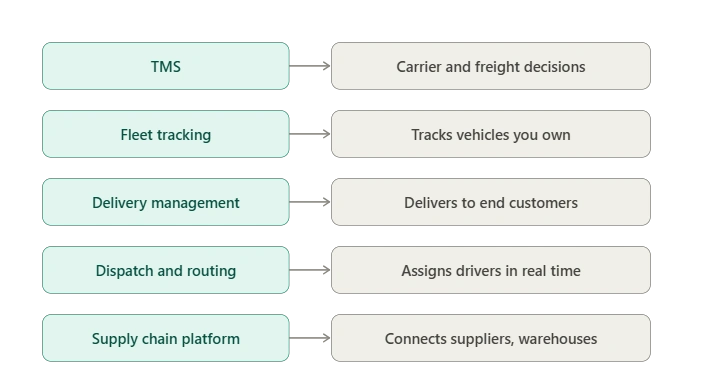
A business that owns and operates its own vehicles usually starts with fleet tracking. A business that ships through outside carriers usually starts with a TMS instead, since there’s no fleet of its own to track.
Dispatch and route planning often get bundled into whichever of these two a business adopts first, rather than being purchased separately, since assigning drivers rarely stands on its own. Supply chain platforms tend to come later, once transportation data needs to connect with warehouse and supplier systems, a step covered in more detail in logistics app types, features, and development steps.
The right starting category depends less on industry and more on how the business actually moves goods. Two businesses selling the same products may need completely different categories of transport software development, because the deciding factor is operational structure, not the goods being shipped.
| Business situation | Category that fits best |
|---|---|
| Owns and operates its own vehicles | Fleet tracking software |
| Ships primarily through third-party carriers | Transportation management system |
| Delivers directly to end customers | Delivery management software |
| Coordinates drivers and daily routes internally | Dispatch and route planning software |
| Manages suppliers, warehouses, and transport together | Supply chain platform |
A business rarely fits neatly into one row, and the table above is a starting point rather than a permanent boundary between categories. A retailer with its own delivery fleet, for example, usually needs both fleet tracking and delivery management working together, an overlap that shows up often once logistics app development costs get scoped out for more than one category at a time.
The categories described above rarely stay isolated for long. As a business grows, the systems supporting each part of the operation need to start talking to each other, and that’s where most of the real engineering complexity in transport software development actually lives.
Off-the-shelf tools for each category often don’t connect cleanly with each other, since they’re usually built by different vendors with no reason to cooperate. This is closer to what the Council of Supply Chain Management Professionals actually means by supply chain management: planning and managing sourcing, conversion, and logistics activities as one coordinated function, not a set of disconnected tools bolted together after the fact. Businesses that reach this point are usually better served by transport software development that treats these categories as parts of one system rather than a sixth subscription added to the pile.
The categories aren’t competing options. They’re different tools for different parts of the same operation, and most businesses end up needing a combination rather than picking just one. Getting the starting category right is the first real decision in any transport software development project, well before the technology stack or timeline comes up.
This is the kind of scoping Zethic works through directly with businesses, as part of our broader logistics software development practice, figuring out where to start, whether that’s a single category built well or several tied together around shared data from the outset. Getting the starting category right matters more than which vendor or framework ends up building it.
Let Zethic help you build smarter Not just faster
It depends on how many categories are needed and how much those systems need to share data, a tradeoff that shows up clearly when comparing logistics app development against in-house teams: custom development tends to pay off once two or more categories need to work together closely.
Ram brings deep expertise in product strategy and system architecture across fintech, SaaS, and AI platforms. He specializes in pre-execution planning to help teams build scalable technology foundations and avoid costly rebuilds.

Adding {{itemName}} to cart
Added {{itemName}} to cart