


Start Your Project Today
Tell us about your project — we’ll get back within 24 hours


An organization adopts a well-known consulting framework wholesale, or treats the word “framework” as another term for its project roadmap, and ends up with a structure that does not match how the business actually makes decisions. A digital transformation framework only works when its components reflect the organization’s real decision-making and accountability lines, not a model built for a different business entirely. The nine components below, and the maturity model used to score them, are what separate a framework that actually functions from one that is never put into practice.
A digital transformation framework is the decision-making structure that determines how an organization sets priorities, allocates resources, and measures progress across every digital transformation effort it runs. It is not tied to one project or one timeline; it is the underlying structure that every individual effort operates within. Building and maintaining this structure is usually the starting point for digital transformation services, rather than a single project added on afterward.
This differs from building a single system or running one project. A CRM rollout has a start and end date; the framework is the ongoing structure that decides which projects like that are approved, funded, and measured in the first place. Two businesses running the same CRM rollout can see very different results depending on whether a framework like this exists underneath it.
A framework, a strategy, and a roadmap answer three different questions, and treating them as interchangeable is a common source of confusion.
A framework stays largely fixed once established. A strategy changes as goals shift, and a roadmap changes even more often, as execution reveals what is actually possible.
Confusing the three usually means nobody owns the framework itself, so each new strategy is built on a different, improvised decision-making structure. Over time, this shows up as the same disagreements resurfacing across separate projects, since no shared structure was ever in place to settle them once. This same clarity is what separates a deliberate build vs buy software decision from one that defaults to whatever was chosen last time.
Each component below answers a specific question a framework needs to cover. A framework missing any one of these tends to work in some areas and stall in others, since the nine components depend on each other rather than functioning as separate checklist items. Technology architecture is usually the component where the need for legacy software modernization shows up first.
| Component | Question It Answers | Common Sign It Is Missing |
| Vision and objectives | What outcome are we actually trying to reach | Goals are described in general terms with no way to measure them |
| Leadership sponsorship | Who has authority to reallocate budget and cut scope | Decisions stall waiting for approval from someone not actually accountable |
| Governance and decision rights | Who approves conflicting priorities between teams | The same disagreement resurfaces in every meeting |
| Technology architecture | How do new and existing systems connect | Every new tool becomes another disconnected system |
| Data and analytics | Where does the organization’s shared, trusted data live | Teams report different numbers for the same metric |
| Workforce skills | What training and role changes does each effort require | New tools launch with no plan for how anyone’s role changes |
| Process design | Which workflows are being redesigned, not just automated | Automation speeds up a broken process instead of fixing it |
| Customer and partner experience | How is the outside impact of each change measured | Internal efficiency improves while customer experience stays flat |
| Performance measurement | Which metrics decide if an effort is working | Success is declared without a way to prove it |
A maturity model applies a consistent scale to each of the 9 components individually, rather than giving the framework a single overall score. This shows exactly which components are strong and which ones are weak, instead of treating the entire framework as one pass or fail judgment.
The same ad hoc, developing, and managed scale used to assess general digital readiness applies here, scoring one component at a time rather than as a single average. A comparable public-sector approach uses framework implementation tiers to score practices on a similar four-stage scale, the same logic applied here to score each of the 9 components individually.
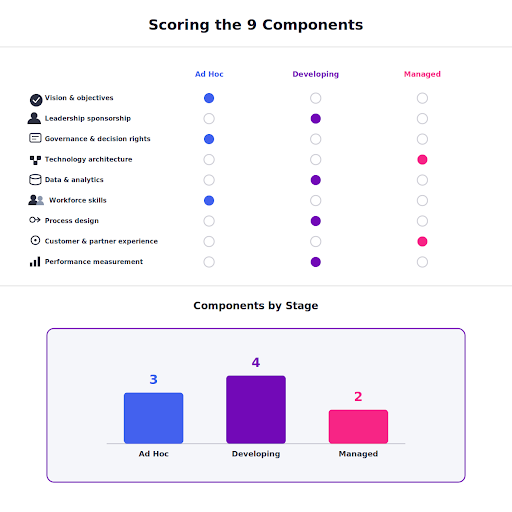
Scoring each component separately also prevents a common error: a business with strong technology architecture but no governance in place often assumes its overall framework is further along than it actually is, which is where an IT management and governance platform can provide a structured way to support that governance. A large industry survey tracking this kind of maturity found that the share of organizations reaching the highest tier rose from 4 percent to 29 percent within a single year. At the same time, more than half remained at an early, exploratory stage. Movement between stages is achievable, but it happens component by component, not all at once.
A global survey on digital transformations found that only 16 percent of respondents reported that their digital transformation both improved performance and sustained that improvement over time. A framework with weak or missing components is one of the more common reasons this figure stays low.
Because the 9 components depend on each other, a weakness in one, most often governance or workforce skills, tends to limit how much value the stronger components can actually deliver. A missing CI/CD pipeline is a common example of a technology component built out while the process and governance around it stay informal.
The framework should be built around how the organization actually makes decisions today, not copied from a named model built for a different business. Scoring each of the 9 components honestly, and assigning clear ownership for the weakest ones, matters more than adopting any particular named methodology. A framework built this way tends to outlast whichever strategy it was first built to support.
Zethic works with business and technology leaders to score each component honestly, close the weakest ones first, and build the resulting framework around how the organization already makes decisions rather than a borrowed model.
Ram brings deep expertise in product strategy and system architecture across fintech, SaaS, and AI platforms. He specializes in pre-execution planning to help teams build scalable technology foundations and avoid costly rebuilds.
