


Start Your Project Today
Tell us about your project — we’ll get back within 24 hours


Teams often choose between a private LLM and an API-based LLM by comparing a GPU price tag to a per-token bill, then are surprised when the real cost shows up somewhere neither number accounted for. The decision holds up better once it accounts for usage volume, data sensitivity, and whether the team can operate the infrastructure it would be taking on.
A private LLM, also called a self-hosted LLM, runs on infrastructure a business owns or rents directly, whether that is a cloud GPU instance or an on-premises LLM deployment inside the company’s own data center. The business controls the model weights, the data that touches them, and every layer in between.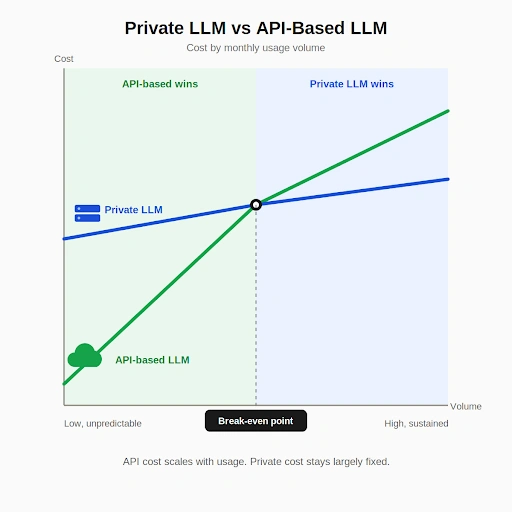
An API-based LLM instead runs on the provider’s infrastructure, and the business sends a request over the network and receives a response, paying per token processed. There is no hardware to manage and no model to host, but the data passes through a system the business does not control end to end.
Neither description settles the private LLM vs API-based LLM question on its own, and it’s the same infrastructure question most artificial intelligence services providers walk a client through before recommending either path. What decides it is how much of that infrastructure control a specific business needs, and whether the savings from owning it would ever outweigh the cost of running it.
Cost comparisons that stop at GPU price versus token price miss most of the real bill. A private deployment carries GPU rental or purchase, storage, networking, and the engineering time to keep it running, while an API-based deployment carries only the per-token rate, scaling directly with usage. The private LLM vs API-based LLM cost comparison only becomes meaningful once all three cost centers, infrastructure, engineering, and usage, sit alongside the base
LLM development cost in India
in the same table.
| Approach | What It Includes | Cost (USD) | Cost (India, ₹) | Timing |
| API-based LLM | Per-token billing, no infrastructure | $2-$15 per million tokens blended, depending on model tier | Integration typically starts near ₹3 lakh, scaling with usage | Ongoing, scales with volume |
| Private LLM (cloud GPU) | Rented GPU capacity, storage, networking | $1.50-$14 per GPU-hour depending on hardware class | ₹49-₹362 an hour depending on GPU class | Ongoing, largely fixed regardless of volume |
| Private LLM (engineering) | Staff to deploy, monitor, and maintain the system | $150,000-$240,000 a year for a dedicated ML engineer | ₹10-₹42 lakh a year depending on seniority | Ongoing, ties up a specialized role |
The break-even point between the two paths is not a single number, whatever a quick search might suggest. Estimates across current 2026 cost analyses put it anywhere between 100 million and 500 million or more tokens a month, and the spread exists because it depends on which model tier gets compared, how many hours a day the GPU stays busy, and whether the engineering cost gets counted honestly. A business well under that volume rarely benefits from owning the infrastructure, no matter how attractive the per-token math looks on a spreadsheet.
Cost stops being the deciding factor the moment a regulator gets involved. Finance, healthcare, and legal services routinely handle data that cannot leave a controlled environment at all, which turns the private-versus-API decision into a compliance question first and a budget question second.
Data residency requirements are the clearest version of this, and frameworks like the
GDPR
spell out which cross-border transfer mechanisms satisfy that requirement and which don’t. A business bound by rules that require certain records to stay on infrastructure it controls cannot satisfy that requirement by sending the same data to an external API, regardless of how strong that provider’s own security practices are. The data sensitivity of the workload, not its volume, is what forces the private option in these cases, which is why a business under 50 million tokens a month can still end up running a private LLM if the data itself leaves no other option.
Cost and compliance answer part of the question, but a private LLM only works if someone on the team can run it. GPU provisioning, model updates, monitoring, and incident response are ongoing responsibilities, not a one-time setup task.
This is the same question that comes up in the
in-house vs outsourced AI development
decision, since a private LLM only makes sense if someone owns it the same way an in-house hire would.
Most production systems in 2026 do not settle the private LLM vs API-based LLM question by picking one architecture for every request. A hybrid setup routes high-volume, predictable, or sensitive workloads to a private LLM, while sending unpredictable or low-volume traffic to an API-based LLM. This mirrors the same logic behind a
build vs buy AI agent
decision, where most teams end up mixing approaches rather than picking one model for every case.
This hybrid routing pattern lets a business capture the API’s simplicity for the traffic that does not justify dedicated infrastructure, while keeping sensitive or high-volume work on infrastructure it controls. It also gives a business a way to start entirely on an API-based LLM, collect real usage data, and move only the specific workloads that earn their keep onto a private deployment later, rather than committing to one architecture before the usage pattern is even known.
The private LLM vs API-based LLM choice rarely comes down to which architecture is better in the abstract. It comes down to matching usage volume, data sensitivity, and team capacity against the real cost of each path, not just the headline number that shows up first in a search result.
Zethic works with founders and CTOs to run that assessment before any infrastructure gets committed to, scoping realistic usage volume, checking which workloads a regulator has already decided for the business, and sizing the engineering effort a private LLM would require;
Zethic
builds the resulting architecture around whichever mix of private and API-based components the workload calls for.
Ram brings deep expertise in product strategy and system architecture across fintech, SaaS, and AI platforms. He specializes in pre-execution planning to help teams build scalable technology foundations and avoid costly rebuilds.
